When The Daily Post asked bloggers to show their “Happy Place” on their blogs this week I wasn’t going to play along. After all, what do you expect me to say?
Mid pleasures and palaces though we may roam,
Be it ever so humble, there’s no place like home;
A charm from the skies seems to hallow us there,
Which seek thro’ the world, is ne’er met elsewhere.
Home! Home! Sweet, sweet home!
There’s no place like home! There’s no place like home!
Funny thing. 1823 is also the year that we can find the first known references to the game of “base ball”:
“I was last Saturday much pleased in witnessing a company of active young men playing the manly and athletic game of ‘base ball’ at the Retreat in Broadway.” ~ The National Advocate, April 23, 1823.
UVa defeated the Canadian squad (an 18-and-under team featuring some of the best young players in the country) 12-5 last night in a strange 14-inning “exhibition” game that was a more a showcase for scouts, I think, than an actual game. Players batting out of order. Pinch runners pinch running and then disappearing. Really odd.
But, still … even really odd baseball is Happy Place worthy.
In response to The Daily Post’s weekly photo challenge: “Happy Place.”
“At the ballpark or even in front of the television, fans are, for the interlude of a few hours, different from whom they are in everyday life. … In the drama that is a baseball game the fan imagines himself not a spectator but a participant, as if the fervor of his rooting will have a bearing on the outcome.” ~ John Thorn, Official Historian of Major League Baseball
Sometime in the 1880s or so, newspapers started to mention baseball “fans” and “cranks” and “rooters.” Before that, who knows what they called the men (and they were mostly men) who would sit and watch the other men (and they were mostly men, too) play baseball.
Ty Cobb unkindly called fans “bugs,” but he didn’t have a good word to say about anyone.
Umpires might argue that today’s fans can be rowdy at times, but all in all, fans are a pretty good bunch.
We’re certainly nowhere near as rowdy as our grandparents and great- and great-great grandparents who went to games and shoved their way onto the outfield, or, if the weather was hot, would bully players out of their dugouts and take over the benches in the shade.
— SDN-006846, Chicago Daily News negatives collection, Chicago History Museum. (1908)
Police hold back the rowdies at Chicago’s South Side Park on April 14, 1908. The White Sox will defeat the Detroit Tigers 15-8. (And, look at that trash!)
Cranks would fight with other fans, the umpires, and the players. They would throw bricks. Today, I pack my scorecard, maybe some peanuts. Back then, fans would pack bricks and guns, along with their sandwiches and moonshine.
Players would climb into the grandstands and beat up heckling fans. Fans would jump onto the field and clobber a player or ump.
Games were forfeited because fans were jerks.
Ahh, the good old days.
I have been known to complain at games if the person next to me is bogarting my cup holder. (Yours is on the right, Bozo.) Back then, I’d have been lucky to get through the game without losing an eye.
I recently asked a policeman at Oriole Park at Camden Yards what the hardest part of his job was and he said catching the underage drinkers who all sit together in the upper deck on student nights. (Yes, fans today are so well-behaved even the bad ones cooperate by sitting together.) Other than that, he said, he got paid really well to walk around for a few hours, maintaining the peace and watching the game.
So sure, a few bad fan eggs. But, without us there would be no baseball. We are the 10th player. We pay the salaries. We are irreplaceable.
That’s why teams have Fan Appreciation Days and lavish gifts on us to lure us to the park – caps and shirts and seat cushions. Bobbleheads that are supposed to look like certain players, but usually don’t. Garden gnomes that are supposed to look like certain players and sometimes actually do.
Sure, it’s cheap crap, but fans will line up for hours – HOURS – to get our swag.
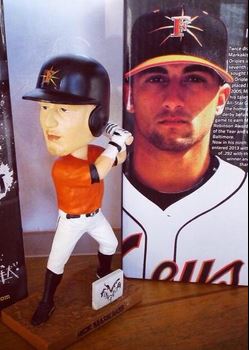
Nick Markakis Bobblehead? Horrible. Did Helen Keller design this? Socks down! Socks down!
Wilson Photo: by CBL 62, via Creative Commons Attribution-Share Alike 3.0 (2011)
Brian Wilson Garden Gnome? Awesome.
Every baseball fan is a great fan. Even if you don’t know a balk from a walk, and can’t name your team’s starting pitchers, you’re still all right in my book.
But, some are just a tiny bit all righter. Here are three of them.
On Friday night, the Baltimore Orioles defeated the Seattle Mariners 2-1 in 10 innings. These fans were at Seattle’s Safeco Field.
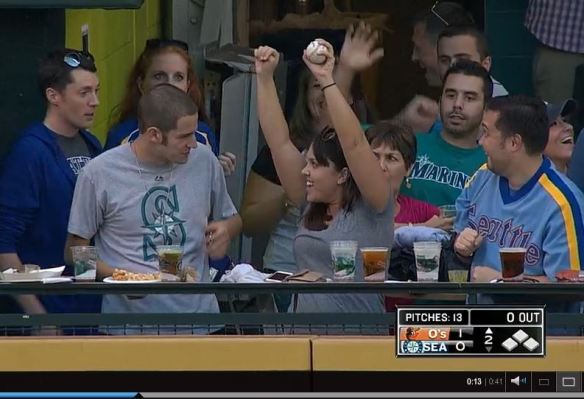
1) Happy Homer.
Who cares if your team just gave up a go-ahead run, you just caught the freaking home run ball! Good for you, happy Mariners’ fan. Your team will lose because of that run, but at least you didn’t spill your beer.
(For the record, if you catch a home run ball, keep it. Even if it was hit by the opposition. You may think you’re some hero by throwing it back on the field in disgust, but really, we just think you’re stupid.)
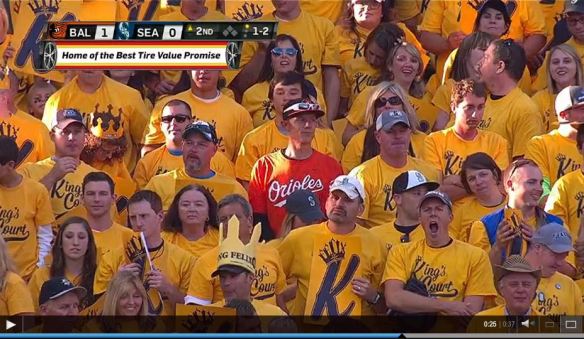
This Orioles fan sat in a sea of Mariners on Friday night.
Editor/Husband thinks the guy lost a bet. I think he’s just a very good fan. Sure, he kind of looks uncomfortable and maybe just a little sad. But, at least he didn’t have to worry about being hit on the head with a brick.
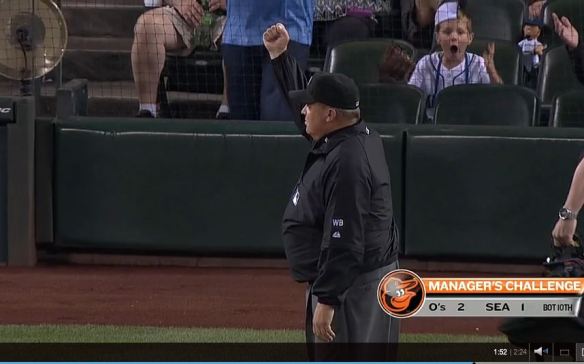
First off, there’s that napkin. The rally napkin. If you don’t have a ball cap to twist or turn to spur your team’s late-inning rally, then you get creative. This kid stuck a napkin on his head. Because, hey, why not?
Well, whatever it was, it didn’t work. Mariners second baseman Robinson Cano – the would-be tying run – was called out to end the game after a challenge.
The rally napkin folded like a … a … a napkin.
Ten innings that kid sat through. The tying run is on first and then, suddenly, he is gone. His team has lost. He is not happy. I love him. I could watch him all day. (He comes at the 1:52 minute mark. He’s worth the wait.)
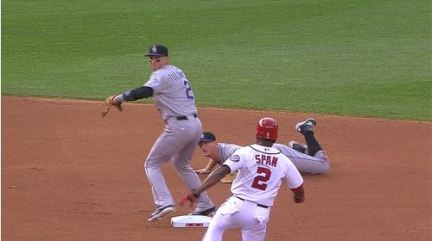
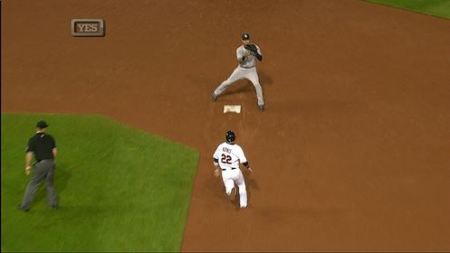
They call a double play in baseball “turning two” which is poetic and beautiful. And, that is what a double play is.
It is often a ballet, seemingly effortless, but dependent upon practice, instinct, poise, and power. If you’re lucky, it will also include a pirouette.
Double plays can make brilliant poetry.
These are the saddest of possible words:
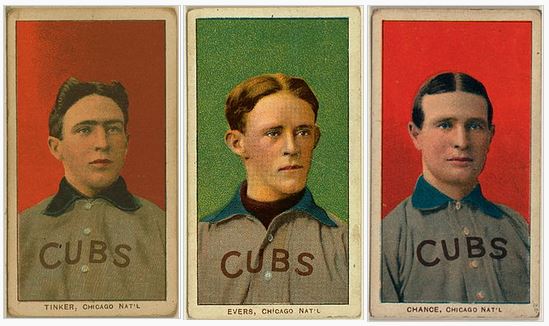
“Tinker to Evers to Chance.”
Trio of bear cubs, and fleeter than birds,
Tinker and Evers and Chance.
Ruthlessly pricking our gonfalon bubble,
Making a Giant hit into a double.
Words that are heavy with nothing but trouble:
“Tinker to Evers to Chance.”
~ Franklin Pierce Adams, New York Evening Mail, 1910
(Oh, go ahead, look up “gonfalon.” I’ll wait.)
The trio of shortstop Joe Tinker, second baseman Johnny Evers, and first baseman Frank Chance played together for the Chicago Cubs from 1902 to 1912.
Don’t let it trouble you that Tinker and Evers admittedly hated each other, once got into a vicious fist-fight on the field, and didn’t speak to each other for several seasons.
And, don’t let it trouble you that they didn’t “invent” the double play … or turn a record number … or were even particularly good at it. Just accept that some folks become legends because of good writing or good timing.
Dickey Pearce, who played in the 1860s and 70s, is thought to have turned the roving “short field” position into the more territorial shortstop position that we know today, and, in doing so, may have invented, or developed, or, at least, refined the double play.
Public Domain image.
Dickey Pearce is the one in the back. Dig those uniforms!
Historian Brian McKenna believes that Pearce’s double plays included intentionally dropping routine fly balls, allowing for easy outs as the runners on base hesitated while waiting to tag up. He is why we have the infield fly rule today.
(Dickey Pearce also invented the bunt, so he is kind of, sort of the Thomas Edison of early baseball.)
The double play is my favorite thing in baseball, unless my team is batting.
In 1949, the Philadelphia Athletics turned 217 in a single season, the most ever.
The Baltimore Orioles have “turned two” 107 times this season, leading all of baseball, and are on pace for 175.
This is both a testament to the Orioles’ defensive abilities and an admission that one can’t “turn two” unless one has already put at least one on.
(Thanks, pitchers.)
And, speaking of “turning two” …
This blog turns two this week.
In the past two years I have churned out 118 posts. This is slightly more than one a week which surprises me, since I should be doing useful things each week like cleaning out the basement and resealing the kitchen countertop.
But, apparently, I am not doing those things. I am doing these blog things.
That you have stopped by to read this (when you probably should be cleaning out your basement and resealing your kitchen countertop) is quite kind of you. Thank you.
WordPress says that “tens of thousands” of blogs are created here every day.
People who count these sorts of things estimate that the vast majority of those blogs will be abandoned within one month.
So, I’m feeling rather sassy about my 118 posts.
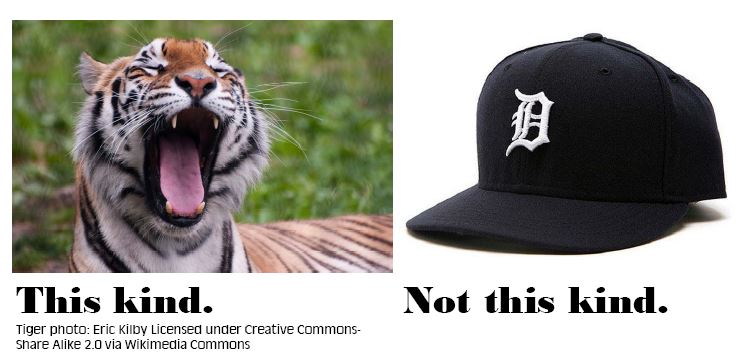
When I was in fifth grade I decided I would be a writer. At the time, I just wanted to write about tigers.
I regularly wore out the ribbon of my dad’s typewriter until my folks got me my own typewriter for my 12th birthday (manual), another one for my high school graduation (electric), and a third for my college graduation (a strange Tron-like thing that I still have, but never used; I didn’t have the heart to tell my mom that no one was really using typewriters anymore).
I ran out of tiger storylines somewhere around junior high. Then I decided I would be the next Dorothy Parker. I went through a Eudora Welty phase. And, then I decided to become a girl Thomas Boswell.
This is not to suggest that I am THE Baseball Bloggess, although I am because I have the URL to prove it.
It is mainly because my friends who travel goose my stats by checking my blog from exotic, far-off places like Brazil, Croatia, Nepal, Pakistan, and Tunisia, and so I have been known to say that I am a “world famous baseball bloggess,” even though I am not.
But, I like to write. And, I like to write about baseball. Occasionally, Yoga. But, mostly, baseball.
Here’s to “turning two.”
____
A special thank you to my occasionally irascible, but always wonderful, Editor/Husband who watches baseball with me, and really, truly does read and edit these posts, and makes them infinitely better (most of the time). If I screw up a fact or mess up on grammar, it’s my fault, not his.
“I simply wanted to play the game that I loved.” ~ Kay “Tubby” Johnston Massar, the first girl to play Little League baseball, 1950.
Watch this stupid scene from an otherwise pretty good movie.
“There’s no crying in baseball.”
It’s a big lie and, if you have ever loved baseball … and loved a team … you’ve cried. If nothing else, you’ve sniffled a little (swallowed hard and wiped your nose on your shirt), which you might say is not crying, but, trust me, it is.
If you’ve never cried at least once when your team has let you down (see: Orioles, Cubs), or cried with joy when your team wins a World Series (see: Red Sox, Yankees, etc etc), or with despair when your team ruined your evening by squandering a perfectly adequate – and rare – five-hit, two-run performance by your struggling starter and then losing to one of the worst teams in baseball (see: Orioles, again), you really don’t love baseball, so stop saying you do.
So, when Kay Johnston Massar told me that when she was a young girl growing up in Corning, New York she cried as she watched her brother go off to play Little League, I understood.
If you love a game as much as she did – and still does – you would cry, too, if you were left behind.
But, this is not a story about crying.
courtesy of Kay Johnston Massar
Massar’s mother saw a notice in the paper that there was another Little League tryout coming up.
It was 1950, though, and girls did not play Little League baseball. Leastways, no one had ever done it before.
So, Massar had her mom cut off her braids, pushed what was left of her hair up under a ball cap, took her sister’s bike, and pedaled off to tryouts.
Her father had taught her to play and love the game. She played sandlot games with her brother Tom and his friends. She was good.
“I’m going to make the team,” she promised her mom. “I bet you will,” her mom replied.
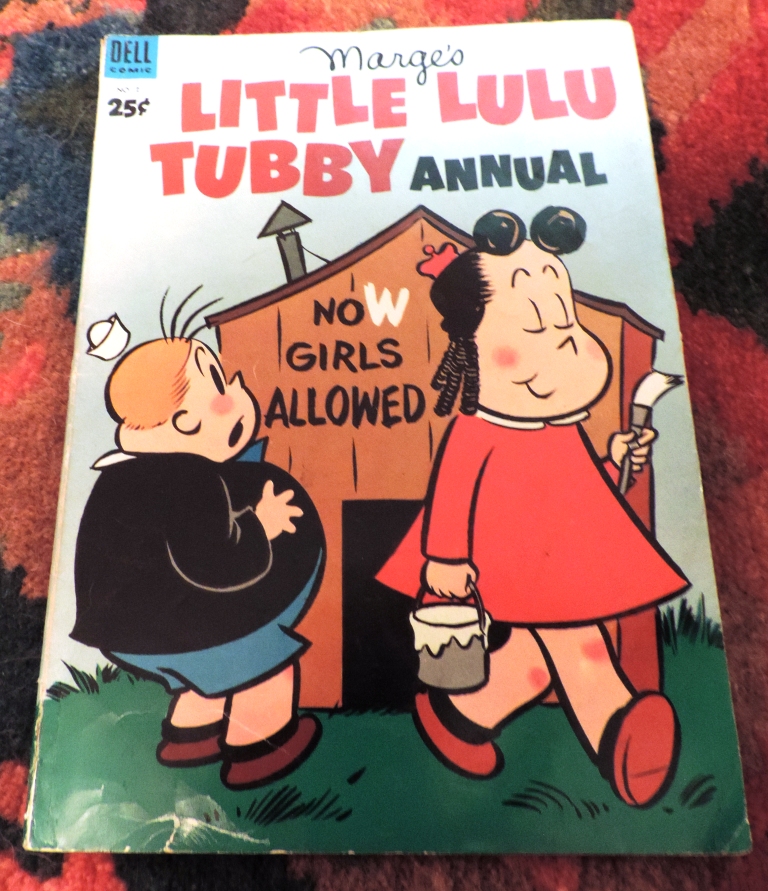
Before she left, her mom suggested she change her name so no one would know she was a girl. Kay became “Tubby”, after the loyal best friend in the Little Lulu comics.
Tubby’s story might have faded away, except for one important thing.
She made the team.
courtesy of Kay Johnston Massar
“Tubby” Johnston was the first girl to play Little League baseball.
Some of you and your googling will try to tell me I’m wrong. You’ll say Maria Pepe was the first. No. Although her lawsuit in the early 1970s opened the door for all girls to play. Some of you will argue for Janine Cinseruli. No. Although she was the first girl to play a full season post-lawsuit in 1974.
Some of you will say, “Girls don’t play baseball.” Now, you’re just being disruptive. (Here. Read this. Then you can come back and read the rest of this post.)
Back to Tubby Johnston.
“When I tried out for Little League baseball I was not trying to be a beacon for women’s rights,” Massar says. “I simply wanted to play the game that I loved.”
Corning, New York wasn’t just any Little League town in 1950 either. Corning had made it to the semifinals of the Little League World Series in 1949 and the quarter-finals in 1948.
Not every kid who tried out got to play in Corning. Corning was tough. You had to earn your way in.
Tubby Johnston was tough too. And, she earned her way in.
Soon after being assigned to play first base for the King’s Dairy team, she told her coach the truth – he had a 14-year-old girl on his Little League squad.
The coach decided that there were no written rules at the time that specifically prohibited a girl from playing. And, if Tubby was good enough to make the team, she was good enough to play.
She played first base all season – she could hit, she could field. (When she finally got a proper first baseman’s glove of her own she slept with it. “I loved the smell of the leather,” she told me.)
When her teammates were told that Tubby, their first baseman, was actually a girl named Kay, they accepted her, she says. “They said, ‘Well, she plays as well as we do.’” And, then she adds, “Actually, I was better.”
But, they never did call her Kay. She was always “Tubby.”
Adults, on the other hand, could be cruel.
When the news broke that a girl was playing Little League in Corning, the fans turned out to watch. Many cheered, but many adults would jeer at her from the stands, call her names, or come right up to her and tell her she was a “freak” for playing baseball with boys.
“I didn’t let it bother me, I didn’t want to raise a commotion or squeal about it,” Massar says. “I didn’t want to get kicked off the team.”
(I told you she was tough.)
King’s Dairy was a prestigious team, highly prized by Little Leaguers, not only because they won a lot, but because after games the coach would take the kids to the dairy store and treat them to banana splits and milkshakes.
That 1950 season was Tubby’s first and last in Little League. After the season, Little League passed the “Tubby Rule” which stated in full:
“Girls Are Not Eligible Under Any Conditions.”
The rule stood until it was overturned in the courts in 1974.
By then, however, most girls were playing softball. That trend pretty much continues. Last year, just one girl played at the Little League Baseball World Series – Eliska Stejskalova, from the Czech Republic, who played for the Europe-Africa Team.
(In 2005, Katie Brownell, the only girl playing Little League baseball in Oakfield, NY, pitched a perfect six-inning Little League game – 18 up, 18 down. All strike outs.)
After Little League, Massar played a few years of softball herself, before getting on with things, becoming a nurse, getting married, having a family.
She was a tough softball player, too. Once, while sliding into second, she dislocated her shoulder. While coaches were trying to hustle her off to the hospital she was busy arguing with the umpire that she should have been called safe.
And, she almost got herself into a football game. Not long after her Little League season, she dressed in her brother’s football uniform one day when he was sick, put on his helmet, and tried to take his spot on the field. A fellow player ratted her out to the coach, however. “The coach ran out on the field shouting ‘Stop, Kay! Stop, Kay!’ or I would have been the first girl to play football, too.”
She still loves baseball. Her father was a lifelong Yankees fan, and she carries on the pinstripe tradition. (Derek Jeter is her #1. And, yes, she’s heartbroken that Robinson Cano, “the best second baseman in the game,” has left the Yanks for the Mariners.)
Today, she lives in Yuba City, California and gets to local college games and to an occasional Oakland A’s game each season.
“My dream as a child was to play first base for the Yankees, but I am still waiting to be called up,” Massar said and then asked, “Do you think that it is too late?”
Massar is 78 this year. She was joking.
I think.
She threw out the first pitch at Yankee Stadium in 2006. (“I one-hopped it to [Jorge] Posada,” she admits.)
And, at an Oakland A’s game in 2010.
Come on, San Francisco Giants! Massar is near you. Why not let her throw one out at AT&T Park this season?
She is featured in a new film commemorating the 75th anniversary of Little League which will air on PBS in June.
Oh, and hey, just one more thing.
Sports Illustrated has written about Massar a couple times, most recently in 2011. In that article, the writer suggested that Massar would trip runners as they rounded first base.
Massar would like to clear that up.
She was tough, but she didn’t routinely trip players. She wasn’t a cheater.
But, she did trip one.
“He pushed me down because I was a girl. So, the next time around I tripped him.”
That “kid” is now in his 70s, and he saw the Sports Illustrated story. He tracked down a mutual schoolfriend. “He said, ‘Tell her I’m sorry,’” Massar said, “So I finally got an apology.”
courtesy of Kay Johnston Massar
“I got to do a great thing. I got to play the game I loved.”
(Thank you to Kay Johnston Massar, who still loves baseball.)
“I disliked the All Star Game before it meant something (like most of my life). Now that it ‘means’ something I both hate it and think it is useless.” ~ our friend Jay
Who hates a vacation? Our friend, Jay.
Baseball is a 162-game, six-month undertaking. (Eight months, if you count spring training and if you are good enough to make it to the post-season.)
Tucked into that stretch is a four-day break that includes the All Star Game. That little baseball vacation begins Monday.
Our friend Jay is a Red Sox fan. He hates the All Star Game because it temporarily stops the “real” baseball season. But, he does have lots of very good qualities, too.
I am pretty sure that I am a baseball fan because of him. I sat next to him at the very first major league game I attended. It was some 25 years ago.
I have been pestering him with baseball questions ever since.
He always responds. Patiently. Kindly. Wisely. (If you ask him how to throw a screwball, he will provide detailed instructions. If you ask about baseball broadcasters he will rate nearly every one. The Red Sox broadcasters are ranked quite highly, incidentally.)
Jay plays. Jay watches. Jay knows a lot about baseball.
Occasionally my questions stir him up.
Like when I asked about the All Star Game.
For me, I like the mini-vacation. I like watching the All Stars (especially when five of them are Orioles). It’s a long season; I don’t begrudge the players a tiny break at this mid-way point.
But, Jay thinks …
Well, here, he’ll tell you …
Baseball is an endurance contest — 162 games in six months. And then, in the middle of that we give players (making $16 million or even a paltry $1 million) four days off to go fishing and rest up? What’s that all about?
…
The greatest thing about baseball is that they play every day (and sometimes twice — in what other sport do they say ‘Let’s play two’?) But, no, the All Star Game says, “We pause from this important season to bring you this unimportant game.” (And, no, having it determine home-field advantage does not mean this is for real. If it was for real Clayton Kershaw would pitch seven innings.)
…
The touchstones for me for baseball are the “Morning Question” – how did the Sox do last night? – and the “Afternoon Question” – who is pitching tonight? I look for the box scores in the paper every day. How many games up (or behind) are we? … All winter I wait for baseball season to start so I can go through my daily baseball rituals — and then in the middle of July they stop it.
…
[Former Red Sox] Manny Ramirez’s grandmother used to “die” each year at All Star time so Manny could go home to grieve with the family. My attitude is like Manny’s Granny’s – “Who cares about the All Star Game? Nothing important is happening so I might as well die again this year.”
(Jay is exaggerating … but here’s the back story on Manny. And, here.)
…
The best thing about baseball is that there is a game every day, so let’s play. (That is why I hate days off, rain outs, and All Star Games.)
These are just the highlights. Jaylights.
But, I’m feeling sort of bad that Jay will have to endure the next four days without baseball while the rest of us are watching the Home Run Derby (Monday) and the All Star Game (Tuesday).
So, here are some things that can pass the time until the season begins again on Friday:
1) Watch NY Giants Pitcher Carl Hubbard strike out Babe Ruth, Lou Gehrig, and Jimmy Foxx in order. It was 1934 at the Polo Grounds. It was the All Star Game. Watch it here.
Or, watch Babe Ruth hit the very first homerun in the very first All Star Game in 1933. Watch here.
2) Explore the arts. Mike Carmichael of Alexandria, Indiana has been painting a baseball – coat by coat – since 1977. The baseball now has more than 23,000 layers of paint and weighs more than 4,000 pounds. If you visit, he’ll let you paint a layer on the ball. See it here.
Photo courtesy of Mike Carmichael
Perhaps the baseball in your garage is artwork in the making.
3) Learn a second language. Orioles outfielder Nate McLouth speaks fluent Spanish, allowing him to chat easily with his Latin American teammates and give interviews to the Spanish-speaking press. While most foreign-born players must learn some English to get by in the game, very few American players take the time to learn their teammates’ languages. Nate es maravilloso. Click aquí.
4) If you can’t watch baseball, play it. In Nicaragua, baseball is El Deporte Rey, the king of sports. NPR’s Only A Game recently had a story about a camp in Nicaragua that allows boys and girls a chance to slip away from the hard realities of poverty for a week of baseball. “[T]his chance to play on a real field coached by a real professional will make a beautiful memory. And even in wealthy countries, beautiful memories aren’t easy to come by.” Listen here.
Jay is my baseball guru (except for that Red Sox thing). He has a blog too. Although he only updates it when he goes to baseball camp each winter. He should keep it up year-round. Visit it here and pester him to write more.
Jay’s Blog.
Enjoy the All Star Game (or not). “Real” baseball resumes on Friday.








 The Baseball Bloggess