French Fries & Baseball & Something About the Weather

batter+up+uva

Baseball begins, in earnest, on Monday.

(Those Dodgers’ games in Australia? They counted, but really, just a tease.)

Oh, baseball, how I’ve waited for you.

You know how you’ll get a jones for French fries, you just have to have French fries, so you stop at the nearest fast food place, because you have to have fries, and this’ll be quick, yet somehow you pick the slow line, and every person ahead of you is actually ordering for four people, four people with obscure allergies and special requests, and you know and everyone else in line knows this is going to take a lot longer than it should, and then finally … finally … your turn comes and all you want are fries and as they take your order, you glance over and you see it, as if in slow motion you see the scooper guy scooping out the last of the fries and handing them to … some … one … else, giving them YOUR French fries, and now the fry tray is empty, so Fry Guy is pulled off of his break to drag an enormous unmarked bag of ice-cold fries out of the freezer in the back and he’s not happy about the break thing, so he’s in no hurry to sort the fries into the fry baskets, and it seems like he’s sorting them one at a time, by size or color or something, and you realize this is going to take for … freaking … ever … and you just want the fries, and you’re waiting and waiting, and it’s taking forever, and all you wanted were some lousy French fries and, hey, where’s the “fast” in fast food anyway, you didn’t realize that French fries take 20 minutes, or maybe it’s just three, but it seems like 45, and you should have taken your phone out of the cup holder in the car and in with you because what if someone calls, and you might pass out from hunger, and then you hear the fryer “beep” but no one behind the counter seems to, so you smile a little, and nod over at the fryer, but that doesn’t work, so you try to get their attention, you cough politely, you stare at the fryer, and nothing, so you start waving at Fry Guy to get his attention, but he’s still annoyed about his break, and you point to the fryer because if they don’t get those fries out now, they’re going to burn and then they’re going to have start all over …

That’s me waiting for baseball.

Here is the University of Virginia’s Nate Irving sitting in the UVa dugout.

nate irving march 2014

He is waiting for: a) French fries, b) the UVa-Boston College game to get underway a few weekends ago, or c) the obligatory reference to the Tom Petty song.

The correct answer is b.

So, when five inches of snow falls on my final days of waiting, it’s a bit annoying.

If I wanted it to snow in the springtime, I could have stayed in North Dakota.

This is a Snow-Me.

me again march.jpg

(Yes, it’s true. I’m incredibly tall. I’m much taller than my blog would have you believe.)

And, now the weather forecasts say it will rain in Virginia this weekend.

norfolk weather

It’s going to rain on the very last spring training game. The one we have tickets for. The Baltimore Orioles are supposed to play their AAA farm club the Tides in Norfolk, and we have tickets, and it’s a three-hour drive, and what’s the point of driving if it’s going to rain out the game?

The Orioles are supposed to fly from Sarasota, Florida to Norfolk on Saturday morning, play the game, and then fly to Baltimore immediately afterward. And, you know what’s going to happen. They’re going to get to Norfolk, see the clouds, toss the remaining guys on the roster who are about to be sent down to Norfolk anyway off of the plane, and then they’re going to “wheels up” as fast as they can, and Chris Davis, and JJ Hardy, and Nick Markakis and all of them are going to be halfway to Baltimore while I’m still on I-64 on the way to the game.

I’m so tired of waiting for baseball.

And, for those of you waiting patiently for Tom Petty …

Where In The World … ?

In 1903, the Boston Americans won baseball’s very first World Series.

I know, I know – the “Americans” won America’s “World” Series. How not-very-worldly of us.

(The Boston Americans, by the way, included Cy Young, the winningest pitcher in the history of baseball. They would occasionally take spring training in Charlottesville, Virginia – just down the road from me. In 1908, they started calling themselves the Red Sox and are known today for their generous facial hair.)

1903_World_Series_-_Boston_Americans

The Boston Americans (front row) defeated the Pittsburgh Pirates (back row) in the nine-game 1903 World Series. ~ public domain image

My Canadian friend Susie (hi Susie!) always reminds me that Canada “invented” baseball. And, while that’s not exactly true, it is not exactly untrue either, and it’s quite a bit truer than Abner Doubleday’s claim, which isn’t true at all.

But, what is true is that Jackie Robinson’s first professional integrated regular season games were played with the Montreal Royals, the Brooklyn Dodgers’ farm club. And, what is also true is that Robinson called Montreal one of his favorite places because the people there were “warm and wonderful” and treated the Robinson family with respect.

So maybe “World” Series is a bit of a stretch. But, at least the world plays baseball.

You want to talk about a stretch, how about calling the Winter Olympics the world’s games, when nearly half of the world’s population lives in countries that are snow free?

Baseball is nearly everywhere today.

And, while there is no baseball in Antarctica, there are penguins and you can click here to play baseball with them.

Every other continent, not covered by an ice sheet, will have a baseball game going on in some field, or village, or town, or city, somewhere. And, the best of those players might get a chance in the big leagues.

Just look at the free-agent multi-multi-million-dollar signings in recent months – Robinson Cano (Dominican Republic), Masahiro Tanaka (Japan), Shin-Soo Choo (South Korea).

Spoiler Alert: The Baltimore Orioles will win the World Series this season thanks to their off-season pick ups of pitchers Ubaldo Jimenez (Dominican Republic) and Suk-min Yoon (South Korea), and veteran power hitter Nelson Cruz (Dominican Republic, again). They will win despite the fact that they nearly signed, and then quickly unsigned, Grant Balfour, a seasoned, but moody, reliever from Australia.

The 2014 baseball season began this weekend in Australia when the Los Angeles Dodgers and Arizona Diamondbacks kicked off their first game at 4 a.m. EDT on Saturday.

I am an insanely passionate baseball fan. But, I did not get up to watch. The Orioles will play 162 regular season games in 2014, and I will try to watch them all (except when they’re on the West Coast playing and I’m on the East Coast sleeping).

There will be plenty of baseball that doesn’t require a 4 a.m. pot of coffee.

That said, boy oh boy, the Dodgers’ Clayton Kershaw looked sharp.

Embed from Getty Images

Clayton Kershaw, sometime around 4 a.m. EDT on Saturday.

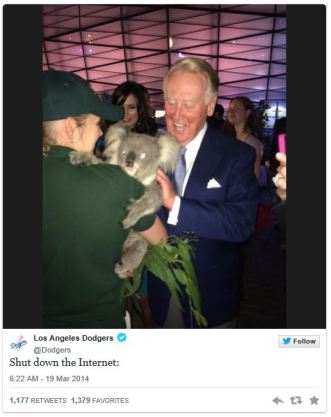
Here’s legendary Dodgers’ broadcaster Vin Scully with a koala bear.

vin koala

The two games this weekend were held at the Sydney Cricket Ground that was reconfigured for baseball. The New York Giants and Chicago White Sox played an exhibition game there way back in 1914.

The Giants won that game.

The Dodgers swept the Diamondbacks this weekend.

Embed from Getty Images

One of the fellas at the MLB channel called the Cricket Ground a mix of World Cup and Wimbledon.

I love baseball’s international spirit.  I love that players come from all over, and a team may have two or three translators hanging around the dugout to help everyone communicate.

Players from Japan and the Dominican Republic and Cuba are some of the best players in major league ball today.

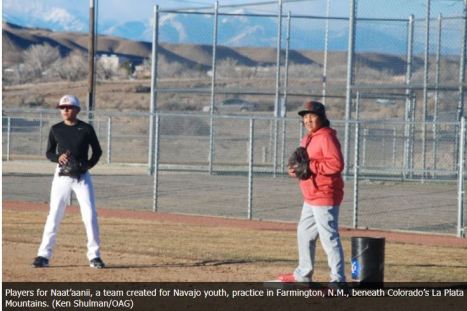
But, baseball also thrives closer to home in Indian Nation.

I just discovered that Jacoby Ellsbury and Joba Chamberlain are Native American.

National Public Radio’s Only A Game had a wonderful story this weekend about baseball and Navajo Nation.  Click here.

This season, the Class A Spokane Indians will honor the tribes of the Pacific Northwest by wearing the Native American Salish language on their jerseys.

Spokane, in Salish, looks a bit like a cat just ran over the keyboard, or something like this:

Sp’q’n’i

spokane jersey

(I must have one!)

(I think Sp’q’n’i is about to make my spell-checker explode.)

Baseball season is finally here. You know what to do.

Root for your “home” team … whether it’s the Baltimore Orioles (whoo!) or the Toronto Blue Jays (hi again Susie!), or an outfielder from Cienfuegos, Cuba or an infielder from Puerto Cabello, Venezuela, or  a pitcher from Habikino, Osaka, Japan.

Or, the Sp’q’n’i … yeh, especially Sp’q’n’i.

(Road trip, anyone?)

Free Baseball ~ i can haz baseball edition

Sixty-two percent of Americans today live with a pet – a cat or a dog or both or a bunch.

In short, most of us. (Goldfish and gerbils aren’t even included in this statistic … so that must account for the rest of you.)

I live with four cats (invited) and an increasing number of gangster attic mice (uninvited). (I’m hopeful the mousies haven’t brought plague into the house.)

(That old saying “quiet as a mouse”? A lie. That old saying, “When the cat’s away, the mice will play”? Also a lie. Cats today no longer care.)

Isn’t it odd that we spend so much time on the Internet looking at pictures of cats …

stevie is tired

Stevie is bored with this post already.

 … and dogs …

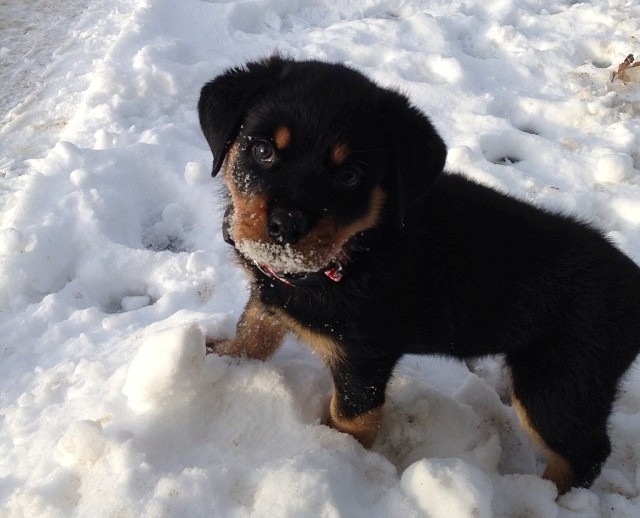
ruby in the snow

My friend Ginger’s new pup Ruby discovers snow!

… when we already have one or some or a bunch at home we could be looking at instead?

Here’s a video of a cat who has learned sign language for “feed me.”

My cats also know sign language for “feed me” (extend claws, swipe). While they couldn’t care less about chasing delicious mice, they will bray like billy goats when hungry. If that doesn’t work, they’ll smack you.

It snowed today.

Which means some time for me to post my first Free Baseball of 2014 … i can haz baseball edition …

(I had my first “Free Baseball” of the season when the University of Virginia went to extra innings against Boston College on Saturday afternoon. UVa won 3-2 in 12, after Nick Howard who started the game as Designated Hitter came in during the 10th and pitched 2.1 scoreless innings. He struck out the side in the top of the 12th and then singled home the winning run in the bottom of the 12th.)

Ok, back to the critters …

10th Inning ~ Rookie The Retriever

Last summer, I wrote about Chase, the golden retriever “bat dog” of the Trenton Thunder, a Yankees minor league team. Sadly, Chase, who was 13, died of cancer last year.

But, Chase was good with the lady dogs and left a number of puppies as his legacy.  A Chase grandpuppy, five-month-old “Rookie,” will take over his grandpa’s bat-retrieving work for the Thunder.

rookie

Apparently, there are trainers who will teach dogs to fetch bats. So, Rookie will get some schooling before he takes over the job full-time in 2015.

11th Inning ~ Hank the Brewer

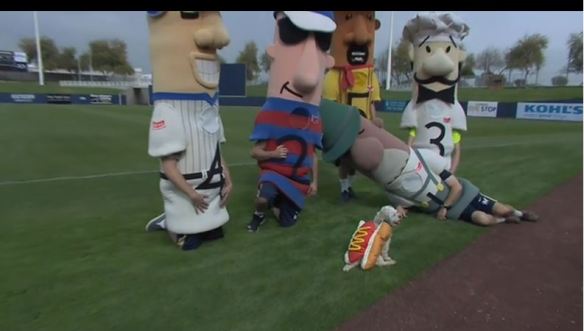
While Rookie figures out the finer points of bat fetching, baseball has already begun for Hank, a stray pup who turned up last month in Phoenix, Arizona at the Milwaukee Brewers’ spring training camp.

hankphoto

They named him Hank in honor of Hank Aaron.

The  Brewers announced last week that Hank’s now officially part of the team and he has already arrived in Milwaukee where he’s been adopted by a local family.

Watch Hank run in the Brewers’ Sausage Race.

hank

(I mean it. Watch this video.)

12th Inning ~ Big O

Big Orange the cat showed up one day at Phoenix Municipal (Muni) Stadium, spring home of the Oakland A’s, and never left.

big orange

Unlike Rookie and Hank the dogs, cats cannot be bothered with retrieving bats (stupid) or running with men dressed as bratwurst (demeaning).  (Cats are funny that way.)

One of the stadium employees takes care of “Big O.”

“The stadium manager kind of cut me some slack with running her off because she was kind of taking care of the rat population and the squirrels,” Jim Folk told Sports On Earth last spring.

“She’s definitely got a little attitude,” he said. “Like in the morning, when I quit petting her, she’ll swat me and then chase me down and grab onto my leg.”

The Oakland A’s are leaving the Muni for Hohokam Park next spring, and stadium employees are working to find a good new home for Big O.

*    *    *    *

smokey jo

This post is in memory of Smokey Jo (1998-2014).

A tough little missy who showed how diabetic cats can live long, normal, and happy lives with just a little bit of human help.

It’s February … Do You Know Where Your Baseball Is?

“People ask me what I do in winter when there’s no baseball. I’ll tell you what I do. I stare out the window and wait for spring.” ~ Rogers Hornsby (legendary 2nd baseman from 1915-1937)

A sunny Sunday, 64 degrees, in Charlottesville, Virginia. Is this winter … and baseball?

Because, while major leaguers use February and March to oil up their joints, warm up their bones, and, apparently, shave for the first time since October, college boys are already grinding.

I was tired of the Olympics anyway. (Oh, wait, what? It’s already over? Goodbye, sweet curling, my friend. You are always a sport to me.)

And, hope springs eternal … even when spring is still a month away.

The University of Virginia Cavaliers win 6-2 over East Carolina

February 23, 2013, Davenport Field, Charlottesville, Virginia

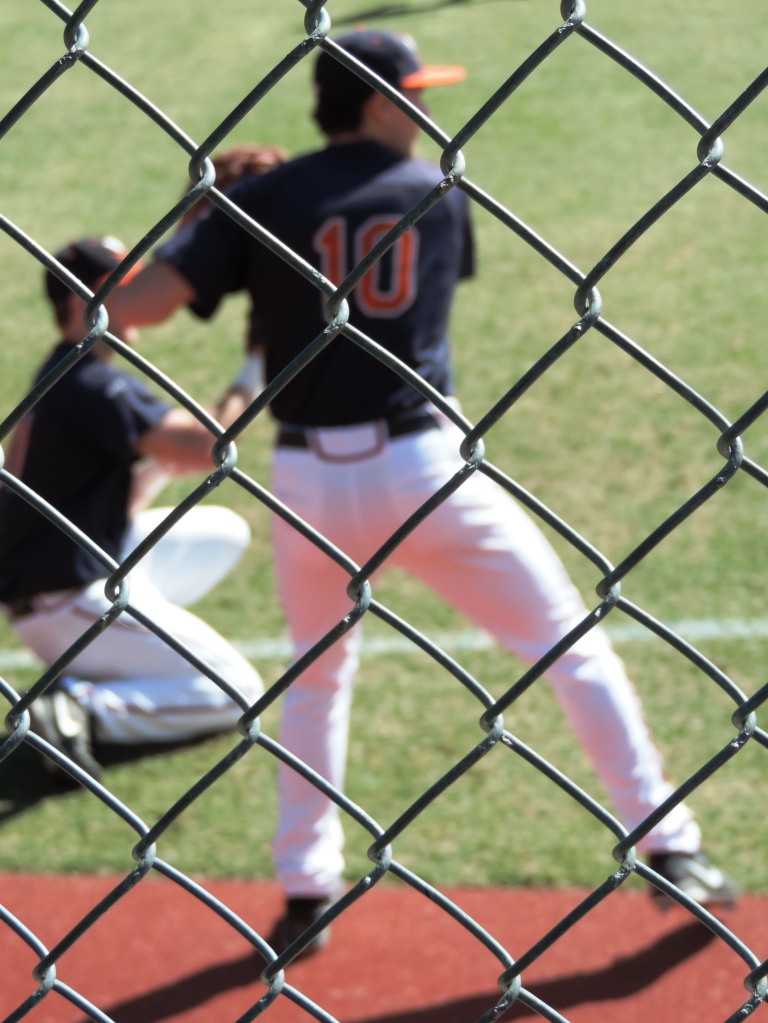
Nearly SpringThe first photo of the season is bound to be a bit fuzzy. Junior Brandon Downes.

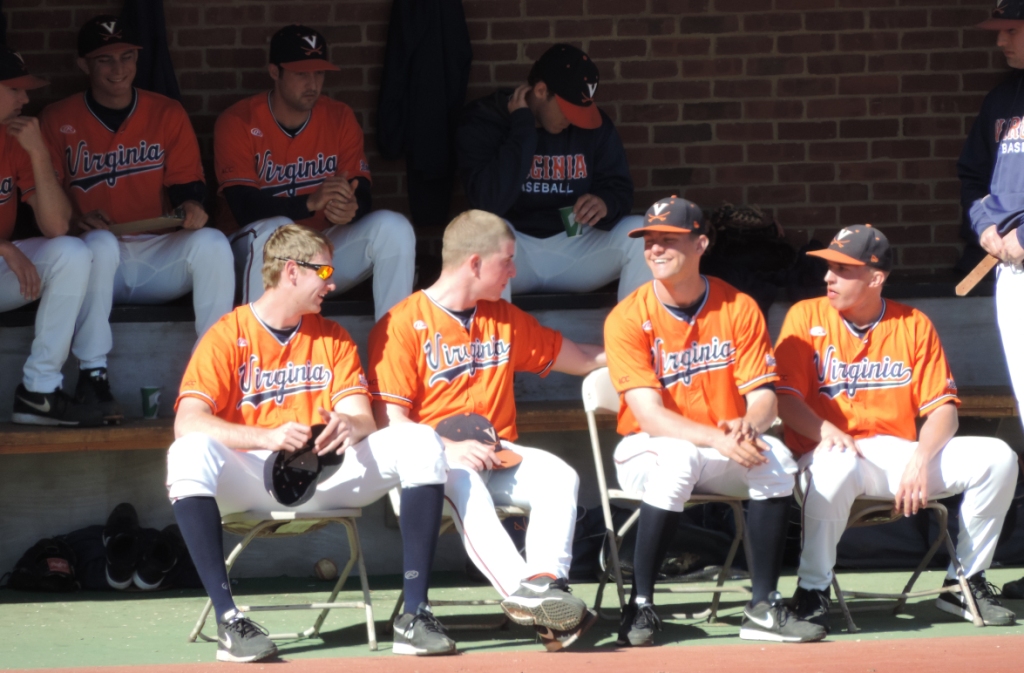
dugout dayHappy for baseball season? Yeh, me, too.

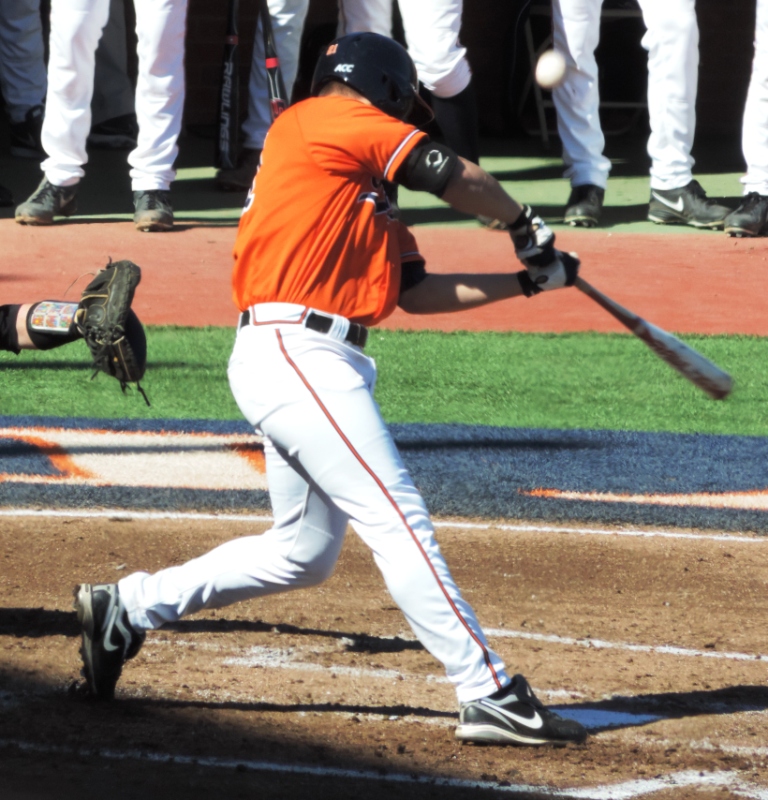
thaiss foulMatt Thaiss, Freshman. (This ball went foul, but we named Thaiss our Player of the Game, after he went 3 for 4, reached base all four times, 2 runs, 1 RBI. Did I mention he is a freshman? I was a freshman once.)

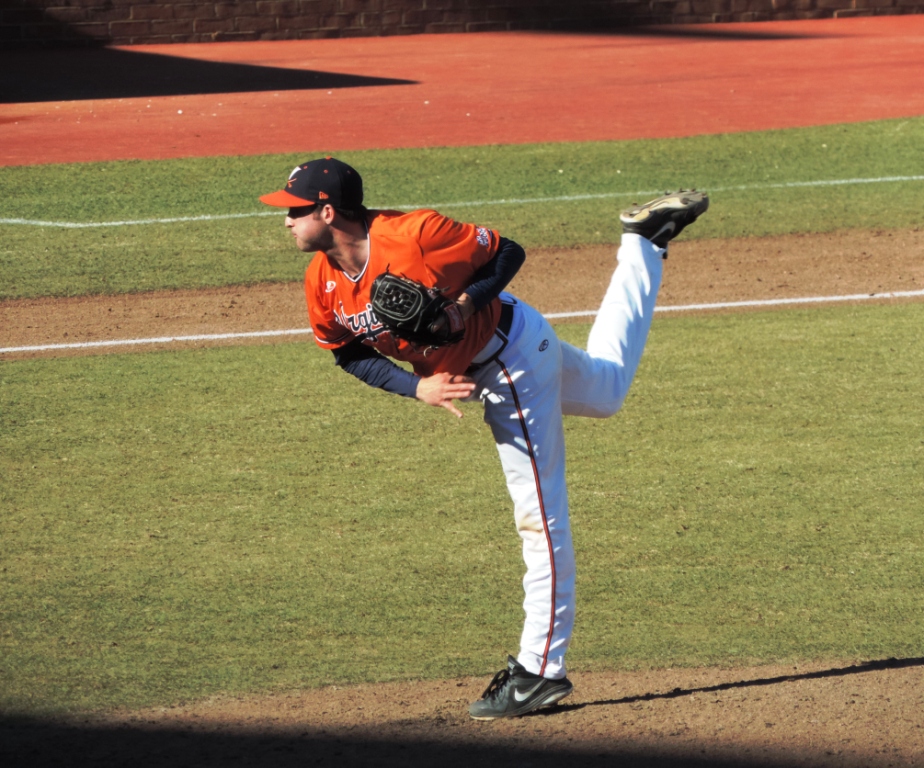
mayberry2Pitcher Whit Mayberry’s got his Yoga going on on the mound.

self portraitSelf Portrait.


Five Things You Should Know About Curling

It seems that I still have a few friends here in Virginia who don’t know that I curled.

This is less a factor of me being modest and unassuming, and more of a factor that I increasingly blot out entire chapters of my life (most of them spent in North Dakota).

For the record, I have curled. I was a good sweeper, but a lousy curler. I couldn’t slide a rock to save my life. (They’re 40 pounds, those rocks.)

But, I could sweep, although I would often get so engrossed in my sweeping – back-forth-back-forth-back-back-forth-forth – that I wouldn’t hear the thrower or skip yelling directions to us sweepers down past the hog line.

(I just wanted to say “hog line.”)

The Olympic curlers are so loud they’ve been heard outside the Sochi arena barking orders to their sweepers.

Curling

Photo by: Otchampery via Creative Commons.

There are no photos of me curling, so stop asking.

I looked forward to curling days in high school gym class.

If it was basketball or volleyball day, it was simply an hour in the gym running around or getting whacked by the bigger, more athletic girls.

We played indoor soccer in the gym, too. That was more fun, and occasionally the tough girls would kick their rivals hard in the legs intentionally, and then blame the ball for the accident.

But, curling was great, because we had to take the school bus to get to the curling rink. (Devils Lake, North Dakota didn’t have much, but it had a curling rink … like a bowling alley only icier. And, colder.)

DL Curling

You thought I was kidding about the “Satan” thing in yesterday’s post?

Shuttling a bus load of high school students to the curling rink … and back … absorbed a good amount of the school day, or at least the daily gym requirement.  Ergo, curling was great.

And, every four years, come Olympics time, I have to defend the sport (and, yes, non-believers, it is harder than it looks, and it is a sport).

Curling_on_a_lake_in_Dartmouth,_Nova_Scotia,_Canada,_ca__1897

public domain image

Curling on a frozen Nova Scotia lake in 1897. Look how popular it is!

As a public service, here are five things you should know about curling.

5) That ice is not smooth.

At the elite, Olympic level, they manufacture an uneven icy surface – known as the sheet – by spraying water on it. At the beer-drinking levels of the sport, the ice just gets dinged up and scuffed on its own.

(I always thought this rough-ish surface was to keep us from falling down. But, the curling gods care less about the safety of its players and more for the maneuverability of the rock.)

4) Curlers wear special shoes.

Sweepers today have special slip-slidey shoes that have Teflon soles. The thrower wears one Teflon shoe (on his front foot) and one non-slip-slidely shoe on his back (hack) foot.

While novice curlers can get cheap “slip-on” soles to turn their normal-people shoes slidey, Olympic curlers will pay upwards of $450 for the perfect curling shoe.

3) The word “curling” has nothing to do with the movement of the rock.

The “currrrr” is the sound the rock makes while it slides on the ice. (I wrote a paper on the history of curling in high school, I know this stuff.)

2) The Beatles curl in the movie “Help!”

If there ever was a reason why I would love curling when I was in high school, that was it. (Spoiler Alert: The bad guys in “Help!” replace the curling rock with a bomb!)

Help

If the Ramones had curled, I’d have Olympic medals by now.

1) A weekend round-robin curling tournament is called a “bonspiel.”

This is one of the greatest, most beautiful, and most underused words ever. Please use “bonspiel” in conversation today.

(Bonus Fun Fact: In bonspiels, teams win “stuff” like tee-shirts, and curling shoes, and brooms, and, possibly, beer. If there’s money involved, then the tournament is called a “cashspiel.”)

Now, go watch curling … and impress your friends!

“The One Foul Blot on Dakota’s Map”

I was going to post this on Friday. But, instead, we shoveled snow away from our cars and plowed down the pasture road and out to freedom. 

Freedom being the paved road about a mile away that was completely clear and dry. Ten inches of snow on Thursday; sunny and 52 degrees on Friday.

So, Editor/Husband and I went out to lunch. And, shoveled just a little bit more, but mostly out of guilt because everyone else seemed to be shoveling, so we thought we probably ought to, too.

Snow Day Feb 14

Nice walkways, yes?

This post should have ended up on the scrap heap. That’s where most of my posts end up. You get only the very best ones. You might now be thinking, “Good god, what kind of crap doesn’t make the cut?”

(That’s very rude and hurtful, by the way.)

Some of what doesn’t make the cut is stuff like this:

“Skdjkl sj;lagja ppppppppppppppppppppppppppppppppppppppppp”

This was a guest post from Stevie who paws her way across the keyboard from time to time. Every cat is attracted to a keyboard at least once. My cat Squeekee once stepped on the “enter” key and sent an unfinished, typo-filled email to a consulting client. Always a plus when you’re charging to edit their copy.

I was going to scrap this post because it’s mostly about (me). Writing about (me) simply means there isn’t good baseball or Yoga to write about.  And, there’s always good baseball and Yoga to write about.

For those of you still reading (as you wait for the Olympics or tonight’s Downton Abbey), here’s the post I should have scrapped:

When I was in Junior High, my parents uprooted me from California to return to their original home – a farm in North Dakota (a few dozen miles from the geographic center of North America; a good 10 miles from the nearest paved, two-lane road, and 15 miles or so from the nearest grocery store).

It was cold and flat. It was very, very cold and very, very flat.

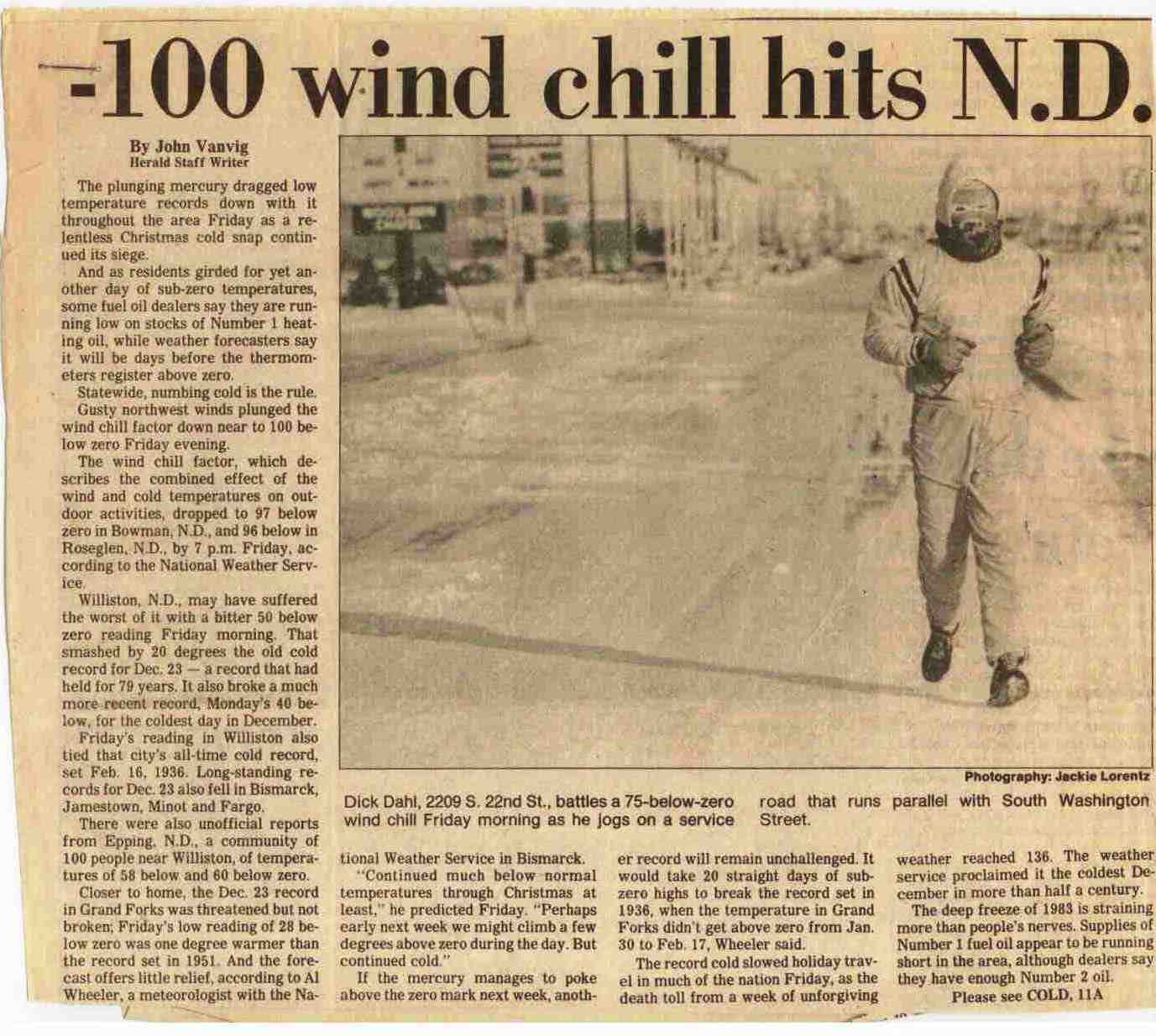
I had the foresight to keep this newspaper article.

windchill

I went outside that day, but I am not the person jogging. Needless to say, that was my last winter in North Dakota.

The eastern half of North Dakota is so flat that from our farmhouse, I could easily see the town lights at night 14 miles away … except when the snow blotted them out (which was more often than you can imagine).

I lived in a town called Devils Lake.

In 1883, a local newspaper editor wrote this about there:

“If they persist in their infernal mobs, shooting scrapes, shanty burnings, etc. people cannot but be convinced that the Devils Lake country is inhabited by a band of roughs and that a decent man’s life is not safe there. … All respectable people regret to see the settlers of Devils Lake … the one foul blot on Dakota’s map.”

The Devils Lake high school sports teams were called the Satans and no one there thought it odd when a gym full of high school students yelled, “Satans spirit never dies! Never! Never! Never!”  (After nearly 80 years, they changed the name to Firebirds in 2002, but, they’ll always be the Satans to the locals.)

yearbooks

High School Yearbooks were called “The Satan.” And, how about that artwork?

It was far too cold and far too snowy for the high school to have a baseball team and no one there thought that was odd either.

Curling

No baseball. But, we did have curling. I was an awesome sweeper.

My years there was time spent, I guess, as the foundation for saying “I’m much happier here in this better place” ever since.

(If you think I’m being tough on that old town, you are right, although I’m being far kinder than I would be if you and I were to sit down together and have a beer. For the record, I recently checked the school’s alumni pages, and I am not included with my graduating class. It’s as though I never existed. This, at first, pissed me off. But, now it just gives me validation in rehashing many not-so-kind memories. It also makes it much easier to lie about my age.)

Finally sprung from both high school and college, I came east, happy to find much warmer weather, far better music, Yoga, and, yes, baseball.

I never looked back.

In North Dakota when it snows, the snow sticks around, often for months. In Devils Lake, the main streets in town have a permafrost layer of packed down snow, ice, and gravel throughout the winter. You just live with it.

Snow? -100 wind chills? You just live with it.

Here in Virginia as soon as there is a threat of even two inches of snow, everyone panics. The store shelves are emptied and schools are closed, often for days on end.

It snows.

And, then the sun comes out and the day turns warm.

The snow melts.

Baseball has come. Spring Training’s underway in Florida and Arizona. College games are being played.

Enough about (me). It’s baseball season!

(Want more curling? I’ve written more curling! Click here.)

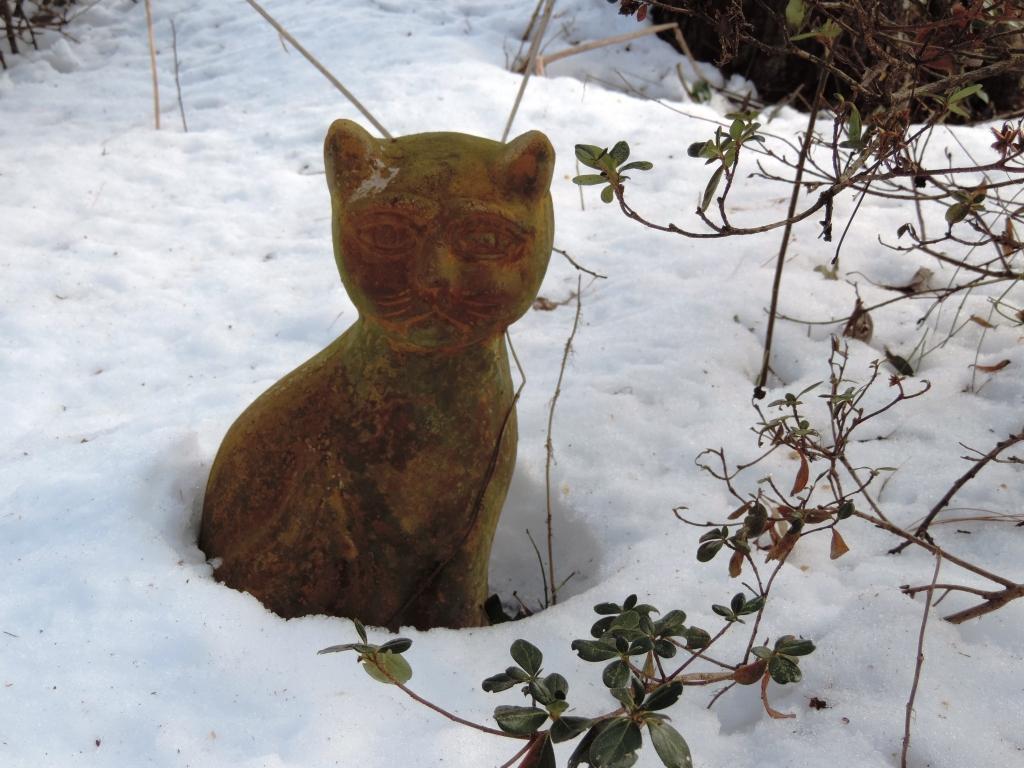
Snow Cat

“And, Along Came Slim …”

There was a lot that was “slim” about the pitcher Slim Love.

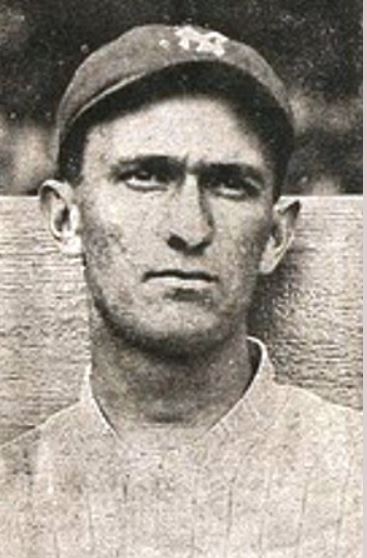
slim love photo

His frame was slim – 6 foot, 7 inches, 195 pounds. And, his baseball career (a few big league seasons between 1913 and 1920) was rather slim, too.

When I wrote about him a couple days ago (click here), I focused on this slimness, his mediocre statistics, and his only pitch, an undisciplined fastball.

Slim’s pretty short list of overall pitching stats (highlighted by an awful lot of walks) made for, well, slim pickings when it came to summing up his career.

But, he was the tallest man in major league baseball at the time and had a very good nickname. So I settled for that.

It could be said that I, an Orioles fan, was unduly hard on Love because he was a Yankee. OK, point taken.

The more I thought about Love, however, the more I thought, “If he was that mediocre, how did he make it through so many major league seasons?”

(You may insert any number of current mediocre pitchers in response here. I’m not going to play that game, but I will say – you do have a point.)

So, I poked around some more. And, I stumbled on something. And, when I say “stumbled” I don’t mean literally, but I came upon it nearly by chance. As if Slim Love himself had steered this newspaper under my nose, controlling his legacy in a way that he couldn’t his fastball.

Slim, I think, wants you to know about this.

Slim vs Babe story

New York Tribune, 6/27/18. Library of Congress, Public Domain http://chroniclingamerica.loc.gov/lccn/sn83030214/1918-06-27/ed-1/seq-12

Wednesday, June 26, 1918

New York Yankees vs. Boston Red Sox

“And along came Slim Love and Babe Ruth was shackled.” (New York Tribune)

Love was a Yankee, Ruth was still with the Red Sox.

Slim vs Babe

New York Tribune, 6/27/18. Library of Congress, Public Domain http://chroniclingamerica.loc.gov/lccn/sn83030214/1918-06-27/ed-1/seq-12

Slim Love Pitching for the Yankees. June 26, 1918

Love gave up only three hits in his 3-1 victory that day, bringing the Yankees to within a game of the league-leading Sox.

Slim Love’s own two RBI double was the difference in the Yankees’ victory. “It was a lovely hit and the 6,000 howlers in the stands howled their OK,” wrote Charles Taylor of the Tribune.

As for Babe Ruth?

Babe_Ruth_Red_Sox_1918

Public Domain image.

Babe Ruth, Red Sox. 1918

Being “shackled” meant Ruth went just 1-for-4 that day; his one hit a double that drove in the sole Red Sox run. Which, isn’t really shackled by my accounts, unless, of course, you’re Babe Ruth and much more is expected of you than of ordinary batters.

But, this is Slim’s story.

And, Love, Taylor wrote, “had a lovely day. His old southpaw wing never fluttered so gracefully or with better results.”

(There’s no baseball writer – or baseball blogger – today who could write a line like that, and that’s a shame.)

Every ballplayer – at every level of the game – deserves at least one great moment.

Every batter deserves a 4-for-4 game, or a home run that cuts through the clouds and breaks someone’s windshield, setting off a line of car alarms in the parking lot.

Every batter deserves a Babe Ruth kind of day.

Every pitcher deserves one no-hitter (and Love did have one of those in the minor leagues).

And, every pitcher should be given a moment when their pitches are so spot-on perfect that they would shut down Babe Ruth himself.

Every pitcher deserves that Slim Love kind of day.

POSTSCRIPT: The Red Sox went on to win the World Series that season (defeating the Cubs). They would not win another World Series for 86 years. The Yankees, with a 60-63 record, sunk to fourth. In December 1920, the Red Sox would sell Babe Ruth to the Yankees for $100,000, which kick started a Yankees’ revival that has led, over the years, to 27 World Series championships.

FUN FACT: Slim Love and Babe Ruth were – very briefly – teammates. In December 1918, the Yankees traded Love to Ruth’s Red Sox. But, before Spring Training or a single game with the Sox, Love was bundled up yet again and traded to the Tigers.

Slim Love ~ A Valentine’s Tale

Slim Love was a pitcher.

(I’m not clever enough to make this up. This story is true.)

slim love photo

public domain image.

This is Slim.

Slim wasn’t his given name, of course.

His birth name, given in 1890, was Edward.

But, baseball is the land of a thousand nicknames. And, while “Slim” isn’t the best of them, it certainly isn’t the worst, and it’s appropriate enough if you’re a lanky, stringbeany, beanpoley, 6 foot 7 kind of fella.

In 1913, as a member of the Senators, The Washington Post called Love the “elongated twirler” with a “bucolic disposition and odd appearance.”

Today, just calling him tall would do.

To be 6’7” is to be pretty tall, but not as tall as Jon Rauch (6’11”) or Randy Johnson (6’10”).

But, to be 6’7” in 1913 is to be the tallest man in the major leagues.

slim love

public domain image.

Slim Love. All 6’7″ of him.

(Fun Fact: The tallest players in major league baseball are all pitchers.)

Slim Love is the perfect-ish name for Valentine’s Day.

It’s sweet with the Love part, but Slim makes the love seem a bit stand-offish and tenuous. A slim love is fragile. It’s a complicated love. Tender, but a little bit sad. Still, it’s a good name.

(Unconditional love is what you get from a dog.  Slim love is what you get from a cat.)

Stevie Grumbles

Even Stevie’s love is slim at times.

Slim Love wasn’t a spectacular pitcher. He isn’t particularly memorable at all.

But, baseball historians are a fair-minded lot and they remember everyone.

Love, apparently, bragged his way onto a minor league team in Memphis, while having, apparently, no real baseball skills.

I thought this was fairly remarkable and quite a lucky break for Slim, and assumed perhaps that this was merely a sign of how baseball behaved in a far simpler time.

Then I realized that idiots in all walks of life brag themselves into jobs they are unsuited for all the time and I find them, as a group, highly annoying.

Slim Love must have figured something out, however, because he eventually played a few big league seasons with the Senators, Yankees, and Tigers.

1918 yankees team

public domain image

1918 New York Yankees. Slim Love is in the middle (kneeling) row, second from the right.

He had an undisciplined fastball and never learned – or just couldn’t – throw a curve or anything else for that matter, despite the futile efforts of Yankees manager Miller Huggins to teach him a new pitch or at least some control.

His major league career was finished by 1920 at age 29. He ended with a 3.04 ERA and a 28-21 record (most of that with the Yankees), which isn’t all that special, but could still land you a job today in many bullpens, if not in a starting rotation.

slim love zeenut

Slim Love even had his own baseball card.

He kicked around in the minor and independent leagues into the 1930s. He died in 1942 in Memphis, at age 52, after being struck by a car.

Love Gravestone

There’s no moral to Slim Love’s tale.

Only that there are plenty of players in baseball who may not have been very good, but were a little bit interesting, or just a touch quirky.

Maybe just their name will stand the test of time.

Or, maybe not. In reporting on his death in 1942, The Sporting News got his name and age wrong. They called him Elmer.

elmer

The Sporting News. Dec. 10, 1942

The Slim Love story doesn’t end quite yet. For Part 2, and the day Slim Love faced Babe Ruth, click here.

Happy Baseball. Pitchers & Catchers report this week. Finally.

“It’s Completely Unraveling.”

football1A soapbox can be a lonely place. Especially on Super Bowl Sunday. Especially when I really do want to see Bruno Mars at half time. Especially when it seems like everyone will be watching.

But (me).

I used to love football (go ‘9ers!)

Not anymore.

Because football is increasingly brutal and senselessly violent. And, in every NFL game, including the “super” one today, men will crash into one another and get their clocks cleaned and their bells rung.

It’s part of the game. And, people will cheer.

And, brains will be injured.

Some will heal. But, some won’t.

And, the National Football League will continue to do its best to pretend like everything is ok.

And, they will continue to ignore the broken and damaged brains in so many broken and damaged players who no longer play the game.

This season the NFL reported that players sustained 228 concussions – a decrease from the previous season.

But, concussion experts say these numbers are deceiving, since the NFL doesn’t catch every concussion and players often hide their symptoms.

Gary Plummer

Gary Plummer. Permission: By © BrokenSphere / Wikimedia Commons

Former NFL linebacker Gary Plummer estimates that he sustained five Grade I concussions in every game he played. Every game.

One thousand concussions over the course of his career.

Remember Super Bowl XXVIII in 1994? Cowboys quarterback Troy Aikman doesn’t. 

He sustained a “mild” concussion in the NFC championship game and was still feeling dizziness and other effects of the injury when he led the Cowboys to their Super Bowl victory over the Bills. Today, he doesn’t remember a thing.

(Last week, Aikman told reporters he has had no recent issues related to the injury.)

But, a few forgotten hours is a small price to pay, compared to the debilitating, dark, and tragic reality facing many former players whose brains have been irreparably damaged by the game they loved.

It’s heartbreaking.

sean morey

Sean Morey. Permission: LPDrew via Creative Commons 2.0

On Friday, National Public Radio (NPR) told the story of Sean Morey, 37, who spent 10 years in the NFL and today struggles with the effects of long-ago, football-related concussions on a brain that has not – will not – heal.

Morey says there’s no question his symptoms are related to brain trauma he sustained playing football.

“You cannot feel that kind of pain and have it not be related to brain damage,” he told NPR. “The dysfunction, the pain, the misery, the confusion, the desperation, the depression. …

“There were instances in my life that would never have existed had I not damaged my brain.”

“It is completely unraveling.”

npr

Listen here.

The damage is Chronic Traumatic Encephalopathy, a progressive degeneration of the brain caused by repeated brain trauma and concussions. It is found in the brains of former NFL players, as well as those who played only in high school and college.  It appears years – sometimes decades – after the original  brain injury and shows itself in myriad ways. Memory loss, confusion, impulse control problems, dementia, depression, suicide.

Despite what the NFL would like you to believe, the damage is real. And, football is to blame.

Apologists say that players know the risk and can choose their fate.

That doesn’t absolve the NFL from its responsibility to provide proper treatment to its current players and adequate medical care to its former players.

I know the risk, too. And, I, too, can choose.

I love a good game. I really do.

But, if it means that even one player will struggle some day with brain damage and dementia simply to entertain me today, count me out.

LEARN MORE

My previous posts on brain injuries and concussions in sports:

The NFL Knew. And, They Covered It Up.

Don’t Try This At Home.

* * *

The Sports Legacy Group works to raise awareness to CTE and brain trauma in athletics and in the military. They work to help coaches and athletes at all levels of sports better understand how to prevent head trauma, as well as encourage proper treatment of concussions so that the brain may better heal.

sportslegacy

For more on their efforts click here.

* * *

To watch the excellent Frontline piece “League of Denial” on the NFL and the CTE crisis click here.

league of denial

Frontline recently updated their report.

Frontline Update

Click here.

And, for the powerful book that accompanies it click here.

league of denial book

There’s No Plate Like Home.

Back in the day, baseball’s home plate was often a perfectly round – and, later, a perfectly square –  chunk of marble. Iron or wood would do in a pinch. Or, a hunk of anything, really, tough enough to withstand baseball’s roughhousing 19th-century games.

The Dodgers’ broadcaster Vin Scully explained the history of home plate during a game last season. Listen here.

vinhome

Home plate is, technically, called “home base” but rarely is it called that, in the same way that the Cincinnati Reds are rarely called the “Red Stockings” even though that is their name. Technically.

Should you wish to build your own 21st-century home plate, you will forgo the marble (and the round and the square). Instead, find yourself a nice piece of white rubber and carefully carve it into a 20-pound pentagon.

Emphasis on “carefully.” Because home plate’s dimensions and placement are very, very precise.

home kingofears

Image Used with Permission By Kingofears via WikiMedia Creative Commons.

(Explicitly precise dimensions in the infield surrounded by decidedly imprecise outfields is what makes baseball a perfect game.)

The pentagon shape was settled on in 1900 to help umpires better see the strike zone.

(You may insert your favorite umpire joke here. Or, try this one … Why are umpires so fat? They always clean their plates!)

Thank the 1880s Baltimore Orioles for the creation of a home plate made of rubber.

(Thank you for home plate, Orioles. Oh, and while I have you, where’s that ace starting pitcher you’ve been promising us?)

orioles 1896

1896 Baltimore Orioles. Public Domain Image.

(Purist Alert: These 19th-century Orioles do lead to the rubber home plate, but they didn’t really evolve into today’s Orioles. They also did not evolve into the New York Yankees – a later, traitorous 1901 Orioles’ incarnation did that.)

The rubber home plate was the invention of lefty pitcher Robert Keating, who pitched one big-league game for the Orioles in 1887.

Keating’s one-game career was rough – a complete-game loss that left him with a career 11.00 ERA.

Apparently, Keating knew his baseball days were numbered, and that same year he patented one of many dozens of inventions that he would create during his lifetime – a much safer rubber home plate to replace the stone and iron ones that often led to injuries.

Keating is rarely remembered for this important contribution to baseball.

Instead, he is best known for the Keating Bicycle, a “safety bicycle” which had front and rear wheels that were the same size. This was an alternative to the dangerous big front-wheel numbers that people seemed all crazy for in the 1880s.

keating bicycle

(Keating, apparently, was a “safety first” man – a safer home plate, a safer bicycle, and he also invented an early version of the “safety razor.”)

Keating fans will also tell you he invented the first motorcycle in 1901, a full year before it was “officially” invented by someone else.

But, back to baseball. Here’s what you should know about home plate.

* It may have informally been called “home” before then, but it was the famed Knickerbocker Rules of 1845 that formally named the base where a batter swings and a runner scores as “home.”

knickerbocker rules

* Major League Baseball’s rules “suggest” that home plate be positioned in an “East-Northeast” direction.

This is to accommodate batters during sunny day games. Of course, most of today’s baseball is played at night under lights – or indoors – so it’s much less important. Still, rules are rules, even when they’re just suggestions, and you’ll see that many modern ballparks still properly place home plate to the east-northeast.

* Modern-day rubber home plates are durable, sure, but they’re no marble. Today’s major league teams will usually wear through two home plates each season (they’ll bring in a fresh plate around the All-Star Break).

Minor league teams will often squeeze a couple seasons out of their home plates.

(Bulldog Field Equipment, based here in Virginia, supplies home plates and pitching rubbers to many major- and minor-league teams. Their “double-sided” plates weigh 40 pounds and can be flipped over to increase their lifespan.)

* Umpires have their own very specific rules for the care of home plate. They will dust it with a brush before each half inning and whenever needed. The umpire will step to the front of the plate, turning his back to the pitcher’s mound before dusting, so as not to moon the fans when he bends over. Players don’t dust off the plate. Ever.

umpire brush

* Whether rubber or marble, it’s not easy to steal home, which makes it one of baseball’s rarest and most exciting plays. Detroit’s Ty Cobb stole home 54 times in his career – the most of any ballplayer.

On those few occasions when a runner on third attempts to steal home, this is what almost always happens:

wieters2

He’s Out!

But, once in awhile, this happens:

Jackie Robinson stole home 19 times in his career, but, to this day, catcher Yogi Berra insists that Robinson was out during this famous play during the 1955 World Series.

Berra told Sports Illustrated in 2009, “The ump never saw the play good. … He was short and never got out of his crouch. The hitter even admitted later that Jackie was out. And he had a great view.”

Asked what he remembered most about one of baseball’s most famous plays, Yogi says, “Mostly, I remember he was out.”

(Special Thanks to Jason Grohoske & Steve Ruckman of the Double A Richmond Flying Squirrels who answered my questions about the life span of modern day home plates. Go Squirrels!)

(Much of the information on Robert Keating is from the fine research of Daniel E. Ginsburg of the Society of American Baseball Research. Find more here.)


More of my posts on the evolution of “home”:

Skizzle, Sweet Skizzle

Don’t Try This At Home