These last few winters, the story has been pretty much the same. The Baltimore Orioles need an outfielder. Preferably two, but at the very least one.
And, every January, Orioles management scoops up a still-available outfielder at a bargain price. The Orioles get the guy for a year, he has a great season – greater than anyone could have imagined – and then “poof” he’s gone the next season, to a far richer, more generous team.
This brings me, in the most meandering way, to the brief career and life of Len Sowders.
Len Sowders
Sowders played just one season in the majors — 1886. He was a Baltimore Oriole.
He was an outfielder (who moonlighted some at first). A so-so fielder. A left-handed batter with a .263 average from his handful of at-bats in Baltimore. Not a lot of power, but still, .263 isn’t the worst you can do.
That puts him right around current O’s centerfielder Adam Jones’s .265 last season and Mark Trumbo’s .256, the Orioles’s one-season outfielder whose 47 home runs led all of baseball last year and who is now a free agent looking for much more money than the Orioles will offer.
Back in 1886, Sowders was picked up by Baltimore late in the season from a minor league club in Nashville. Before Nashville, he’d played in Evansville, where he was also known for running a local fish business and for making loans with interest (fitting, I guess, that a man in the fish business was also a loan shark). He was, one newspaper assured readers, a good player and a strict church-goer.
There’s a lot of baseball on the 4th of July. Playing baseball on Independence Day is a tradition that goes back more than a century – pretty much as long as baseball has been baseball.
All 30 big league teams will play today (weather permitting). There will be hundreds more playing in the minors, college summer leagues, kids’ leagues, and pick-up games. There will be a lot of baseball.
This is not about any of today’s games. (Except to say, “Good luck, Orioles. Don’t screw this road trip up any worse than you already have.”)
1881 was as good a 4th of July as any for baseball, I figured.
Because there were two games in Buffalo that day, along with two in Detroit, that marked the first-ever major league doubleheaders specifically created to take advantage of a holiday.
Public Domain
Troy Trojans Pitcher Mickey Welch
Because future Hall of Fame pitcher Mickey Welch of the Troy Trojans pitched both of those games against the Buffalo Bisons – complete games, winning both, including a three-hit shut-out in the afternoon.
Because, that 4th of July also was Welch’s 22nd birthday.
Game One: Troy Trojans – 8 Buffalo Bisons – 3
Game Two: Troy Trojans – 12 Buffalo Bisons – 0
There are no box scores from that game.
Well, that’s not exactly right. There are box scores. I just can’t read them …
Game 1 Box Score. Buffalo Morning Express, July 5, 1881
Pitching was different in 1881. Complete games – and two-man pitching rotations – were as normal then as worn-out bullpens and six-inning “quality starts” from your ace are today.
Public Domain
Troy Trojans, early 1880s. Welch may be the player seated at the far left.
Troy was a pretty lousy team with few hometown fans. So, the owners agreed to move a July 5 home game to fill out the Buffalo doubleheader. The teams would make more at the gate in Buffalo on a holiday then they could ever make in Troy on a Tuesday.
The story should end there:
The 4th of July. A Monday, just like today’s.
Mickey Welch – “Smiling Mickey,” the future Hall of Famer with the friendly demeanor and an assortment of quirky underhand curves – pitches 18 innings and wins two complete games in baseball’s first holiday doubleheader.
On his birthday. On America’s birthday.
I love that story.
Except for this.
As in all things, baseball doesn’t exist in a vacuum.
New York Times, July 3 1881
Two days earlier, President James A. Garfield was shot at a train station in Washington, DC.
Public Domain
President Garfield
If you know your high school history, this will all sound vaguely familiar. Just three months into his Administration, a deranged office-seeker shot Garfield twice – once in the arm and once in the belly. And, if you remember your medical science classes, you might recall that Garfield died two months later, not from the actual gunshot wounds, but from infection caused by the virtually nonexistent sanitation practices of the time and all the unwashed, dirty fingers that doctors used to probe the belly wound.
This lets a lot of the air out of an otherwise sweet 4th of July story.
The country was in shock. Citizens clogged city streets near newspaper and telegraph offices to get the latest news on the condition of the President.
His “condition” depended on the newspaper …
Washington Evening Critic, New York Times, and Buffalo Evening News, July 4, 1881
Many cities cancelled their Independence Day fireworks and events out of respect.
Buffalo called off its military parade. The city’s annual boating regatta went on as planned because, organizers agreed, the President seemed to be doing better by Sunday, and the weather was supposed to be perfect.
Buffalo Evening News, July 5, 1881
The Regatta, a Pigeon Shoot, and the Independence Day revelry of people shooting at each other went on as scheduled in Buffalo.
Despite the somberness of the weekend, people tried to get back to normal.
Baseball went on as planned and more than 4,000 fans attended the games against the Trojans at Buffalo’s Riverside Park.
“In the afternoon the stands were filled to sardine compactness and the assemblage was very enthusiastic,” according to the next day’s Buffalo Morning Express.
Troy surprised the Bisons. “It does seem ridiculous that such a motley combination of base-ball talent should be able, when they play in this city, to do such good work as the Troys,” The Express reported. “The [12-0 afternoon game] was a disgrace to the name of the Buffalos. … Welch was too much for the home club.”
The 4th of July wins were rare ones for the Troy Trojans. They finished the season in fifth place in the National League, with a 39-45 record. Twenty-one of those wins belonged to Welch.
President Garfield never recovered. He died on September 19.
The Troy Trojans folded the following season and Welch went on to become a star with the New York Gothams, whom you may know today by the nickname which ultimately stuck with them – the Giants.
Public Domain
After finishing his playing career – amassing 307 wins and a career 2.71 ERA — Welch went on to run a hotel and saloon and then a dairy business, before returning to baseball as a gatekeeper and attendant at both the Polo Grounds and Yankee Stadium.
Mickey Welch died of heart failure, at age 82, on July 30, 1941. On his death certificate his “Usual Occupation” was listed as this: “Baseball player.”
To fall in love with baseball is to fall into the past, as far back as you can remember it when you were a child, and even further than that if you can.
To fall in love with baseball is to fall in love with people and places and games that are from times that are much older than you, places you’ve never been to, and games that are now just box scores on paper.
Baltimore Orioles beat the NY Giants 10-4. August 5, 1896.
To fall in love with baseball is to be in love with a game that has a history and a culture that is nearly 200 years old. It has changed and evolved and changed back again, but, it’s still pretty close to what it was right from the start.
(When the main thing that people still argue about is the designated hitter rule, you know that things really haven’t changed all that much.)
Hey, kid! Don’t freak out! The Baltimore Orioles have had plenty of seasons worse than this one.
Sure, the Orioles will finish a crummy third in the American League East this season. They’ve hovering a game under .500 with just one left to play.
But, it coulda been worse.
In 1899, the Baltimore Orioles finished 4th in the 12-team National League with a 86-62 record.
The Baltimore Sun, September 9, 1899
“The Poor Orioles”
Their .581 win percentage, good enough for 4th place in 1899, would have won them this year’s AL East pennant. So, there. Take that, Blue Jays.
Those Orioles weren’t that bad, especially when you realize that 1899 was also the season that the Cleveland Spiders went 20-134, the worst team in baseball history.
(The Spiders were so bad – and attracted so few fans – that most teams refused to travel to Cleveland for games, forcing the Spiders to play most of their games on the road. Teams don’t get to do that anymore. It doesn’t matter if raw sewage is seeping into the dugouts, you still have to play in Oakland.)
But, finishing 4th wasn’t good enough. At the end of the season, the League decided to cut its “deadwood” and the Orioles were tossed in the chipper along with those lousy Spiders, the Washington Senators, and the Louisville Colonels.
In 1902, a patched-together Baltimore Orioles, now in the American League, finished 8th – 34 games out of first – with a 50-88 record.
The Baltimore Sun, September 30, 1902
“Almost Like a Funeral”
At the end of the season, that team was packed up and moved to New York.
Damn Yankees.
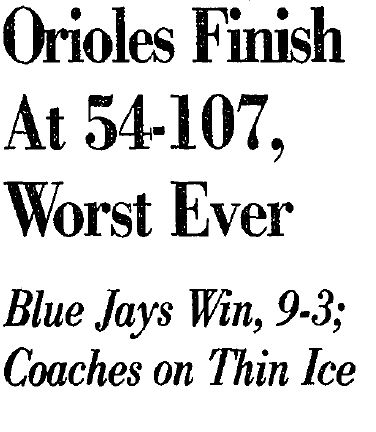
In 1988, the Baltimore Orioles started their season 0-21, the worst start by any major league team ever. They finished the season 54-107.
Oh, for crap’s sake. Can nothing go right for the Orioles?
Yesterday, I shared one of those “On This Day In Baseball” stories. It’s here.
How, on September 3, 1897, two Baltimore Orioles – outfielder “Wee” Willie Keeler and first baseman “Dirty” Jack Doyle – both went 6-for-6 in a single game.
This, historians agree, would be the only time in baseball history that two teammates went 6-for-6 in the same game.
I checked the story out. I checked the box score. I knew that there was a very brief time that walks counted as hits in baseball. But, that was 1887. And this was 1897.
Keeler — 6 At Bats, 5 Runs, 6 Hits
I should have left it at that. I should have said, “Wow. Cool.” I should have walked away.
But, no.
Because, come to find out, box scores don’t always agree.
Especially box scores that are nearly 120 years old.
So, out of curiosity, I checked the Baltimore Sun’s report from the game.
And, wouldn’t you know …
Keeler — 6 at bats, 5 runs, 4 hits
“The official table of the slaughter” that day shows Keeler with just four hits.
Not that this stopped the Baltimore Sun from also accepting the legend of 6-for-6.
“Seven times [in 1897], he got four hits in one game. Four times, he got five hits. Once, Keeler went 6-for-6.”
But, the Internet can be a wild and wonderful place, and I found this buried deep in its archives:
Robert Edwards Auctions, 2008
A letter from Orioles outfielder Joe Kelley about the 1897 game
(Kelley, you may remember, went 5-for-6 in that game. He was also known as a something of a cutie pie ladies man who would slip a comb under his cap, so he could tidy up in the outfield before flirting with the gals during games.)
In 1940, Kelley, then 68, responded to historian Albert Kermisch’s inquiry about the game:
“Your letter with the summary of game played in 1897 received and you are going a long way back on me to think and be right. But I am pretty sure that the Sun paper’s account is right and Billy Keeler did not make six (6) hits in that game. Frank Patterson was the Sun reporter at that time and am kind of certain but not real sure that he was the official scorer that season.”
(This letter, by the way, was authenticated and sold at auction for nearly $10,000 in 2008. It was, according to the auctioneers, an extremely rare handwritten letter from the future Hall of Famer.)
By BPL CC BY 2.0, via Wikimedia Commons
Orioles Keeler, John McGraw, Hughie Jennings, and Kelley, circa 1895 (clockwise from top left)
So, who’s right?
The general press account and box score of the game that appeared in newspapers throughout the country that show that Keeler went 6-for-6?
The Baltimore Sun’s “official table of the slaughter” that says 4-for-6?
Or, Kelley, who, thinking about a long-ago game, is “pretty sure” it wasn’t six?
The Baltimore Sun’s report gives a somewhat clear rundown of Keeler’s day. Batting second, behind McGraw, Keeler:
Singles, steals second, and scores in the first;
Reaches first on a questionable play in the second that includes an error that allows the man on third to score. That error would not necessarily negate a single by Keeler, but it looks like the Sun believes it does. Keeler takes part in a double steal and scores on a double from Kelley;
Triples in the third;
Is hit by a pitch in the fourth, takes part in another double steal, and scores on a wild pitch;
Singles in the sixth; and
Singles in the eighth.
There you go. Keeler was on base in all six of his appearances. But, it looks like he reached on an error in the second and his hit-by-pitch negates his at-bat in the fourth.
Ergo, Keeler was 4-for-5. (I don’t know why The Sun reports six at-bats. Maybe they counted the hit by pitch as an at-bat, which we don’t today.)
Doyle’s 6-for-6 day checks out, by the way. But, Keeler’s doesn’t. Two major league teammates have never gone 6-for-6 in the same game.
But, I can tell you this. Keeler began the 1897 season with a 44-game hitting streak, a record that stood until DiMaggio. His 206 singles in 1898 was a record until Ichiro Suzuki broke it in 2004. His .424 average in 1897 is the best for a left-hander, ever. Over his 19-season career he batted .341.
And, good grief! 22 runs, 28 hits, double steals. Must have been quite a game.
When you were little, did you ever have someone hand you an ice cream cone and you greedily pushed your tongue into it and, just like that, the scoop of the best chocolate ice cream in the whole world, pure frozen perfection, the best thing you ever, ever tasted, just fell over off the edge of the cone and landed at your feet?
And, there’s a moment of stunned silence, when you think, like any five year old would, “What the f***?”
And, then you cried.
Not tears-rolling-out-of-your-eyes cried, but the shrieking, gulping, wailing kind of cry that only children can get away with, and that pretty much sums up how it feels to have your ice cream fall to the ground … the result of some lazy, careless adult who couldn’t take the two seconds to tamp the scoop firmly into the cone before giving it to you – a child – and who has now ruined everything because this has to be one of the worst things that could ever happen to anybody …
Until, years later, the Orioles fall over, just like that lousy ice cream and you realize …
Suckity, suck, suck, suck.
Not a single Oriole, not a single one of the 19 position players who have had at least one at-bat is batting better than .295 over the past 30 days. Nine of the 20 – that’s 45 percent of them – are batting .208 or worse.
Compare that to the Toronto Blue Jays, who have six players batting .300 or better during the past 30 days.
That, along with porous, unreliable, hapless pitching, is why the Orioles have won just three of their last 16 games. They are 3-13 and 6.5 nearly impossible games away from that second Wild Card.
It makes you want to change the subject …
On this date, September 3, 1897, Baltimore Oriole right fielder Wee Willie Keeler went 6-for-6 in a game against the St. Louis Browns. (“Wee” because the outfielder stood just shy of 5’5”.)
His teammate, first baseman “Dirty” Jack Doyle, went 6-for-6, too. (“Dirty” because he was an aggressive baserunner, prone to brawls on and off the field, and was once arrested in the middle of a game.)
Left fielder Joe Kelley went 5-for-6.
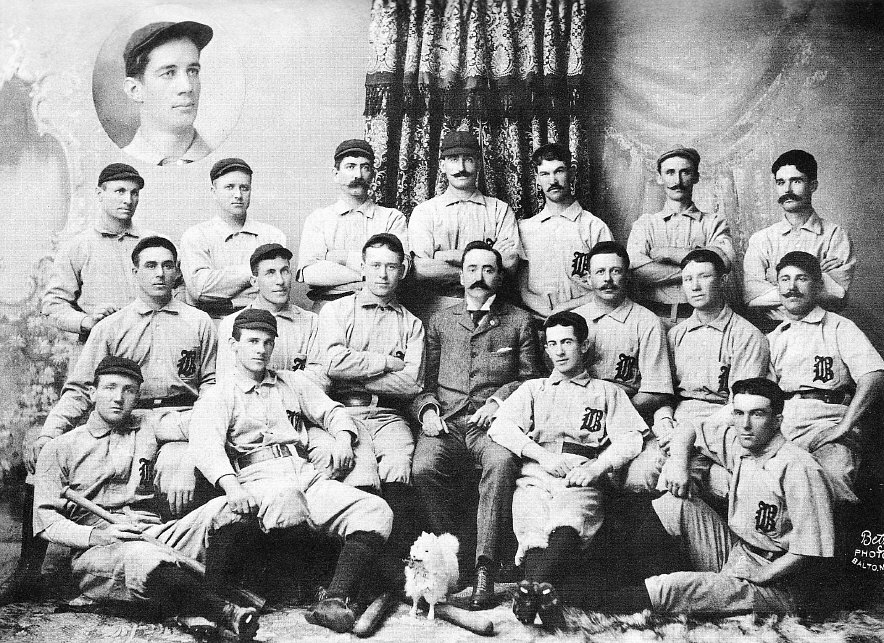
The 1896 Orioles. Keeler is in the front row, third from the left (with his elbow on his manager’s leg). Doyle is in the front row, far left, holding a bat. Kelley is in the second row, third from the left.
The Orioles defeated the Browns that day 22-1. Twenty-eight hits.
(Over their past four games, the 2015 Orioles have scraped together 26 hits and 12 runs. Total.)
The Orioles would finish the 1897 season second to Boston. Keeler would lead the league with a .424 average.
Those 1897 Orioles did not evolve into the present-day Orioles. They share only the name. (The 1897 St. Louis Browns were renamed the Cardinals a few seasons later. Yes, those Cardinals.)
(Those Orioles are also not the 1902 Baltimore Orioles that, through a cruel twist of fate, became the New York Yankees.)
They were one of baseball’s greatest teams.
And, Keeler was one of the greatest batters. His secret? “I have already written a treatise and it reads like this: ‘Keep your eye clear and hit ‘em where they ain’t; that’s all.’ ”
And, hang on to your ice cream …
UPDATE: Maybe Wee Willie Keeler wasn’t 6-for-6 after all. Here’s where I revisit the “facts” and change my mind about things: “The Official Table of the Slaughter”
“So, then, to every man his chance — to every man, regardless of his birth, his shining, golden opportunity — to every man the right to live, to work, to be himself, and to become whatever thing his manhood and his vision can combine to make him — this, seeker, is the promise of America.” ~ Thomas Wolfe, You Can’t Go Home Again, 1940
Best I can tell, the first reference to a ballplayer having a “cup of coffee” – or a short stint – in baseball referred to New York Giant Fred Merkle. Yes, Bonehead Merkle.
Fred Merkle, Public Domain
It was in 1908 in a game versus the Cubs that Merkle neglected to tag second at the end of a game that the Giants thought they had won. Once the “boner” was revealed, negating the Giants’ winning run, the game was replayed and the Cubs won. (They went on to win the World Series, their last, in case you’re keeping track.)
It was after that first game that the New York Globe referred to Merkle, 19 and the youngest player in the National League, as “just getting his ‘cup of coffee’ in the league.”
Bonehead or not, Merkle lingered quite some time over his cup, playing more than 1,600 games over 16 seasons, including, ironically, his last six with the Cubs. (I believe Starbucks would call that “cup of coffee” a Venti-sized career.)
The real “cup of coffee” players are those who play the shortest times in the big leagues. A game or two and not much more.
Fun Fact: We Americans will drink 400 million cups of coffee today. (I tried to figure out how much caffeine that was, because decaf is ridiculous, and I think it’s something like 500 billion mg. Really, math is not my strong suit, so I might be off by a billion or two.)
Three major league players had their single game “cup of coffee” on the 4th of July. It’s strange there have been only three, and none, that I can see, since 1885.
When you play just one game in an era without ESPN and online box scores, it’s hard to know much about these guys. All I can tell you is this …
1882
The Baltimore Orioles played the Louisville Eclipse on July 4, 1882.
John Russ, a Louisville carpenter, may have played on a local team and had the opportunity for a one-day cup of coffee in the bigs when the Orioles came to town and needed a player to fill out the squad.
Russ, 24, played centerfield and pitched, giving up three hits and one earned run over three innings, and went 1-for-3 at the plate. This might not sound like much, but it could get you a solid million-dollar bullpen job with teams today.
Russ was the son of immigrants, his father a blacksmith, his mother a candymaker. He never ventured from Louisville and is listed in its directories over the years as a carpenter, plowmaker, and woodworker in a plow factory, until his death in 1912 from cirrhosis.
1882 was the inaugural season for the six-team American Association and the Orioles finished dead last. Their record, 19-54, put them 32.5 games out of first.
1883
Charlie Ingraham got his shot with the Baltimore Orioles the next year on July 4, 1883.
He went 1-for-4 with a single, and had one error as catcher.
It was a doubleheader for the Orioles, playing the Red Stockings in Cincinnati.
Ingraham was an Ohio native living by then in Chicago. He’s another case of a player who may have gotten scooped up by the Orioles for that one day, so that they could field enough players for the two games.
In 1880, Ingraham was listed as a medical student in Chicago. This would mean he was planning to follow in his father’s footsteps. His father was a prominent physician and medical lecturer whose death in 1891 was covered by the Chicago Tribune.
In the obituary, his son C.W. – our Charlie – is listed as a ballplayer in the Northwestern League, a minor league that had folded four seasons earlier.
Things don’t often work out the way you think they will when you’re young, and when C.W. succumbs to pneumonia at age 46, he is neither a doctor nor a ballplayer. He is listed on his death certificate as a “stage carpenter.”
The Orioles finished last again in 1883 – 28-68 and 37 games out of first.
1885
Bill Collver, just 18, played his one and only big league game for the Boston Beaneaters on July 4, 1885.
An outfielder, he went 0-for-4 at the plate that day, with one strikeout.
The Beaneaters were in the middle of a roadtrip – a grueling one by today’s standards – that had begun on June 23 and would go through July 17. On July 4, they played a doubleheader against the Detroit Wolverines, losing the first game 8-3 and the second 11-6.
It’s unclear which loss Collver played in, but it’s likely that the Beaneaters, like the Orioles before them, just picked up Collver from a local team to help fill out their roster.
Collver didn’t have much beyond that cup of coffee. He died in 1888, still in Detroit and just 21, of a “spinal disease,” which could mean meningitis, of which there was plenty in Detroit, or who knows?
The Beaneaters finished their season 46-66 and finished fifth and 41 games out of first in the National League.
___
The sad thing about a cup of coffee in baseball, is that someday it’s gonna be your last. And, unlike Mariano Rivera, Cal Ripken, and the other greats who chose when and where to drink their final cup, for most players, with names you’ll never know, the pot is emptied before they’ve had their fill.
So, here’s to John and Charlie and Bill who had their cup of coffee, who lived the American Dream, even if it maybe wasn’t what they planned, and who are still remembered 130-some years later for just one day, just one game.
I’m sure someone in New England has just come in from shoveling snow off of his roof – again – and is cursing me for complaining.
(Fun Fact: If my local paper was using baseball players to measure snowfall, we’d be moving.)
Pitchers and catchers reported to Florida and Arizona this week. The NCAA college baseball season began last weekend. Because, when it comes to baseball, spring begins in winter.
There may not be eight feet of snow on the ground here, but there was still enough to run the University of Virginia baseball team down to Charleston, South Carolina this weekend to play its first “home series” of the season 450 miles away from home.
Virginia, snow. South Carolina, no snow.
This meant no baseball for me this weekend.
Charleston, South Carolina was one of the first locations to serve as a big league spring training spot when the Philadelphia Phillies set up shop there in the spring of 1886. (The Chicago White Stockings put together their own spring training in Hot Springs, Arkansas that same year.)
Philadelphia Phillies in Charleston, SC, Spring 1886. ~ Public Domain Image
In 1884, Cap Anson, of the White Stockings, told Sporting Life magazine that early spring workouts in a warmer climate would “relieve the men of all stiffness, soreness, and rheumatism, and [allow the White Stockings to] start off with a physically strong team.”
But, really, the goal was simply to dry out the drinkers.
(The Chicago White Stockings of 1886, incidentally, eventually became the Chicago Cubs and not the White Sox, as you might have assumed. See, baseball can teach you something even in February.)
The snow is melting today. It never lasts long in Virginia.
And, the University of Virginia is 7-0 this season.
But, it took a historic 18 innings — and five hours — this afternoon to notch that last win versus Marist down in Charleston.
So, I guess it’s no surprise that baseball lost Bob Valentine.
I don’t mean Bobby Valentine, who played in the 1970s and went on to manage the Mets (quite well) and the Red Sox (not well at all).
I mean Robert (Bob) Valentine who played for the New York Mutuals for one game in 1876.
Just one game at catcher and three at-bats. No hits.
Righty, lefty? Who knows? Fly out, ground out, struck out? Don’t know that either.
Place of birth, date of death, anything? Nothing.
A name. And, a line in a box score.
Bob Valentine is just three obscure at-bats in a game the Mutuals lost 7-4 to the Boston Red Caps on May 20, 1876.
Baseball fans and historians pride themselves on keeping track of every play by every player, in every game. I estimate that 22 percent of the internet cloud today is storage for baseball statistics. (I base this estimate on nothing more than I chose the number 22 because it was Jim Palmer’s number.)
What happened to Bob?
The New York Mutuals were one of baseball’s first professional teams, a powerhouse for many seasons, and had just joined the brand new National League in 1876. Just a few days before Valentine’s debut (and farewell), the Mutuals executed major league baseball’s first triple play.
That was the highlight of an otherwise dismal season. They went 21-35 and were permanently expelled from the league when they refused to make their last road trip of the season. That was the end of the Mutuals.
And, really, good riddance, because in 1865 the Mutuals were also the first team to fix a game.
But, back to Bob. Where the hell did he go?
I’ve started and stopped this post several times, in the hope that Bob would turn up.
He never does.
Bob?
Could he be the Robert Valentine who goes on to open a muslin underwear factory in Jackson, Michigan?
Was he the cotton mill worker in Tennessee?
Or, did he become the jeweler in New York?
Maybe he was the divorced and retired Bob Valentine who moves in with his son and son’s family in Duncannon, Pennsylvania sometime around 1920.
Did he become the clay miner in Woodbridge, New Jersey?
Or, the fireman in Philadelphia?
They were all Robert Valentine. Their ages are close enough to fit. Maybe he is one of them.
Who knows?
But, Bob Valentine has it over the 984 others who played just one big league game. Because his name is Valentine. And, every February someone like me looks him up.
Oh sure, he’s no Moonlight Graham. Graham also played just one big league game. In 1905, for the New York Giants.
More precisely, he played two innings. And, never had an at-bat.
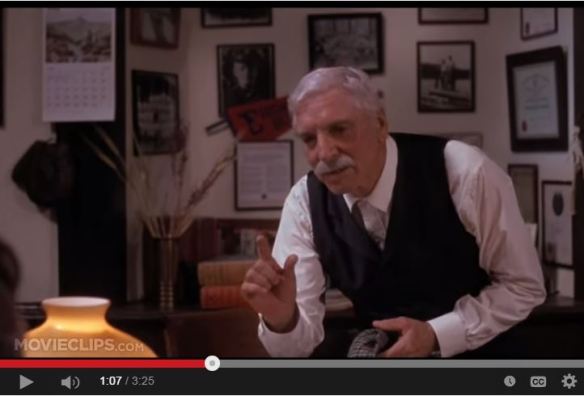
A bunch of decades later, W.P. Kinsella stumbles across Graham in a baseball book, is smitten by the name “Moonlight”, and mentions him in his book Shoeless Joe. Next thing you know Burt Lancaster is playing Moonlight Graham in Field of Dreams.
(Fun Fact: Field of Dreams is not the best baseball movie ever. Have I mentioned that I was a “crowd extra” in Major League II?)
Look, it’s me in the crowd!
But, let’s set aside the Valentines and Moonlights. Let’s honor a player who is truly obscure. Someone, like, say, Jack Smith, who played one game for the Detroit Tigers in May 1912. I picked him at random out of the list of 985because his name was Smith.
Come to find out, Jack Smith was an 18-year-old college kid from St. Joe’s in Philadelphia hired by the Tigers for one game when they were in Philly playing the A’s, and needed to quickly replace the regular Tigers who had gone on strike to protest Ty Cobb’s suspension for jumping into the stands and beating up a disabled fan a few days earlier.
Smith was paid $25 (or $10 depending on who you believe), played five innings at third, and had either no at-bats (baseball-reference.com) or one at-bat (Associated Press box score of the game). The Tigers lost that game, 24-2.
Jack Smith wasn’t even his real name. His real name was John Joseph Coffey. I hope he changed it that day because he was ashamed to be a scab.
(Pun Fact: A very short career in the majors is called “a cup of coffee.” In Jack Smith’s case, it was a “cup of Coffey coffee.”)
In any event, I now know more about Smith than poor old Bob Valentine.
Which is a shame. This being Valentine’s Day and all.
“Games, you remember, go by a kind of immutable rotation – as much a law of childhood as gravitation of the universe. Marbles belong to spring, to the first weeks after the frost is out of the ground. They are a kind of celebration of the season, of the return to bare earth. Tops belong to autumn, hockey to the ice, base-ball to the spring and summer, football to the cold, snappy fall. … If you played ‘em out of time, they didn’t seem right; there was no zest to them.” ~ Walter Prichard Eaton in Scribner’s, 1911.
(Spinning your tops in the spring? Unzesty.)
There wasn’t much snow in Central Virginia yesterday. Just a splatter. Or, maybe someone just emptied a bag of cotton balls out in the yard.
Some people argue that baseball season goes on too long, that games are too long, that everything should just be shortened up, speeded up, and wrapped up quickly.
They are wrong. Who wants more baseball-less winter?
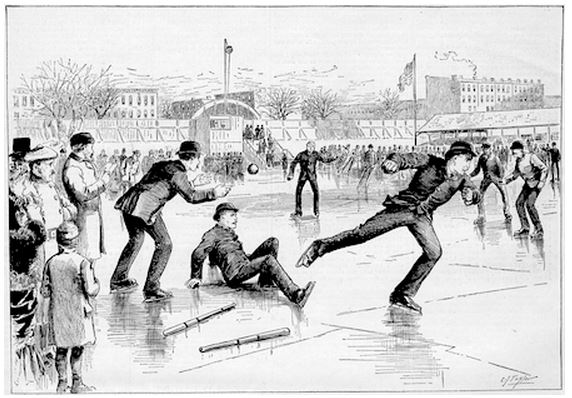
In the 1860s, “Ice Base-Ball” was invented to keep the season going longer.
“Base Ball On Skates” by C.J. Taylor in Harper’s, 1884
A few teams in Brooklyn – and later in Chicago and Philadelphia – gave it a go and you can find reports of it through the early 1880s or so.
Some games had 15,000 fans out in the cold watching players skate around the bases.
(Imagine this … Billy Butler. Stealing second. On skates.)
(You’ll be thinking about it all day, won’t you? Maybe this baseball on ice thing isn’t such a bad idea.)
Following a game between the New York Mutuals and Atlantics in January 1871, The New York Sun noted that the bases were drawn on the ice with paint and ashes, the ice “was in fine condition” and “[t]he play was good.”
The Mutuals lost, although the reporter neglected to give a final score.
The game’s highlight? “In the second innings, [sic] one of the Mutuals, Shreeves, took the bat and struck at the first ball pitched to him. The next that was seen of him he was lying in a heap on the ice, while his bat was flying over the heads of the spectators.”
Fun.
Just 21 days until pitchers and catchers report to warm places where the only ice is in drinks and wrapped around sore muscles.
In the meantime, here’s a hardy women’s team in Toronto playing baseball on ice in 1924.
The “latest in Winter sports – demands skill, speed and strong clothes.”
(Don’t forget your strong clothes … there’s still a bit of winter left out there.)

















 The Baseball Bloggess