I’m sure someone in New England has just come in from shoveling snow off of his roof – again – and is cursing me for complaining.
(Fun Fact: If my local paper was using baseball players to measure snowfall, we’d be moving.)
Pitchers and catchers reported to Florida and Arizona this week. The NCAA college baseball season began last weekend. Because, when it comes to baseball, spring begins in winter.
There may not be eight feet of snow on the ground here, but there was still enough to run the University of Virginia baseball team down to Charleston, South Carolina this weekend to play its first “home series” of the season 450 miles away from home.
Virginia, snow. South Carolina, no snow.
This meant no baseball for me this weekend.
Charleston, South Carolina was one of the first locations to serve as a big league spring training spot when the Philadelphia Phillies set up shop there in the spring of 1886. (The Chicago White Stockings put together their own spring training in Hot Springs, Arkansas that same year.)
Philadelphia Phillies in Charleston, SC, Spring 1886. ~ Public Domain Image
In 1884, Cap Anson, of the White Stockings, told Sporting Life magazine that early spring workouts in a warmer climate would “relieve the men of all stiffness, soreness, and rheumatism, and [allow the White Stockings to] start off with a physically strong team.”
But, really, the goal was simply to dry out the drinkers.
(The Chicago White Stockings of 1886, incidentally, eventually became the Chicago Cubs and not the White Sox, as you might have assumed. See, baseball can teach you something even in February.)
The snow is melting today. It never lasts long in Virginia.
And, the University of Virginia is 7-0 this season.
But, it took a historic 18 innings — and five hours — this afternoon to notch that last win versus Marist down in Charleston.
So, I guess it’s no surprise that baseball lost Bob Valentine.
I don’t mean Bobby Valentine, who played in the 1970s and went on to manage the Mets (quite well) and the Red Sox (not well at all).
I mean Robert (Bob) Valentine who played for the New York Mutuals for one game in 1876.
Just one game at catcher and three at-bats. No hits.
Righty, lefty? Who knows? Fly out, ground out, struck out? Don’t know that either.
Place of birth, date of death, anything? Nothing.
A name. And, a line in a box score.
Bob Valentine is just three obscure at-bats in a game the Mutuals lost 7-4 to the Boston Red Caps on May 20, 1876.
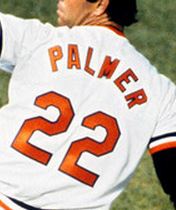
Baseball fans and historians pride themselves on keeping track of every play by every player, in every game. I estimate that 22 percent of the internet cloud today is storage for baseball statistics. (I base this estimate on nothing more than I chose the number 22 because it was Jim Palmer’s number.)
What happened to Bob?
The New York Mutuals were one of baseball’s first professional teams, a powerhouse for many seasons, and had just joined the brand new National League in 1876. Just a few days before Valentine’s debut (and farewell), the Mutuals executed major league baseball’s first triple play.
That was the highlight of an otherwise dismal season. They went 21-35 and were permanently expelled from the league when they refused to make their last road trip of the season. That was the end of the Mutuals.
And, really, good riddance, because in 1865 the Mutuals were also the first team to fix a game.
But, back to Bob. Where the hell did he go?
I’ve started and stopped this post several times, in the hope that Bob would turn up.
He never does.
Bob?
Could he be the Robert Valentine who goes on to open a muslin underwear factory in Jackson, Michigan?
Was he the cotton mill worker in Tennessee?
Or, did he become the jeweler in New York?
Maybe he was the divorced and retired Bob Valentine who moves in with his son and son’s family in Duncannon, Pennsylvania sometime around 1920.
Did he become the clay miner in Woodbridge, New Jersey?
Or, the fireman in Philadelphia?
They were all Robert Valentine. Their ages are close enough to fit. Maybe he is one of them.
Who knows?
But, Bob Valentine has it over the 984 others who played just one big league game. Because his name is Valentine. And, every February someone like me looks him up.
Oh sure, he’s no Moonlight Graham. Graham also played just one big league game. In 1905, for the New York Giants.
More precisely, he played two innings. And, never had an at-bat.
A bunch of decades later, W.P. Kinsella stumbles across Graham in a baseball book, is smitten by the name “Moonlight”, and mentions him in his book Shoeless Joe. Next thing you know Burt Lancaster is playing Moonlight Graham in Field of Dreams.
(Fun Fact: Field of Dreams is not the best baseball movie ever. Have I mentioned that I was a “crowd extra” in Major League II?)
Look, it’s me in the crowd!
But, let’s set aside the Valentines and Moonlights. Let’s honor a player who is truly obscure. Someone, like, say, Jack Smith, who played one game for the Detroit Tigers in May 1912. I picked him at random out of the list of 985because his name was Smith.
Come to find out, Jack Smith was an 18-year-old college kid from St. Joe’s in Philadelphia hired by the Tigers for one game when they were in Philly playing the A’s, and needed to quickly replace the regular Tigers who had gone on strike to protest Ty Cobb’s suspension for jumping into the stands and beating up a disabled fan a few days earlier.
Smith was paid $25 (or $10 depending on who you believe), played five innings at third, and had either no at-bats (baseball-reference.com) or one at-bat (Associated Press box score of the game). The Tigers lost that game, 24-2.
Jack Smith wasn’t even his real name. His real name was John Joseph Coffey. I hope he changed it that day because he was ashamed to be a scab.
(Pun Fact: A very short career in the majors is called “a cup of coffee.” In Jack Smith’s case, it was a “cup of Coffey coffee.”)
In any event, I now know more about Smith than poor old Bob Valentine.
Which is a shame. This being Valentine’s Day and all.
“Games, you remember, go by a kind of immutable rotation – as much a law of childhood as gravitation of the universe. Marbles belong to spring, to the first weeks after the frost is out of the ground. They are a kind of celebration of the season, of the return to bare earth. Tops belong to autumn, hockey to the ice, base-ball to the spring and summer, football to the cold, snappy fall. … If you played ‘em out of time, they didn’t seem right; there was no zest to them.” ~ Walter Prichard Eaton in Scribner’s, 1911.
(Spinning your tops in the spring? Unzesty.)
There wasn’t much snow in Central Virginia yesterday. Just a splatter. Or, maybe someone just emptied a bag of cotton balls out in the yard.
Some people argue that baseball season goes on too long, that games are too long, that everything should just be shortened up, speeded up, and wrapped up quickly.
They are wrong. Who wants more baseball-less winter?
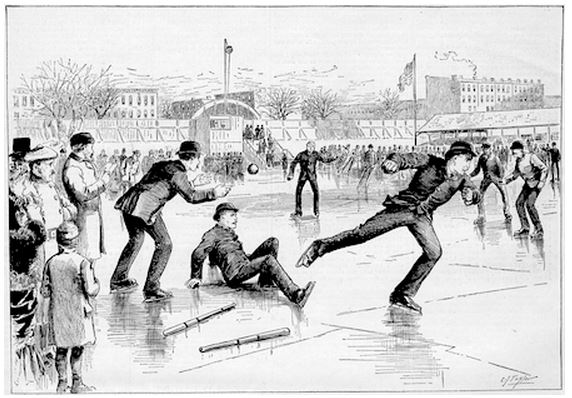
In the 1860s, “Ice Base-Ball” was invented to keep the season going longer.
“Base Ball On Skates” by C.J. Taylor in Harper’s, 1884
A few teams in Brooklyn – and later in Chicago and Philadelphia – gave it a go and you can find reports of it through the early 1880s or so.
Some games had 15,000 fans out in the cold watching players skate around the bases.
(Imagine this … Billy Butler. Stealing second. On skates.)
(You’ll be thinking about it all day, won’t you? Maybe this baseball on ice thing isn’t such a bad idea.)
Following a game between the New York Mutuals and Atlantics in January 1871, The New York Sun noted that the bases were drawn on the ice with paint and ashes, the ice “was in fine condition” and “[t]he play was good.”
The Mutuals lost, although the reporter neglected to give a final score.
The game’s highlight? “In the second innings, [sic] one of the Mutuals, Shreeves, took the bat and struck at the first ball pitched to him. The next that was seen of him he was lying in a heap on the ice, while his bat was flying over the heads of the spectators.”
Fun.
Just 21 days until pitchers and catchers report to warm places where the only ice is in drinks and wrapped around sore muscles.
In the meantime, here’s a hardy women’s team in Toronto playing baseball on ice in 1924.
The “latest in Winter sports – demands skill, speed and strong clothes.”
(Don’t forget your strong clothes … there’s still a bit of winter left out there.)
The Internet regularly turns rumors, half-truths, and not-true-at-alls into “factishness” in a snap. One person sees something stupid online, believes it, and a thousand forwards later Jon Bon Jovi is dead and NASA is warning of a massive power failure due to solar flares. (He’s not and they didn’t. Stop sending me this crap.)
Which brings us to the “fact-ish” story of Lewis P. Dickerson, 19th-century baseball player. Known to baseball geeks as “Buttercup.”
In 1979, Dickerson was inducted into the National Italian American Sports Hall of Fame for this: “Lewis Pessano, better known as Buttercup Dickerson, was the first Italian American to play in the major leagues.”
And, that became Buttercup’s legacy. Except …
He wasn’t Lewis Pessano. And, he is probably not Italian American. I’m not sure why the Chicago-based Italian-American Sports Hall of Fame ever thought he was.
Dickerson was “better known” as Dickerson, because Dickerson was his name.
His middle name was Pessano, but he was always a Dickerson. And, so was his father.
In the book Sport and the Shaping of the Italian American Identity (2013), Gerald Gems says that the Anglicization of “Pessano’s” name was significant because it showed how athletes had to “obscure and cast doubt upon any Italian identity.”
The implication that “Lewis Pessano” was so traumatized by ethnic bigotry that he was forced to change his name to avoid the stigma of being a low-class Italian just isn’t true.
Take a look at these facts, culled from U.S. census and Maryland records.
Dickerson was born Lewis P. Dickerson in 1858 in Tyaskin, Maryland.
1860 Census
1880 Census. Now 22, Lewis Dickerson is still living at home in Tyaskin …
… and identifies himself as a “Professional Base Ball Player.”
His father was William P. Dickerson, an illiterate oysterman. (The elder Dickerson is listed at one point as William Porter Dickerson and is always listed as being born in Maryland.) William can be traced back to the 1840s on Maryland records. Lewis’s mother is Mary P. (Larmore) Dickerson, also born in Maryland. Both parents are buried in St. Mary’s Episcopal Cemetery in Tyaskin.
In 2001, historian Charles Weaver spoke to one of Buttercup Dickerson’s granddaughters who told him that both William and Mary were of English (or, perhaps, Scottish) descent. The granddaughter also told Weaver that the middle name Pessano was given in gratitude to the attending physician at Lewis’ birth, a common tradition at the time. (This conversation is mentioned briefly in a footnote in Beyond DiMaggio: Italian Americans in Baseball, by Lawrence Baldassaro, 2011.)
Buttercup Dickerson wasn’t the first Italian American baseball player, because he wasn’t Italian American.
Public Domain
But, he was a baseball player.
“L.P. Dickerson” joined the Cincinnati Reds as an outfielder in July 1878. He batted .309 in 29 games that season. In 1879, his 14 triples for Cinci over 81 games led the league.
(Dee Gordon’s 12 triples for the Dodgers over 162 games led the league in 2014, although comparing 1879 to 2014 isn’t quite fair since so many things were so very different then.)
And, he was Buttercup.
Buttercup!
Wasn’t he?
In 1879, the Cincinnati Daily Star reports in passing that Dickerson is now being called “Sweet Little Buttercup.”
Cincinnati Daily News, 6/28/1879
1879 Poster. Public Domain
(“Sweet Little Buttercup” was an amply-sized female character in the Gilbert and Sullivan comic opera H.M.S. Pinafore. It debuted in the United States in 1879 and was a pretty big deal.)
That’s it. That’s the first and last direct reference to Dickerson being called Buttercup that I can find.
News reports are spotty, but in most cases he’s called Lew, occasionally Lou, and most often, just Dickerson.
Never Pessano. And, never again Buttercup.
Dickerson kicks around from team to team – Binghamton, Cincinnati, Troy, Worcester, Pittsburgh, St. Louis, Baltimore, Louisville, Buffalo, Norfolk, Chattanooga – playing mostly in the outfield and getting suspended at least a couple times for carousing and being a drunk.
There’s plenty of mentions of Dickerson’s drinking. And, to be singled out for being a “lush” at a time when hard-drinking and hard-living was the common ballplayer trait is pretty telling.
“Lew Dickerson has been suspended from Chattanooga for lushing.” ~ The Sporting News 5/31/1886
“One day Ben told Billy Taylor then of the [Pittsburgh] Alleghenys that Lou Dickerson was sick. … Said Billy, ‘Has he got delirium tremens?’ ‘Oh no. He is never sober enough for that.’” ~ The Sporting News 10/4/1886
“Lew Dickerson still exists. It is a cold day when he gets left, as he knows the ingredient to keep him warm.” ~ National Police Gazette 5/7/1887
“I was hoping some great temperance agitator would bring Lew Dickerson along and show him up as a terrible example. I guess Lew is done for, but his many escapades in the past will live for some years to come.” The writer tells of a player named Brown’s efforts to reform Lew, who agrees to stop drinking. “‘When will the good work begin?’ [Brown asks.] ‘When the breweries stop running,’ was Dickerson’s reply and ever after that Mr. Brown had no earthly use for Dickerson.” ~ The Sporting Life, 11/1891
Buttercup wasn’t all that reliable either. He was playing for the St. Louis Maroons of the Union Association in 1884 when this happened …
“During the St. Louis Unions eastern trip, Lew Dickerson disappeared at Baltimore, and has not been heard from since. Meeting many old friends, he yielded to his inclination for strong drink and fell by the wayside.” ~ St. Louis Globe Democrat 7/25/1884
He reappears two days later. Playing for Baltimore.
“Dickerson played with the Baltimores yesterday at right field. He will be expelled by the Unions for drunkenness. Several days ago [St. Louis Team] President Lucas announced that he was only waiting to locate him before expelling him. He says there is now not a lusher on his nine and he will never have another.” ~ St. Louis Globe-Democrat, 7/27/1884
In April 1885, he signs with the Omaha Omahogs of the new Western League, pockets a $100 advance, and then quickly skips town to join the National League’s Buffalo Bison.
Dickerson’s recorded stats dwindle after 1885, but I’m pretty sure he played a good bit longer.
Through 1891, he is regularly listed as a “ballplayer” in the annual Baltimore City Directory.
1891
By the mid-1890s, he is reported to be a “salesman” and, in 1896, a “huckster,” which made me smile until I realized that back then a huckster was simply a door-to-door or street salesman.
1896
1898
In 1898, he is again listed as “ballplayer.” So, he continued to make some living at baseball far longer than the records show.
There you have it.
Things are never quite as simple as they seem. And, often the real story isn’t nearly as nice as the one we’ve come to know.
Buttercup Dickerson was probably not the first Italian-American ballplayer. And, “Buttercup” was likely a fleeting nickname.
But, we do know this. Dickerson was a heavy drinker, broke contracts and jumped teams, and didn’t seem like a particularly nice fella. He had a couple awfully good seasons playing baseball, and plenty more mediocre ones.
On July 11, 1914, George Herman Ruth played his first major league game. He had recently joined the Boston Red Sox and was already known as “Babe”.
He pitched seven innings, gave up three runs (two earned), and got a no decision in a 4-3 win over the Cleveland Naps (later the Indians).
He went 0-for-2 at the plate. His first major league at bat? A strike out.
SDN-061193, Chicago Daily News negatives collection, Chicago History Museum. (1917)
He became the greatest ballplayer ever. (This is not even worth arguing over.)
If you want the stats, you can find plenty online.
But, how about some other Ruthian notes on this auspicious day?
He Was Born In Baltimore (And Lived In Centerfield)
According to the plaque at Baltimore’s Camden Yards: “During the early 1900’s, Babe Ruth and his family lived at 406 Conway Street in what is now centerfield of Oriole Park at Camden Yards. Babe’s father operated Ruth’s Café on the ground floor of the residence.”
The Café? A polite way of saying saloon.
Adam Jones, Orioles Centerfielder. Camden Yards.
Ruth Was A Catcher (Before He Was A Pitcher, Before He Was The Sultan of Swat)
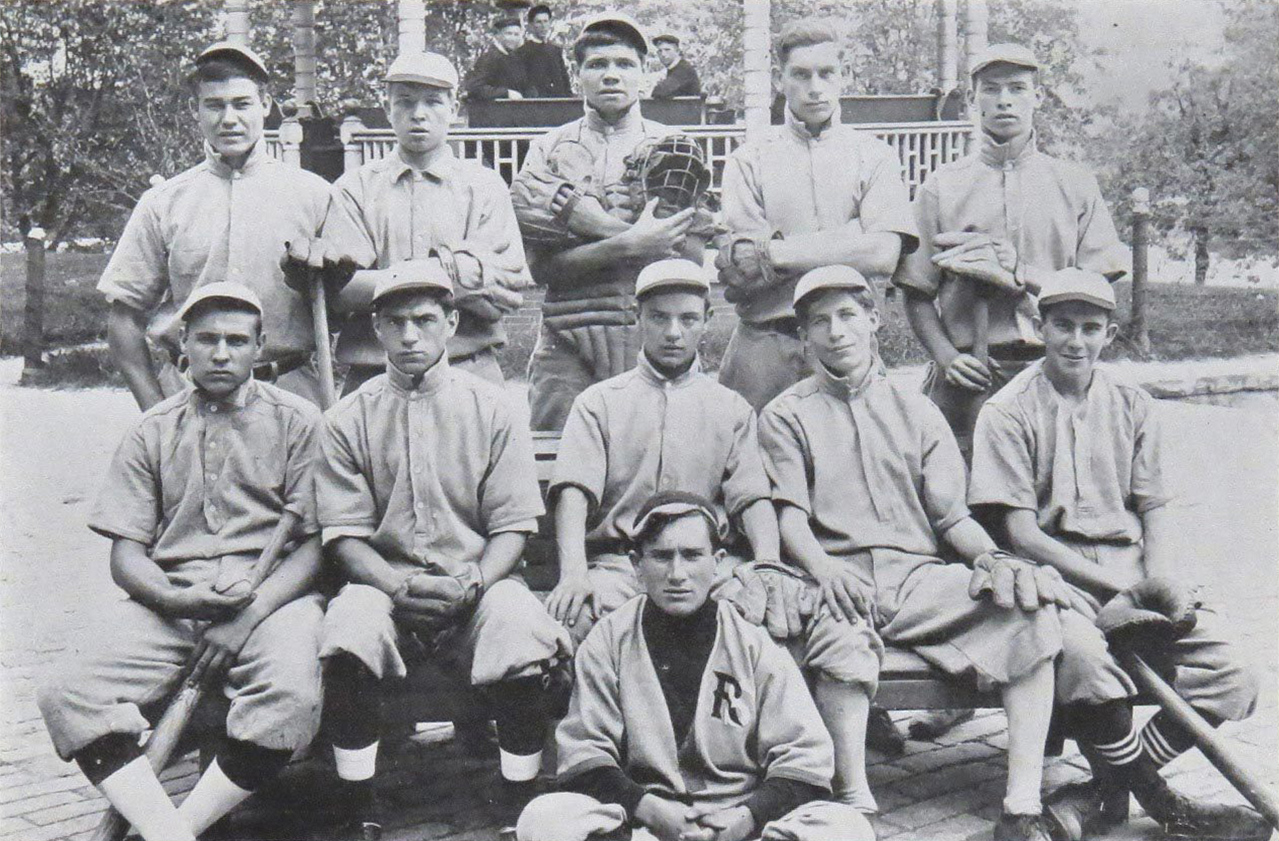
While at St. Mary’s – a reform school/orphanage for wayward boys where Ruth was sent by his family for being “incorrigible” – he began to play as part of a formal school baseball league. He was a star of the league and played catcher – a lefty catcher (a rarity then and now).
Public Domain image. (1913)
Babe Ruth, Catcher. St. Mary’s. Back Row, Center.
He later moved to pitcher and in 1913, his last year at St. Mary’s, according to historian Robert Creamer, he homered in nearly every game he played and was undefeated in every game he pitched.
The Baltimore Orioles Signed Ruth To His First Professional Contract (But, Not Those Orioles)
Yes, the Baltimore Orioles did sign Babe Ruth to his first professional baseball contract in 1914. (His salary: $100 a month.)
But, no, it was not the historic 1890s-era Baltimore Orioles that eventually moved to New York and evolved into the Yankees. (They were long gone by 1914.)
And, no, it wasn’t the current Baltimore Orioles. They have only been in Baltimore since 1954, and were previously the St. Louis Browns.
The Baltimore Orioles that signed Ruth were a minor league team in the International League – a team that was originally based in Montreal.
The Orioles weren’t even the most popular baseball team in Baltimore that year. They played a woeful second fiddle to the Baltimore Terrapins, a Federal League team.
They couldn’t compete with the popular Terps and Ruth was quickly sold to the Boston Red Sox. The next season, those Orioles packed up and headed to Richmond, Virginia.
SDN-061536, Chicago Daily News negatives collection, Chicago History Museum. (1918)
Babe Ruth and two other Orioles were sold to the Red Sox in July 1914 for a reported $25,000.
Baby Ruth Candy Bars Were Not Named For Babe Ruth (Except That They Were)
The Curtiss Candy Company always claimed they named the Baby Ruth bar for Ruth Cleveland, President Grover Cleveland’s daughter who died at age 12 in 1904, which was nearly 20 years before the candy bar even appeared.
More likely is that the Curtiss Candy Company jumped on the Babe Ruth bandwagon, but Ruth Cleveland was a convenient back story that would allow them to avoid paying Babe for his image, likeness, name, and endorsement.
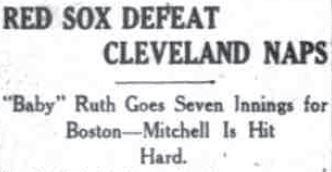
Should you wish to argue that Babe Ruth and Baby Ruth are two completely different names: Reporters of the day would, on occasion, refer to the Babe as “Baby Ruth” and here’s some proof of that.
In the 1990s, Nestlé, which now owns the brand, contracted with the Ruth family to use the Babe’s image in their marketing.
Although, Nestlé seems to have put Baby in the corner these days – Baby Ruths aren’t even listed on their chocolate page. (Aero Bars? They’re horrible.)
A candy bar melted into a brownie? With cream cheese? The Babe would definitely put his name on that!
Ruth Played Where The Sun Don’t Shine
In 1922, Ruth lost a fly ball in the sun while playing left field at New York’s Polo Grounds.
After that, Ruth determined what position he would play from game to game, based on where the sun would shine in the outfield in every stadium – always avoiding the “sun field.”
At the Polo Grounds and in Yankee Stadium, for instance, he would always be in right field. At Boston’s Fenway Park, however, he would forever after play in left.
He didn’t literally build it. He did, however, have basic tailoring skills and while at St. Mary’s briefly worked at a shirt factory. His job was to attach collars and he was paid six cents a collar.
I’m Related To Babe
Seriously. But, not Babe Ruth.
My mom was named Julie at birth, but everyone in the family and most everyone in town knew her as Babe. Her high school yearbook lists her as Babe, too. She was called Babe, she said, because she was the youngest in her family and the youngest in her class.
Sadly, her daughter’s witty jokes about her being named for Babe Ruth or Babe the Blue Ox were wholly unappreciated.
But get this …
In the 1930s, Babe Ruth discovered that he was a year older than he had been told he was, when he had to produce a certified birth certificate in order to get his passport.
In the 1990s, Babe, my mom, discovered that she was a year older than she had been told she was, when she had to produce a certified birth certificate in order to get Social Security.
Ducks On The Pond ~ A baseball phrase referring to runners on base; used primarily when the bases are loaded.
Gypsy Hill is an old Victorian park in Staunton, Virginia. It’s been a park, in some form or another, since the 1890s.
Inside its 200-odd acres today are picnic areas, baseball diamonds, basketball courts, and a football field. But, the most popular spot in the park is the duck pond. The pond attracts both people and ducks.
But, mainly ducks. A whole lot of them. So many that the pond becomes covered with a blanket of ducks, like a real-life down comforter.
Photo: City of Staunton Parks & Recreation
And, when all those ducks get to quacking and elbowing to get the best spots in the water, some unlucky ducks are going to get run over, bullied, or pecked on.
I know, you thought ducks were sweet feathery things that just paddle around all day enjoying the scenery, didn’t you? Yeh, me, too.
But, the pond is like high school, and there are always a few bad seeds and bullies making things miserable for everybody else.
A few nasty ducks are bad enough. But, add in overcrowding and too many people feeding too much bready junk food that sickens ducks, and now you’ve gone from high school to something out of a Quentin Tarantino movie.
Somebody’s going to get hurt.
Not all ducks are bullies.
Although this one definitely was …
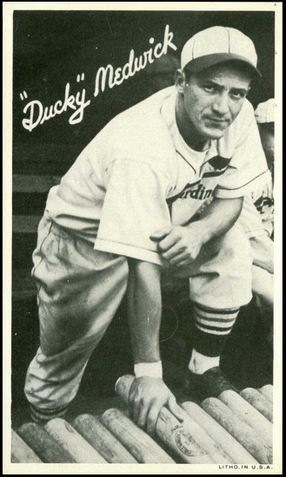
Ducky Medwick ~ A member of the famed 1930s-era Gashouse Gang on the St. Louis Cardinals. He waddled when he walked, hence “Ducky.” A powerful .362 career hitter, he also was powerfully mean and would brawl with other players and his own teammates – during and after games. He won the Triple Crown in 1937 (leading the league in hits, RBIs, and home runs), the last National Leaguer to do so.
These are often smaller ducks who fell in with the bad crowd and paid the price. The Center’s vets and rehabbers clean up their wounds, stitch them back up, and give them a little bit of healing time.
Editor/Husband works at the Wildlife Center of Virginia. And, that’s how two Wildlife Center Mallard Ducks, Patient #14-1373, a male, and Patient #14-1378, a female, ended up at our house on Thursday.
All healed up, they certainly couldn’t go back to Gypsy Hill Park. Our job? Find a comfortable and safe duck-friendly pond for them.
Hey, ducks, welcome to Paradise …
Our friends Michelle and Chris have a lovely pair of ponds at their home. They’ve helped Wildlife Center patients before, allowing a “soft” release for ducks who need a bit of a watchful eye as they ease back into life in the wild, or who might not be able to fly too well anymore due to injuries.
Their ponds are home to 10 assorted ducks and a gaggle of Canada geese. (I just wanted to say gaggle.)
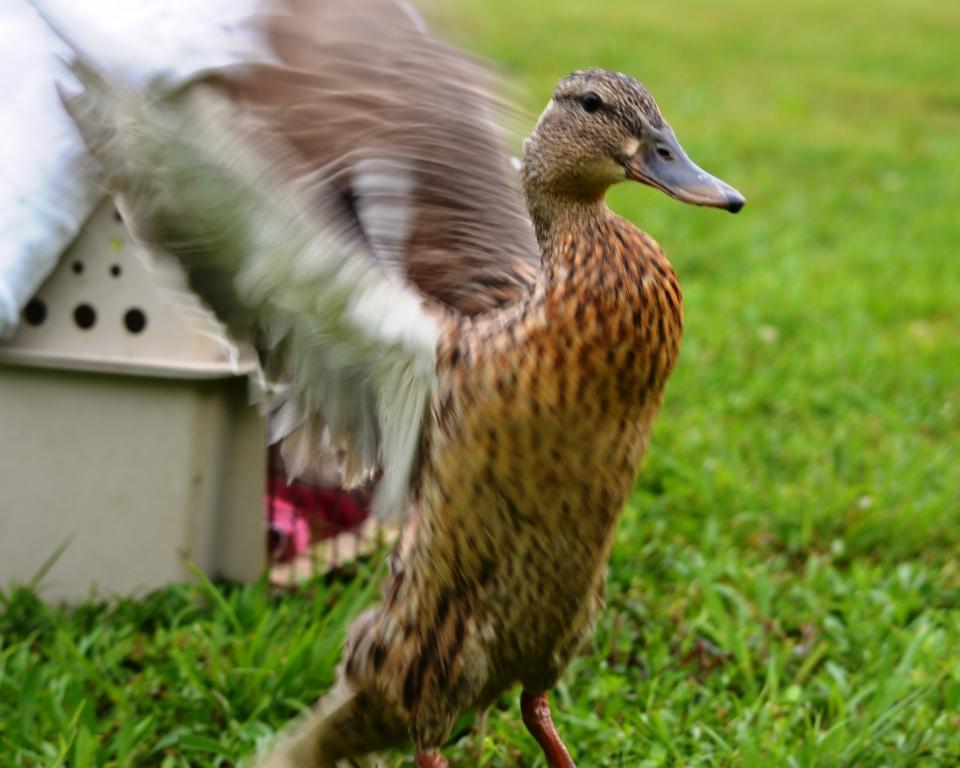
We headed down to one of the ponds and slipped the Gypsy Hill ducks out of their crates.
Hey! No traffic jams!
Yoga stretch …
Just a couple ducks on the pond and plenty of room.
And, no bread, which is terrible for ducks and leads to severe malnourishment. I’m serious. Enough with the bread, people.
UPDATE:
Michelle reports that the ducks are still hanging around on the pond. Although the ducks can fly off whenever they like, really, why would they leave?
Paddle your feet and take a spin around the pond. It’s Paradise, baby.
One of the greatest games in baseball history happened on the Fourth of July.
It really did.
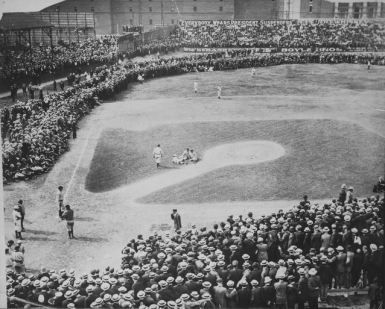
On July 4, 1905, the Philadelphia Athletics and the Boston Americans played a doubleheader at Boston’s Huntington Avenue Grounds.
Doubleheaders, in those days before stadium lights, began bright and early in the morning.
(1910) Public Domain image.
Huntington Avenue Grounds
The A’s took the morning game 5-2. At some point late in the game, the A’s quirky lefty Rube Waddell came in, pitched in relief, and got a couple outs.
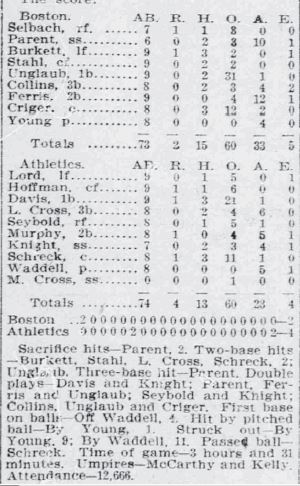
This would be of only passing note, except that Waddell then started the afternoon game. And, pitched a 20-inning complete game. And, won. Beating Cy Young (who also pitched all 20).
Every game your team wins is a great game. But, this really might have been the greatest.
Twenty innings pitched by two of the greatest pitchers ever.
This conversation really happened:
The Baseball Bloggess: “How about that ‘the greatest baseball game on record’ happened on the Fourth of July?”
Editor/Husband: “How about that ‘the greatest baseball game on record’ was 20 innings and was over in three hours and 31 minutes?”
(The average nine-inning game these days – what with all the commercials and instant replay and batting gloves and infield shifting – hovers around the three-hour mark.)
Waddell later estimated that he threw 250 pitches in that single game. Cy Young thought he pitched slightly fewer.
(No one counted in those days.)
“That 20-inning game was the best game I ever pitched,” Waddell said. “But it didn’t take a feather out of me. I felt just as good after the game was over as I did during the contest.”
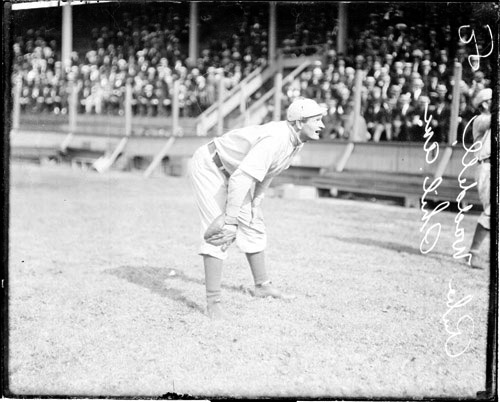
(1909) Permission: SDN-055366, Chicago Daily News negatives collection, Chicago History Museum.
Rube Waddell
“I can’t claim that I did better work than Young,” Waddell said. “I had the luck. … The fact that it was the Fourth of July kept me going, and I guess the shooting of revolvers and the fireworks and the yelling made me pitch better.”
Wait, what? Revolvers?
Fireworks, in the daytime?
Holy crap.
Our great-grandparents were crazy (and dangerous)!
Waddell was nicknamed “Rube” because he was thought to be a little slow, a goofy, country bumpkin. Young was nicknamed “Cy” – for Cyclone – because it was said he threw fastballs so hard they would destroy the wooden grandstand walls.
Waddell loved a good drink and would skip starts to go fishing or wrestle alligators or play street games with neighborhood kids. He could become so distracted on the mound that he would just up and leave. (Fans of other teams suggested that holding a puppy up at a game would distract Waddell from his work.)
But, his pitching itself, including a powerful fastball and deceptive curve, reflected a focus and control that he lacked in other aspects of his life. On at least one occasion, he was so “on” that he shooed his outfielders out of the game and proceeded to strike out the side.
(1908) Permission: Library of Congress Prints and Photographs Division #LC-USZ62-77897 DLC
Cy Young
Cy Young was far less colorful, except when he pitched. He threw the first perfect game of the modern era (against, wouldn’t you know it, the A’s and Waddell in 1904) and won 511 career games, the most by any pitcher ever, which is why pitchers today vie for the Cy Young award and not the Rube Waddell award.
Here’s your 20-second 20-inning recap of that Fourth of July game.
The Americans went up 2-0 in the first. The A’s tied it up with a two-run home run in the sixth. Then, for the next 13 innings, nothing.
Finally, sometime before dark, in the 20th inning, Boston – and Young – faltered. A couple Boston errors, and a batter hit by pitch, allowed the A’s to cobble together two runs, and a victory.
Despite the loss, it was, Young said, “the greatest game of ball I ever took part in.”
The glove Waddell used that day is in the National Baseball Hall of Fame.
Their combined 20-inning complete game was a pitching record that stood – for one season. In 1906, the A’s and Americans met again at Huntington Grounds. This time the A’s Jack Coombs and the Americans’ Joe Harris combined for a 24-inning complete game. (The A’s won that one, too.)
The Philadelphia A’s moved to Kansas City in 1955 and Oakland in 1968. They are currently 52-33, the best record in baseball.
The Boston Americans are now called the Red Sox. They are currently 38-47. Their Fourth of July game today with the Baltimore Orioles has been rained out. Doubleheader tomorrow!
Oh, hey … one more thing!
Waddell went 0-for-8 at the plate in that 1905 game. Only one other player has gone 0-for-8 in a game AND gotten the win. And, it was against Boston, too.
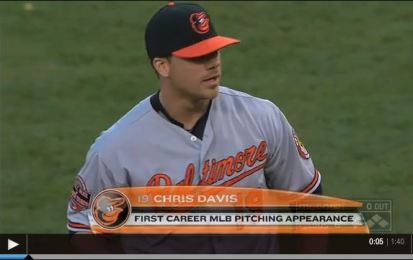
The Orioles’ Chris Davis, the designated hitter, was moved to pitcher at the end of a 17-inning game against the Red Sox in May 2012 when the team ran out of available pitchers. He hadn’t ever pitched in the big leagues before. He pitched two scoreless innings. He got the win. He hasn’t pitched since.
(Editor/Husband would want me to tell you this: That 2012 O’s – Red Sox game? It took six hours.)
“I simply wanted to play the game that I loved.” ~ Kay “Tubby” Johnston Massar, the first girl to play Little League baseball, 1950.
Watch this stupid scene from an otherwise pretty good movie.
“There’s no crying in baseball.”
It’s a big lie and, if you have ever loved baseball … and loved a team … you’ve cried. If nothing else, you’ve sniffled a little (swallowed hard and wiped your nose on your shirt), which you might say is not crying, but, trust me, it is.
If you’ve never cried at least once when your team has let you down (see: Orioles, Cubs), or cried with joy when your team wins a World Series (see: Red Sox, Yankees, etc etc), or with despair when your team ruined your evening by squandering a perfectly adequate – and rare – five-hit, two-run performance by your struggling starter and then losing to one of the worst teams in baseball (see: Orioles, again), you really don’t love baseball, so stop saying you do.
So, when Kay Johnston Massar told me that when she was a young girl growing up in Corning, New York she cried as she watched her brother go off to play Little League, I understood.
If you love a game as much as she did – and still does – you would cry, too, if you were left behind.
But, this is not a story about crying.
courtesy of Kay Johnston Massar
Massar’s mother saw a notice in the paper that there was another Little League tryout coming up.
It was 1950, though, and girls did not play Little League baseball. Leastways, no one had ever done it before.
So, Massar had her mom cut off her braids, pushed what was left of her hair up under a ball cap, took her sister’s bike, and pedaled off to tryouts.
Her father had taught her to play and love the game. She played sandlot games with her brother Tom and his friends. She was good.
“I’m going to make the team,” she promised her mom. “I bet you will,” her mom replied.
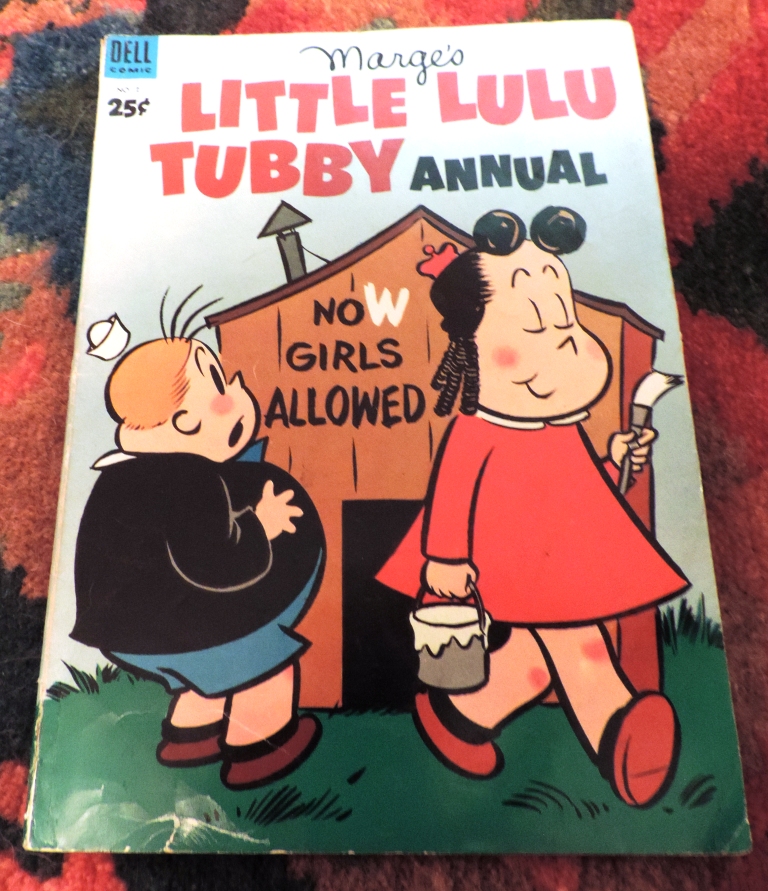
Before she left, her mom suggested she change her name so no one would know she was a girl. Kay became “Tubby”, after the loyal best friend in the Little Lulu comics.
Tubby’s story might have faded away, except for one important thing.
She made the team.
courtesy of Kay Johnston Massar
“Tubby” Johnston was the first girl to play Little League baseball.
Some of you and your googling will try to tell me I’m wrong. You’ll say Maria Pepe was the first. No. Although her lawsuit in the early 1970s opened the door for all girls to play. Some of you will argue for Janine Cinseruli. No. Although she was the first girl to play a full season post-lawsuit in 1974.
Some of you will say, “Girls don’t play baseball.” Now, you’re just being disruptive. (Here. Read this. Then you can come back and read the rest of this post.)
Back to Tubby Johnston.
“When I tried out for Little League baseball I was not trying to be a beacon for women’s rights,” Massar says. “I simply wanted to play the game that I loved.”
Corning, New York wasn’t just any Little League town in 1950 either. Corning had made it to the semifinals of the Little League World Series in 1949 and the quarter-finals in 1948.
Not every kid who tried out got to play in Corning. Corning was tough. You had to earn your way in.
Tubby Johnston was tough too. And, she earned her way in.
Soon after being assigned to play first base for the King’s Dairy team, she told her coach the truth – he had a 14-year-old girl on his Little League squad.
The coach decided that there were no written rules at the time that specifically prohibited a girl from playing. And, if Tubby was good enough to make the team, she was good enough to play.
She played first base all season – she could hit, she could field. (When she finally got a proper first baseman’s glove of her own she slept with it. “I loved the smell of the leather,” she told me.)
When her teammates were told that Tubby, their first baseman, was actually a girl named Kay, they accepted her, she says. “They said, ‘Well, she plays as well as we do.’” And, then she adds, “Actually, I was better.”
But, they never did call her Kay. She was always “Tubby.”
Adults, on the other hand, could be cruel.
When the news broke that a girl was playing Little League in Corning, the fans turned out to watch. Many cheered, but many adults would jeer at her from the stands, call her names, or come right up to her and tell her she was a “freak” for playing baseball with boys.
“I didn’t let it bother me, I didn’t want to raise a commotion or squeal about it,” Massar says. “I didn’t want to get kicked off the team.”
(I told you she was tough.)
King’s Dairy was a prestigious team, highly prized by Little Leaguers, not only because they won a lot, but because after games the coach would take the kids to the dairy store and treat them to banana splits and milkshakes.
That 1950 season was Tubby’s first and last in Little League. After the season, Little League passed the “Tubby Rule” which stated in full:
“Girls Are Not Eligible Under Any Conditions.”
The rule stood until it was overturned in the courts in 1974.
By then, however, most girls were playing softball. That trend pretty much continues. Last year, just one girl played at the Little League Baseball World Series – Eliska Stejskalova, from the Czech Republic, who played for the Europe-Africa Team.
(In 2005, Katie Brownell, the only girl playing Little League baseball in Oakfield, NY, pitched a perfect six-inning Little League game – 18 up, 18 down. All strike outs.)
After Little League, Massar played a few years of softball herself, before getting on with things, becoming a nurse, getting married, having a family.
She was a tough softball player, too. Once, while sliding into second, she dislocated her shoulder. While coaches were trying to hustle her off to the hospital she was busy arguing with the umpire that she should have been called safe.
And, she almost got herself into a football game. Not long after her Little League season, she dressed in her brother’s football uniform one day when he was sick, put on his helmet, and tried to take his spot on the field. A fellow player ratted her out to the coach, however. “The coach ran out on the field shouting ‘Stop, Kay! Stop, Kay!’ or I would have been the first girl to play football, too.”
She still loves baseball. Her father was a lifelong Yankees fan, and she carries on the pinstripe tradition. (Derek Jeter is her #1. And, yes, she’s heartbroken that Robinson Cano, “the best second baseman in the game,” has left the Yanks for the Mariners.)
Today, she lives in Yuba City, California and gets to local college games and to an occasional Oakland A’s game each season.
“My dream as a child was to play first base for the Yankees, but I am still waiting to be called up,” Massar said and then asked, “Do you think that it is too late?”
Massar is 78 this year. She was joking.
I think.
She threw out the first pitch at Yankee Stadium in 2006. (“I one-hopped it to [Jorge] Posada,” she admits.)
And, at an Oakland A’s game in 2010.
Come on, San Francisco Giants! Massar is near you. Why not let her throw one out at AT&T Park this season?
She is featured in a new film commemorating the 75th anniversary of Little League which will air on PBS in June.
Oh, and hey, just one more thing.
Sports Illustrated has written about Massar a couple times, most recently in 2011. In that article, the writer suggested that Massar would trip runners as they rounded first base.
Massar would like to clear that up.
She was tough, but she didn’t routinely trip players. She wasn’t a cheater.
But, she did trip one.
“He pushed me down because I was a girl. So, the next time around I tripped him.”
That “kid” is now in his 70s, and he saw the Sports Illustrated story. He tracked down a mutual schoolfriend. “He said, ‘Tell her I’m sorry,’” Massar said, “So I finally got an apology.”
courtesy of Kay Johnston Massar
“I got to do a great thing. I got to play the game I loved.”
(Thank you to Kay Johnston Massar, who still loves baseball.)
“Once a woman becomes a (baseball) fan, she is the best fan in the world.” ~ Bill Veeck, Baseball Team Owner, Promoter & Innovator
Postcard, circa 1910.
This is my 100th post on this blog.
(I know, really, crazy isn’t it? I sure do type a lot.)
And, here’s Stevie’s 20th random appearance!
hi.
I like to think that my parents named me for Jackie Robinson, although I know they didn’t.
I wasn’t named for Jackie Mitchell either, but that would have been nice, too. I’m pretty certain that my parents had never heard of Jackie Mitchell which is a shame.
(You haven’t either? Sigh.)
In 1931, Mitchell was the first woman to get a professional minor league baseball contract, signing with the Double A Chattanooga Lookouts. She had one good pitch – a sinking curveball that broadcasters today would probably call “filthy.”
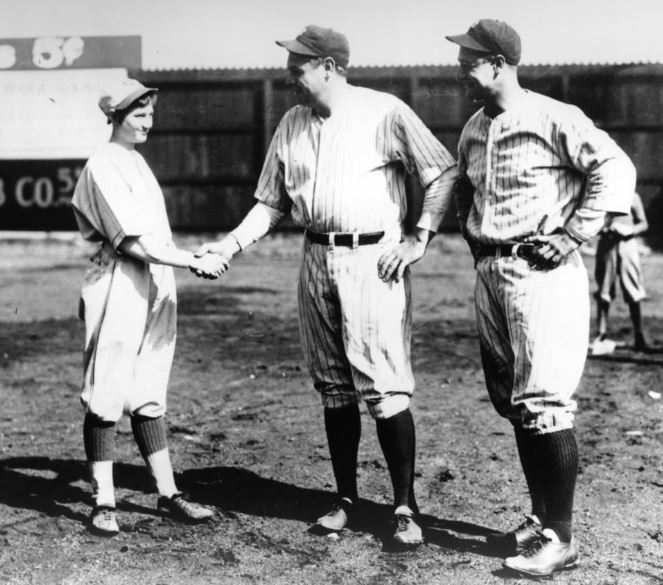
In a 1931 exhibition game against the Yankees, Mitchell, just 18 years old, struck out Babe Ruth and Lou Gehrig on just seven pitches. (Ruth threw his bat, grumbled angrily, and had to be led back to the dugout by teammates.)
Jackie Mitchell, Babe Ruth, & Lou Gehrig. April 1931. ~ public domain image
Some argue that Ruth and Gehrig struck out on purpose that day, just for a gag. But, some big boy egos must have been bruised because just a few days later Baseball Commissioner Kenesaw Mountain Landis voided Mitchell’s contract because baseball was “too strenuous” for women, particularly those with nasty curveballs.
Some of my favorite baseball “guys” are girls.
And, since this is blog post #100, I was going to list 100 of them for you. (Cute, right?) But, Editor/Husband got overwhelmed by my loving and long list of names and suggested that I mention just a few instead. (Killjoy.)
Jennie Finch did the very same thing in 2004. (You should hear the excuses people made for Barry Bonds and Albert Pujols who were “struck out by a girl.” Actually, they were the very same “they struck out on purpose” excuses made for Ruth and Gehrig decades earlier. But, Pujols admits, she blew the ball by him.)
Lizzie “Spike” Murphy. ~ public domain image
Lizzie “Spike” Murphyplayed with, and against, men in countless semipro, barnstorming, and exhibition games between 1918 and 1935.
Even the great pitcher Satchel Paige couldn’t get her out (she singled) and she played with some of the era’s greatest male players as a member of American League and National League All-Star teams in games against the Boston Red Sox and the Boston (now Atlanta) Braves.
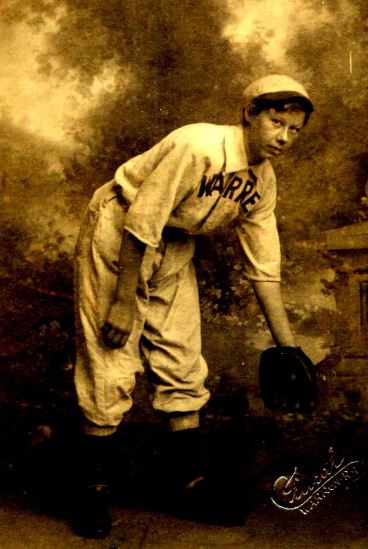
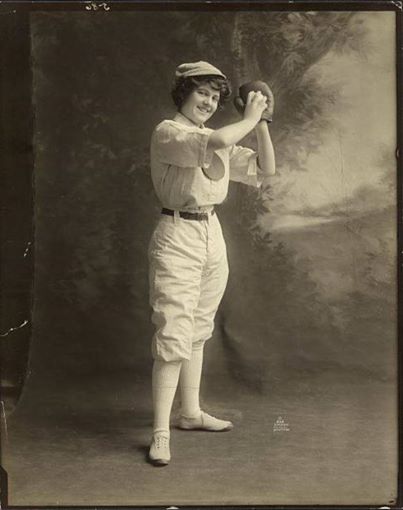
Hundreds of “Bloomer Girls” teams prowled the country from the 1890s through the early 1930s taking on whatever men’s local, semipro, or minor league teams they could find.
Bloomer Girl, 1913. ~ public domain image, Library of Congress
They were followed by the All-American Girls Professional Baseball League (1943-1954). And, many women of color, denied a place on still-segregated All-American Girls’ teams, played alongside men in the Negro Leagues.
Kay “Tubby” Johnston, Little Leaguer. 1950 ~ courtesy of Kay Johnston Massar
Kay “Tubby” Johnston Massar disguised herself as a boy so she could play Little League in Corning, New York in 1950.
(I’ve written more about “Tubby” Johnston and her Little League season here.)
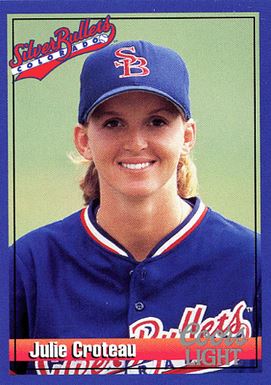
In the late 1980s and 1990s, Virginian Julie Croteauplayed men’s NCAA baseball and later coached NCAA men’s baseball teams, including at Division I University of Massachusetts, and had a long career at the semipro level. She is also one of only two women to play in Major League Winter League ball.
In 1998, pitcher Ila Borders became the first woman to win a minor league game during the modern era (with the independent league Duluth Dukes).
There are other amazing trailblazers, too. So many. Many played against men. Others broke barriers as umpires, trainers, front office executives, announcers, and reporters.
I’m just a fan.
But, we fans need our role models, too.
So, let me tip my fan-cap to the most famous “unknown” woman in baseball … “baseball mad” Katie Casey, a fan whose love of the game back in 1908 is recounted during nearly every seventh-inning stretch in the song “Take Me Out To The Ballgame.”
If Katie were around today, she’d love great plays at third, a well-stocked bullpen, three-run homers, and the AL East. She’d never waste an out on a bunt. And, she’d have her own blog. I just know it.
* * *
Postscript: It took me a couple weeks to pare this post down to highlight just a few women, eliminating what hatchet-man Editor/Husband called the “blah, blah, blah.” I cut even more on Thursday night … painstakingly deleting fascinating stories, amazing people, and prose that, I’m sure, would have made Grantland Rice jealous.
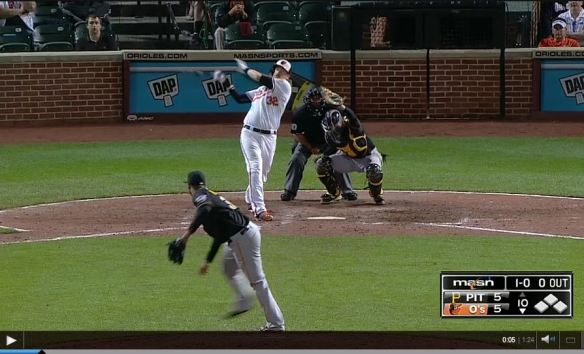
As I did this, the Baltimore Orioles were playing the second game of a double header against the Pittsburgh Pirates. I watched, I chopped, I watched, I rewrote. Top of the first, Orioles’ ace Chris Tillman loads the bases … walks in a run … walks in another. He threw 49 pitches in just that one half inning.
Hair-pulling time.
Then he settled down. And, then this post was done. And, then, it’s four hours later and this happens …
In 1903, the Boston Americans won baseball’s very first World Series.
I know, I know – the “Americans” won America’s “World” Series. How not-very-worldly of us.
(The Boston Americans, by the way, included Cy Young, the winningest pitcher in the history of baseball. They would occasionally take spring training in Charlottesville, Virginia – just down the road from me. In 1908, they started calling themselves the Red Sox and are known today for their generous facial hair.)
The Boston Americans (front row) defeated the Pittsburgh Pirates (back row) in the nine-game 1903 World Series. ~ public domain image
My Canadian friend Susie (hi Susie!) always reminds me that Canada “invented” baseball. And, while that’s not exactly true, it is not exactly untrue either, and it’s quite a bit truer than Abner Doubleday’s claim, which isn’t true at all.
But, what is true is that Jackie Robinson’s first professional integrated regular season games were played with the Montreal Royals, the Brooklyn Dodgers’ farm club. And, what is also true is that Robinson called Montreal one of his favorite places because the people there were “warm and wonderful” and treated the Robinson family with respect.
So maybe “World” Series is a bit of a stretch. But, at least the world plays baseball.
You want to talk about a stretch, how about calling the Winter Olympics the world’s games, when nearly half of the world’s population lives in countries that are snow free?
Baseball is nearly everywhere today.
And, while there is no baseball in Antarctica, there arepenguins and you can click here to play baseball with them.
Every other continent, not covered by an ice sheet, will have a baseball game going on in some field, or village, or town, or city, somewhere. And, the best of those players might get a chance in the big leagues.
Just look at the free-agent multi-multi-million-dollar signings in recent months – Robinson Cano (Dominican Republic), Masahiro Tanaka (Japan), Shin-Soo Choo (South Korea).
The 2014 baseball season began this weekend in Australia when the Los Angeles Dodgers and Arizona Diamondbacks kicked off their first game at 4 a.m. EDT on Saturday.
I am an insanely passionate baseball fan. But, I did not get up to watch. The Orioles will play 162 regular season games in 2014, and I will try to watch them all (except when they’re on the West Coast playing and I’m on the East Coast sleeping).
There will be plenty of baseball that doesn’t require a 4 a.m. pot of coffee.
Clayton Kershaw, sometime around 4 a.m. EDT on Saturday.
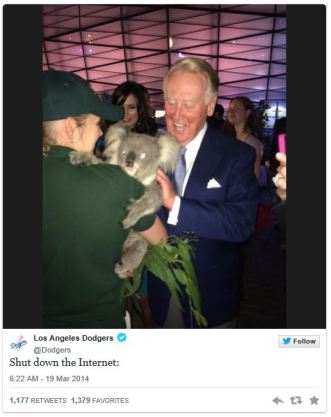
Here’s legendary Dodgers’ broadcaster Vin Scully with a koala bear.
The two games this weekend were held at the Sydney Cricket Ground that was reconfigured for baseball. The New York Giants and Chicago White Sox played an exhibition game there way back in 1914.
One of the fellas at the MLB channel called the Cricket Ground a mix of World Cup and Wimbledon.
I love baseball’s international spirit. I love that players come from all over, and a team may have two or three translators hanging around the dugout to help everyone communicate.
Players from Japan and the Dominican Republic and Cuba are some of the best players in major league ball today.
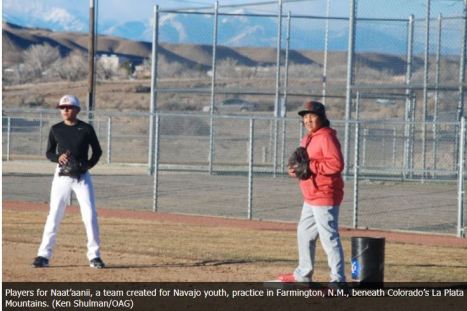
But, baseball also thrives closer to home in Indian Nation.
This season, the Class A Spokane Indianswill honor the tribes of the Pacific Northwest by wearing the Native American Salish language on their jerseys.
Spokane, in Salish, looks a bit like a cat just ran over the keyboard, or something like this:
Sp’q’n’i
(I must have one!)
(I think Sp’q’n’i is about to make my spell-checker explode.)
Baseball season is finally here. You know what to do.










 On July 11, 1914, George Herman Ruth played his first major league game. He had recently joined the Boston Red Sox and was already known as “Babe”.






















 The Baseball Bloggess