During the World Series, Francisco Lindor of the Cleveland Indians stole a base, and, because of that, Taco Bell promised everyone in America – all 319 million of us – a free taco.
(That’s 54-billion delicious taco calories!)
When @POTUS is in on it, you know it’s a big deal.
When a ballplayer’s career in the majors is brief – just a game or two – he is said to have had just “a cup of coffee” in the big leagues.
So, if your time in the town where you were born was brief, does it become your “cup of coffee” hometown?
Clay Bryant had more than a “cup of coffee” with the Chicago Cubs.
The right-handed fastball pitcher spent about six seasons with the Cubs – from 1935 through 1940 – including their pennant-winning and World Series-losing 1938 season.
It’s his birthplace that’s the cup of coffee in this story.
Bryant was born in 1911 in Madison Heights, Virginia.
He wasn’t there long. Maybe a year – or a couple of years at most – before the family moved to Birmingham, Alabama, where his father found work as a pipe fitter. And, that’s where they stayed.
But, being born in Virginia, cup of coffee or not, gets you on my Virginia-Born Project list, even if everyone in baseball forever knows you as “the big, curly-headed kid from Alabama.”
Bryant dropped out of high school when he was 16, and left Birmingham to work his way through the minors. He was called up and played a few games for the Cubs in 1935, and settled there in 1936, where he played until his arm finally gave out in 1940.
Cubs fans who know their history remember Bryant for just one season – 1938.
~ Franklin Pierce Adams, New York Evening Mail, 1910
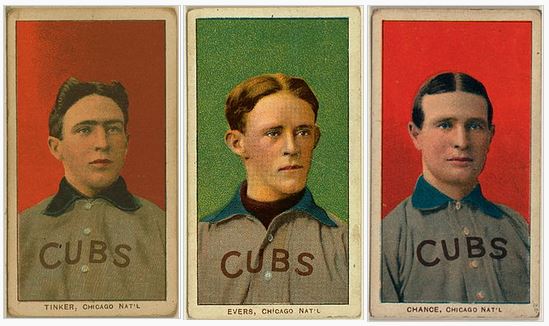
In 1908, it was the infield of Joe Tinker, Johnny Evers, and Frank Chance – shortstop, second base, first base – who helped carry their Chicago Cubs to a World Series victory.
They weren’t the greatest double-play makers in history, but they sure make a good poem, don’t they?
And, they helped lead those 1908 Cubs to the Series.
You know what happens next. It takes 108 years before the Cubs win another World Series. Which they did just two weeks ago.
Which is what I should be writing about. Because Chicago put on a celebration that was beautiful and exciting and embraced us all.
I often tell my friends that part of my love of baseball is how it – and its long, rich history – reflect us. Both good and bad. Our society, our culture. Who we are. Baseball is us.
Elkton, Virginia is the halfway point between where you are now and where you want to be.
It is snugged tight between the Blue Ridge Mountains on its east side and the Massanutten Mountains on its west side.
It is halfway between here … and there.
It’s an anonymous town. The town you pass through, but where you never stop unless you need gas, a snack, or a bathroom.
All my friends around here tell me they’ve been to Elkton. But, when pressed, I discover they mean they’ve been through Elkton, or driven past Elkton, or they’ve stopped out on the highway at the Dairy Queen, but they’ve never actually been to it.
Garland Shifflett, who pitched in the majors, but mostly the minors, from the 1950s into the 1970s, was born in Elkton in 1935.
The Los Angeles Times once profiled him on their front page.
His major league career was brief, just 16 games. A few games in 1957, a few more in 1964. But, his minor league career, over 16 seasons, was much longer and richer.
But, there he is on the front page of the Los Angeles Times in the spring of 1972. Next to stories about the Hanoi Offensive, an indicted New Jersey Congressman, and President Nixon’s doctor’s enthusiasm for acupuncture.
Top of the fold. A story about Garland Shifflett and his long career in the minors.
“Anonymous Man.”
A front-page profile in the Los Angeles Times about a player I didn’t know should have made this story simple. Instead, it has bothered me for a couple weeks now. Ever since I found it and ever since we made our visit to Elkton.
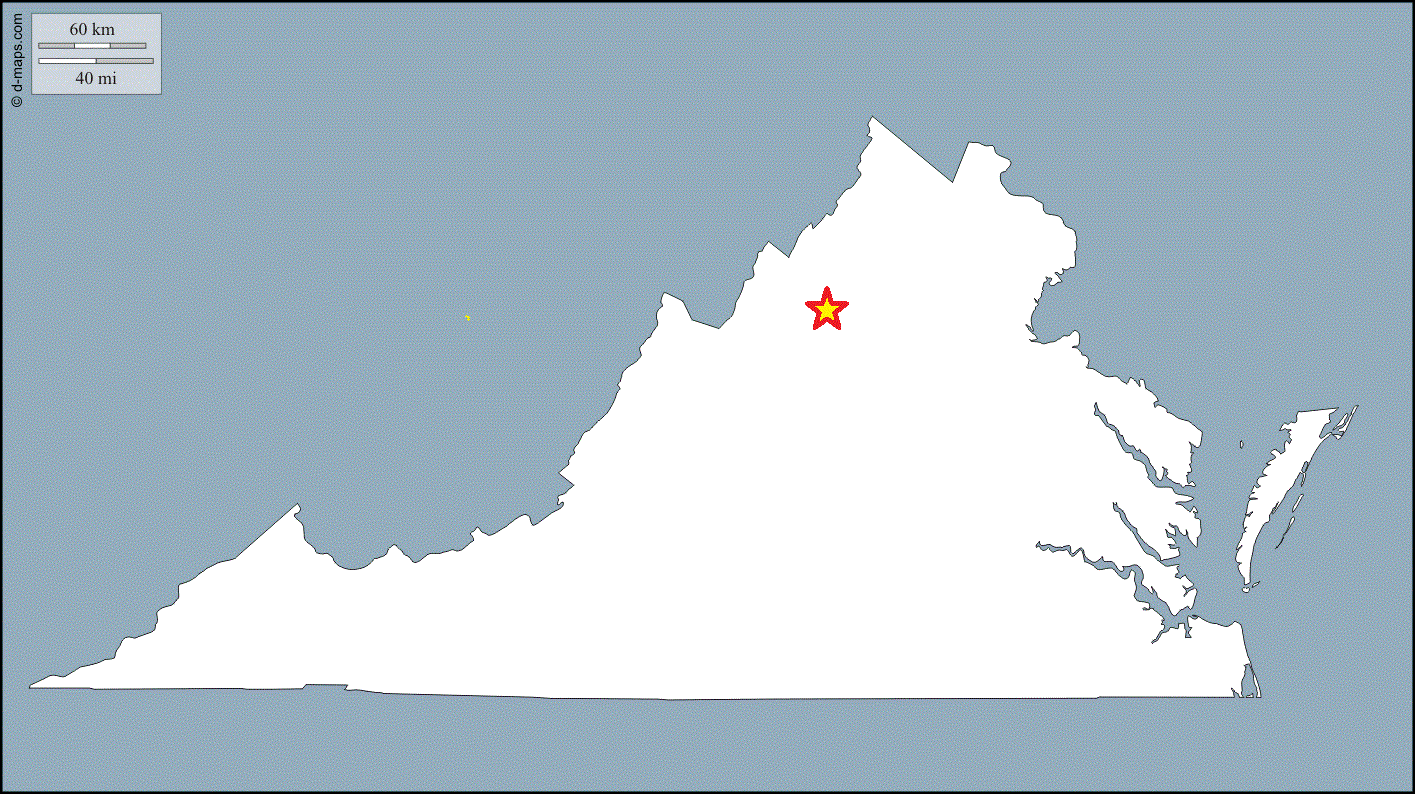
In 1903, a mail train departing from Monroe, Virginia derailed 80 miles away in Danville.
Monroe, Virginia
This may not be something you know anything about. But, it was one of Virginia’s worst train crashes and is retold in the old country song, “The Wreck of the Old 97” that Johnny Cash once covered.
The derailment, the result of excessive speed and trying to keep the train and the mail on schedule, killed 11.
That pretty much sums up all I knew about Monroe. (And, to be fair, even that is mostly about Danville and when we get to Danville on this Virginia-Born Project, I’m sure you’ll hear about it again.)
That train wreck 80 miles away may be all anyone knows about Monroe, Virginia, because, if you set your GPS to Monroe, it will lead you off Business Route 29 and to an empty and desolate rail yard.
(You’re going to have imagine some train tracks running through a spooky, empty field. Editor/Husband told me to take a photo of the tracks. I said we didn’t need to bother because I was sure that we would find something better to show Monroe. I should listen more to Editor/Husband.)
When cities start to sprawl, the one-time little towns that were out on the edges start to dissolve or just get absorbed into a ghostly kind of suburbia. Who needs a grocery store when the big city, in this case Lynchburg, is just 10 minutes away?
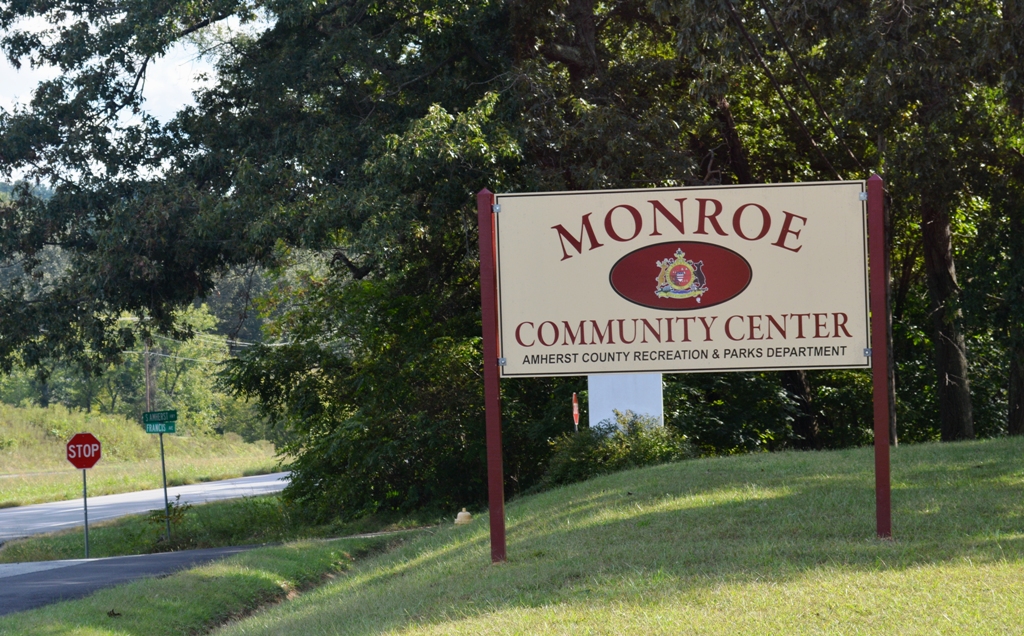
We found railroad tracks, houses, churches, and a community center.
In case the GPS was lying, this sign is the only proof that we actually visited Monroe.
Monroe seems to be split today by Route 29, the four-lane highway that will take you south to Lynchburg in just a few minutes, or Charlottesville, about an hour north. Houses cluster on both sides of the highway.
Editor/Husband: “There’s a lot of Monroe, and there’s not a lot of Monroe.”
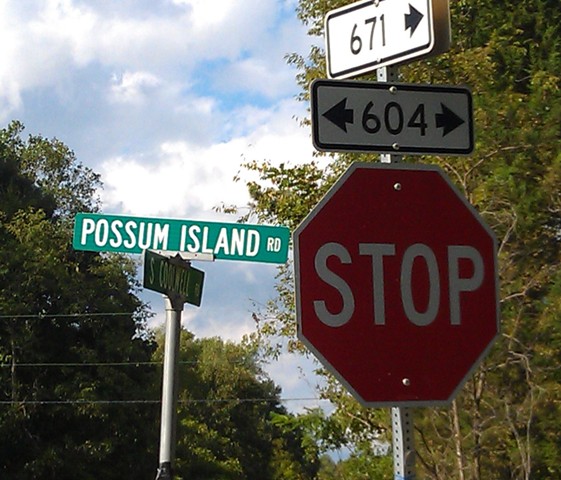
While an island filled with possums sounds delightful, this sign was just a cruel tease. We saw no possums or island on this road.
Monroe was also the birthplace of Ken Dixon, who was born there in 1960 and pitched for the Baltimore Orioles between 1984 and 1987.
Somewhat unrandomly, I’ve ended up in a little town just 25 minutes away from our house – a place I’ve been to scads of times.
Not exactly out seeing the unseen world, but you gotta start somewhere.
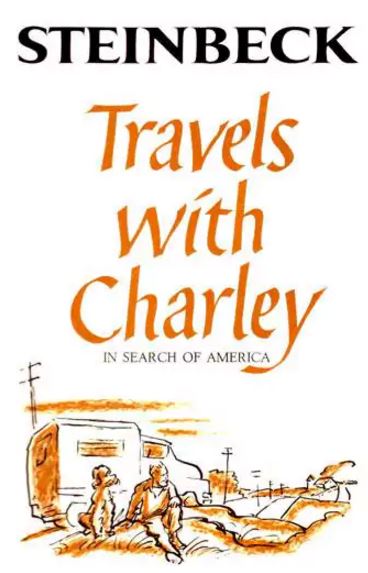
What were you expecting, John Steinbeck? (Steinbeck made up a lot of Travels with Charley, you know. He said he listened to the Yankees-Pirates World Series while driving around with his dog in the fall of 1960, but now I’m not even sure that’s true. In any event, I’m not making up any part of my trip to Gordonsville, Virginia.)
Eliot didn’t mean baseball. If he had he would have said August.
But, Eliot was a baseball fan and, it’s said, his heart was broken when his team, the Red Sox, sold Babe Ruth to the Yankees in 1919.
So, yeh, he knew cruel.
(Hemingway once slammed Eliot’s writing by telling a friend that Eliot “never hit a ball out of the infield in his life.” Also cruel.)
The Baltimore Orioles are slowly tumbling down the AL East ladder.
They’ve been looking increasingly listless and pitiful, like a ratty old tomcat trying to hack out a hairball. So much hacking and all that comes out is a desperate, sad noise that sounds, best I can translate, something like, “Ggggackuck [brief pause] Aahkgggackuck [longer pause] geeeeeeack.” Then he stops, swallows, shakes his head, and starts all over again.
I mean, you still love that ratty old tomcat, sure, but mainly you’re just hoping you’re not the one who’s going to get stuck cleaning up whatever is trying so hard to come out.
It is 100 here again today. It is hot and humid and sticky. It is miserable.
If it is not 100 degrees where you are, I am both happy for you and a little annoyed that you deserve better weather than me.
There is baseball this afternoon in Richmond – minor league ball – and in younger times we would go.
But, not today. Not when it’s 100. Because these are not younger times and age slows you down. Age tires you out. And, age protects you from doing stupid things like going to a baseball game when it is 100 degrees outside.
Because 100 is a lot of anything.
Dennis Eckersley threw 100 complete games in his career. Which is strange because I’m of the generation that remembers him mainly as a shaggy-headed closer.
“Finding good players is easy. Getting them to play as a team is another story.” ~ Casey Stengel
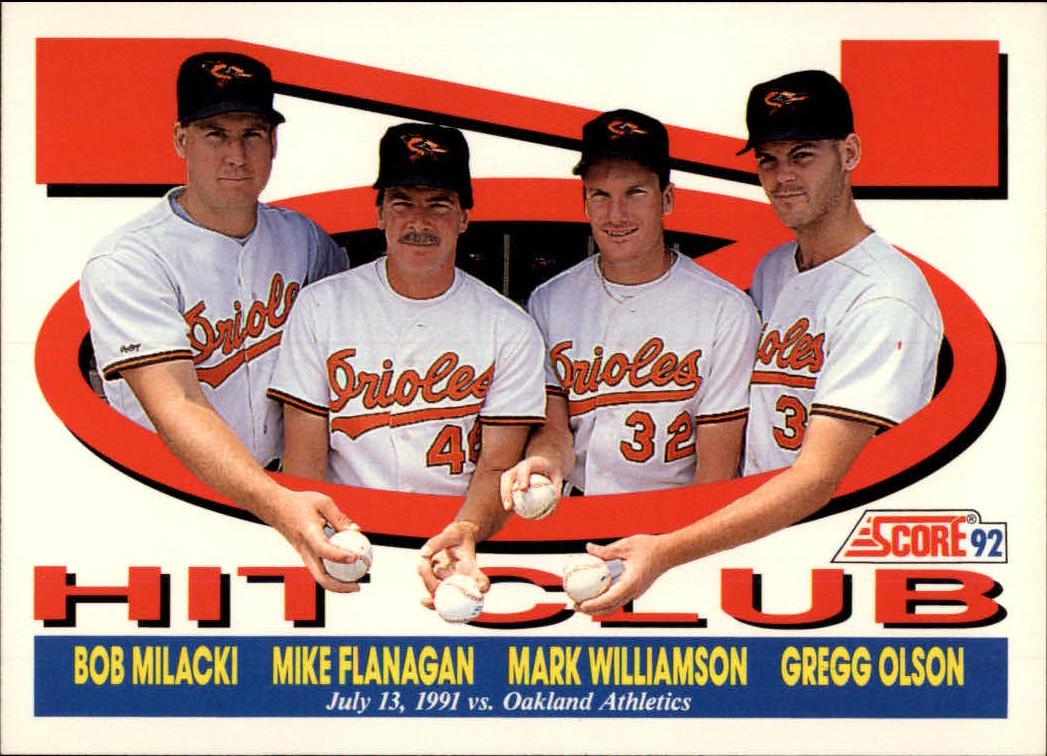
On July 13, 1991, in a game in Oakland versus the A’s, Baltimore Orioles starting pitcher Bob Milacki threw a no-hitter.
So did Orioles reliever Mike Flanagan.
And, so did Orioles relievers Mark Williamson and Gregg Olson.
It was a four-pitcher no-hitter.
Not unheard of, but kind of rare.
In a game that prides itself on the power of teamwork, there’s an awful lot of focus on individual performance in baseball.
So, you may sniff a bit and say, “Hmm, four pitchers to get through a game? That’s no big deal.”
But, you’re wrong.
No hit is no hit. And, the A’s, including Jose Canseco, Harold Baines, Mark McGwire, and a young Mike Bordick, no hit that day.
(Baines and Bordick went on to play for the Orioles, and Bordick is, today, a color guy for Orioles games on television.)
Sure, there are a few of you Giants and Dodgers fans who are so used to no-hitters that you’re a bit surprised to learn that one team has never even had one.
(Sorry, San Diego Padres … it’s still you.)
Seven pitchers had no-hitters last season – five came after the All-Star Break.
Just one this season so far. (Congratulations, former Oriole, reigning Cy Young, and current Cub Jake Arrieta!)
But, see! Even I have wandered off into the land of individual excellence and in less than 200 words, I’ve abandoned those four Orioles pitchers – including two (Milacki and Williamson) that even seasoned Orioles fans don’t really remember – and this is supposed to be about them.
Since becoming the Baltimore Orioles in 1954, there have been only five Orioles no-hitters.
Hoyt Wilhelm versus the Yankees in 1958.
Steve Barber and Stu Miller versus the Tigers in 1967.
Tom Phoebus versus the Red Sox in 1968.
Jim Palmer versus the A’s in 1969.
And, Milacki, Flanny, Williamson, and Olson 25 years ago this past week.
(For the cruel readers out there – and I know some of you by name – I know what you’re asking, so here … the Orioles have been on the receiving end of a no-hitter seven times, most recently last season.)
13 Jul 1991: Pitcher Greg Olson of the Baltimore Orioles prepares to throw the ball as the scoreboard behind him shows that he has pitched a no-hitter during a game against the Oakland Athletics. (Getty Images)
See, even Getty Images can’t get the game straight. Olson threw one no-hit inning. Milacki threw six. Flanny and Williamson, one each.
(Oh, and it’s Gregg Olson, not Greg Olson.)
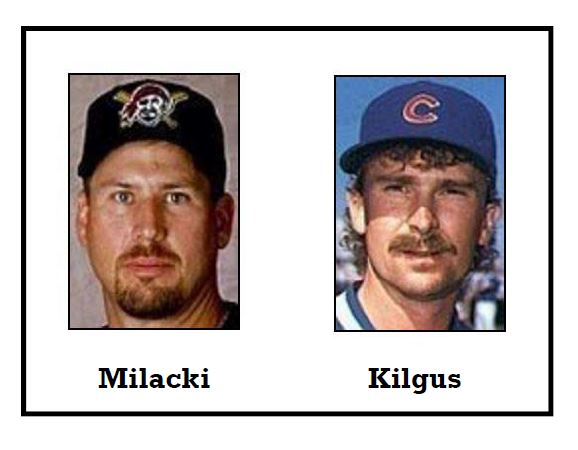
Embed from Getty Images BALTIMORE, MD – CIRCA 1991: (L-R) Paul Kilgus #17, Mike Flanagan #46, Mark Williamson #32 and Gregg Olson #30 of the Baltimore Orioles pose together for this portrait prior to the start of a Major League Baseball game circa 1991 at Memorial Stadium in Baltimore, Maryland. (Getty Images)
Oh, for crying out loud. That’s Bob Milacki on the left, not Paul Kilgus.
Come on people, how hard can it be? These four pitchers threw a combined no-hitter!
(Kilgus did, indeed, pitch briefly for the Orioles in 1991, but I had to look that up to make sure. Fun Fact: he looks nothing like Bob Milacki.)
Milacki was cruising through six when he was hit on the hand by a comebacker.
That might have done in both Milacki and the no-hitter. But, the ball ricocheted off his hand and bounced right to first baseman Randy Milligan for the out.
Milacki’s day was done. Although bruised and swelling, his hand wasn’t badly injured, and he argued to stay in the game, to no avail.
“I thought I could still pitch with it,” he said afterwards. “They didn’t want me to risk it. I was very disappointed. You never want to come out of a game like that.”
The Orioles scored just two runs – catcher Chris Hoiles batted in beloved utility guy Chito Martinez in the fifth and outfielder Mike Devereaux homered in the sixth.
Flanagan, Williamson, and Olson each pitched one hitless inning. The game ended. The Orioles won.
Thanks to Orioles closer Gregg Olson, who shared this 30-second recap online. Otherwise I’d have no video to share.
(2017 Update: What the heck!? Gregg Olson’s video is gone. I’m going to be pretty mad if Major League Baseball made Olson take down a video of his own no-hitter.)
(2017 Update2: I found another quick video recap, just in case you thought I was making this whole thing up.)
(You’re welcome.)
“There was no raucous celebration,” The Baltimore Sun reported the next day. After striking out Harold Baines to end the game, “Olson walked off the mound the same way he did after each of his first 18 saves. The Orioles took the field slowly, as if they still were trying to digest what had happened.”
“It kind of seemed like nobody knew what was happening,” Olson told The Sun. “There weren’t really any diving plays or great plays to save it. Bob Milacki is the guy who deserves all the credit. If he had been out there [in the ninth], there would have been a dog pile on the mound.”
“Perhaps it was the [Oakland] crowd that set the tone,” The Sun continued. “Fans began leaving the stadium before the game was over, apparently unimpressed over only the second four-pitcher no-hitter in major-league history.”
(There have been other multi-pitcher no-hitters, including a couple six-pitcher affairs, since then.)
The Orioles are surrounded by former players today – like Jim Palmer, Boog Powell, Rick Dempsey, and Cal Ripken – who stay close to the team and remind fans of the O’s two World Series championships (in ‘66 and ‘83).
This season the O’s are celebrating the 50th anniversary of their 1966 trophy with special events and promotions.
So, maybe the 25th anniversary of that understated, but still wonderful, four-man no-hitter has gotten lost. And, that’s a shame.
Because nothing says teamwork like a no-hitter shared.
There have been 295 no-hitters in major league baseball. Babe Ruth threw one. And, yes, dear Orioles readers, Ubaldo Jimenez threw one for the Rockies in 2010.
And, on July 13, 1991, Bob Milacki, Mike Flanagan, Mark Williamson, and Gregg Olson threw one, too.

















 The Baseball Bloggess