If your team is in a mid-season tumble (what, just me?) it might be wise to simply coast through these next few days … close your eyes and crawl to the All-Star Break and hope your team’s bats and fastballs warm up on the other side.
(It really is just me, isn’t it?)
While you’re busy ignoring your team’s little mini-implosion, which I’m sure is just temporary and won’t slow them from their destiny run to the World Series in October, how about helping out the minor leagues?
Minor League baseball would like to know which minor league team – and there seem to be tens of thousands of them – has the best cap in the game.
Now, you might think the easy thing to do would be to just ask me. If people would just ask me who has the best cap*, we wouldn’t have to go to all the trouble of voting.
Once you vote, another two caps will appear and you can vote again. And,again.
There seems to be no limit to the number of caps you can view and vote on. You could, presumably, vote all day and I seriously encourage you to do that, because it’s so much better than other things you could be doing on the Internet, like watching stuff like this.
That’s 28 seconds of your life you’ll never get back, but more important, you could have voted three times in that span.
So start voting. (And, keep voting until July 21.)
* I’m still waiting for someone to ask me.
Because if they did, I would tell them the best cap in minor league baseball (possibly the best cap in the entire world) is this one.
The Spokane Indians, a Texas Rangers affiliate, celebrate their Native American heritage by using the Salish language on their caps. (Try pronouncing it. Go ahead. I’ll wait.)
Isn’t there a Baseball Bloggess in your life who deserves that cap?
Baseball is the perfect way to spend your Independence Day. But, just in case your guys are the away team today (Dear Orioles, did you forget to pack your bats before you left for Chicago?), here’s some Free Baseball* to keep your game red, white, and blue.
Happy4thofJuly!
10th Inning: Silent Cal
We are a nation of mega-mansions, monster trucks, and hotdog eating contests. More is always better. And, because five Racing Presidents weren’t enough for the Washington Nationals, we now have six. Welcome Racing President Calvin Coolidge!
Coolidge joins Washington, Jefferson, Lincoln, Teddy Roosevelt, and Taft.
(Add in Presidents Woodrow Wilson, Jimmy Carter, and George H.W. Bush – all played baseball in college – and you can field your own Racing Presidents baseball team!)
Apparently, Coolidge was not much of a baseball fan, but his wife Grace was. (Impeccable source for this fact? Annoying Nats color guy F.P. Santangelo. If it’s wrong, blame him.)
But, President Coolidge did say: “Baseball is our national game.” Which is about as generic as you can get, but apparently is enough to get a 40-pound felt head built in your likeness.
Oh, and he’s the only U.S. President born on the 4th of July. Happy Birthday, Cal!
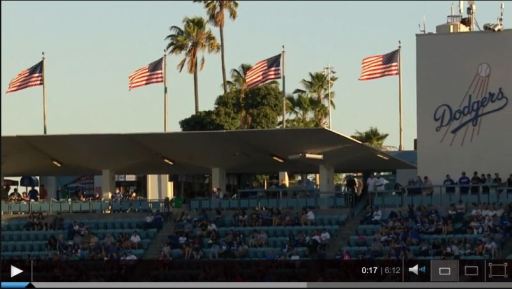
Legendary Dodgers broadcaster Vin Scully can call a game all by himself – no need for color guys. And, he still has time left over to teach you a little history. During last night’s Dodgers-Mets game Vin shared some Star-Spangled Banner stories.
So gather round, listen, and Vin promises, you’ll “learn a little something about our flag.”
As usual, all players will wear special 4th of July caps today.
Look, everything’s stars and stripey!
Editor/Husband Fashion Review: “Those are horrible. Where’s Betsy Ross when you need her?”
And, don’t worry Toronto Blue Jays, it may not be your special day, but we’ve got something for you, too. Awww, it’s your maple leaf. On a cap.
Happy Canada Day, three days late, Blue Jays!
13th Inning: Keep Your Critters Safe!
One more thing … The 4th of July is great and so is baseball. But, fireworks stink if you’re an animal. Keep your critters safe!
______________________________________
* Free Baseball refers to extra innings that come after a nine-inning game ends in a tie. Here it’s the extra things that don’t quite fit into my regular-sized posts.
“So, then, to every man his chance — to every man, regardless of his birth, his shining, golden opportunity — to every man the right to live, to work, to be himself, and to become whatever thing his manhood and his vision can combine to make him — this, seeker, is the promise of America.” ~ Thomas Wolfe, You Can’t Go Home Again, 1940
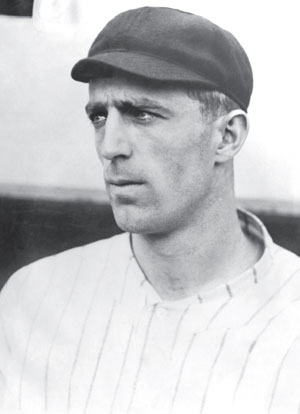
Best I can tell, the first reference to a ballplayer having a “cup of coffee” – or a short stint – in baseball referred to New York Giant Fred Merkle. Yes, Bonehead Merkle.
Fred Merkle, Public Domain
It was in 1908 in a game versus the Cubs that Merkle neglected to tag second at the end of a game that the Giants thought they had won. Once the “boner” was revealed, negating the Giants’ winning run, the game was replayed and the Cubs won. (They went on to win the World Series, their last, in case you’re keeping track.)
It was after that first game that the New York Globe referred to Merkle, 19 and the youngest player in the National League, as “just getting his ‘cup of coffee’ in the league.”
Bonehead or not, Merkle lingered quite some time over his cup, playing more than 1,600 games over 16 seasons, including, ironically, his last six with the Cubs. (I believe Starbucks would call that “cup of coffee” a Venti-sized career.)
The real “cup of coffee” players are those who play the shortest times in the big leagues. A game or two and not much more.
Fun Fact: We Americans will drink 400 million cups of coffee today. (I tried to figure out how much caffeine that was, because decaf is ridiculous, and I think it’s something like 500 billion mg. Really, math is not my strong suit, so I might be off by a billion or two.)
Three major league players had their single game “cup of coffee” on the 4th of July. It’s strange there have been only three, and none, that I can see, since 1885.
When you play just one game in an era without ESPN and online box scores, it’s hard to know much about these guys. All I can tell you is this …
1882
The Baltimore Orioles played the Louisville Eclipse on July 4, 1882.
John Russ, a Louisville carpenter, may have played on a local team and had the opportunity for a one-day cup of coffee in the bigs when the Orioles came to town and needed a player to fill out the squad.
Russ, 24, played centerfield and pitched, giving up three hits and one earned run over three innings, and went 1-for-3 at the plate. This might not sound like much, but it could get you a solid million-dollar bullpen job with teams today.
Russ was the son of immigrants, his father a blacksmith, his mother a candymaker. He never ventured from Louisville and is listed in its directories over the years as a carpenter, plowmaker, and woodworker in a plow factory, until his death in 1912 from cirrhosis.
1882 was the inaugural season for the six-team American Association and the Orioles finished dead last. Their record, 19-54, put them 32.5 games out of first.
1883
Charlie Ingraham got his shot with the Baltimore Orioles the next year on July 4, 1883.
He went 1-for-4 with a single, and had one error as catcher.
It was a doubleheader for the Orioles, playing the Red Stockings in Cincinnati.
Ingraham was an Ohio native living by then in Chicago. He’s another case of a player who may have gotten scooped up by the Orioles for that one day, so that they could field enough players for the two games.
In 1880, Ingraham was listed as a medical student in Chicago. This would mean he was planning to follow in his father’s footsteps. His father was a prominent physician and medical lecturer whose death in 1891 was covered by the Chicago Tribune.
In the obituary, his son C.W. – our Charlie – is listed as a ballplayer in the Northwestern League, a minor league that had folded four seasons earlier.
Things don’t often work out the way you think they will when you’re young, and when C.W. succumbs to pneumonia at age 46, he is neither a doctor nor a ballplayer. He is listed on his death certificate as a “stage carpenter.”
The Orioles finished last again in 1883 – 28-68 and 37 games out of first.
1885
Bill Collver, just 18, played his one and only big league game for the Boston Beaneaters on July 4, 1885.
An outfielder, he went 0-for-4 at the plate that day, with one strikeout.
The Beaneaters were in the middle of a roadtrip – a grueling one by today’s standards – that had begun on June 23 and would go through July 17. On July 4, they played a doubleheader against the Detroit Wolverines, losing the first game 8-3 and the second 11-6.
It’s unclear which loss Collver played in, but it’s likely that the Beaneaters, like the Orioles before them, just picked up Collver from a local team to help fill out their roster.
Collver didn’t have much beyond that cup of coffee. He died in 1888, still in Detroit and just 21, of a “spinal disease,” which could mean meningitis, of which there was plenty in Detroit, or who knows?
The Beaneaters finished their season 46-66 and finished fifth and 41 games out of first in the National League.
___
The sad thing about a cup of coffee in baseball, is that someday it’s gonna be your last. And, unlike Mariano Rivera, Cal Ripken, and the other greats who chose when and where to drink their final cup, for most players, with names you’ll never know, the pot is emptied before they’ve had their fill.
So, here’s to John and Charlie and Bill who had their cup of coffee, who lived the American Dream, even if it maybe wasn’t what they planned, and who are still remembered 130-some years later for just one day, just one game.
If you graduate from the University of Virginia with a degree in mechanical engineering and a 3.7 GPA … you’ve earned a place on my blog.
If you persevere in the sport you love … walking on as a freshman and working hard day-in and day-out even though the odds are long against you that you will ever get a chance to play and your last at-bats were in the middle of May … you’ve earned a place on my blog.
And, if you go 3-for-4 and hit a decisive 2 RBI single in a do-or-die game of the College World Series, sending your underdog University of Virginia Cavaliers to Game 3 against heavily favored Vanderbilt … you know, you’ve earned a place on my blog.
“[T]his guy has been as unselfish a team player as you could possibly be for four years. And I really believe that at the most important time you get rewarded for that, and certainly it showed true today. And it worked. We just did enough.” ~ UVa Coach Brian O’Connor
That Thomas Woodruff and the entire team of “Cardiac Cavs” left the Vandy-happy ESPN broadcasters stunned and speechless as the Hoos went on to win 3-0 against “this-team-can’t-lose” Vanderbilt Commodores is simply a bonus.
A tip of the cap to all the Hoos.
I’m hoping for another night of stunned confusion from ESPN.
Because, it’s so nice when ESPN is left with nothing to say.
Why do we sing “Take Me Out To The Ballgame” when we’re already there?
The answer to this corny old joke is simple. Because we do, and not everything in baseball has to make sense.
The University of Virginia’s very strange season has somehow taken them to the championship of the College World Series this week and that doesn’t really make sense either.
I’ve been calling it improbable. But, then so has everyone else.
(And, by improbable, I don’t mean that they don’t deserve to be in Omaha, only that, had you asked me four weeks ago … well, fortunately, no one did.)
The post-game announcers on ESPN on Saturday night were so unprepared for Virginia’s win over Florida that they had nearly no statistics or background info on UVa ready to air after the Hoo’s win. The best they could come up with was to joke that Vanderbilt is such a prohibitive favorite and the odds are so long against UVa in this week’s championship, that Las Vegas oddsmakers have probably closed the book on the series.
Dear ESPN, If you’re going to tell a baseball joke to fill airtime, why not make it a good one? Like this …
Which takes longer: to run from 1st to 2nd base or to run from 2nd to 3rd base? It takes longer to run from 2nd to 3rd base because there’s a “short stop” in the middle.
Fun Fact: Since the post-season began on May 29, the Hoos are 8-1. They have scored 49 runs over those nine games; 25 of them have been scored in the 7th, 8th, and 9th innings.
Funner Fact: The Hoos have scored the go-ahead runs in the 6th inning or later in all eight wins.
Here’s to the Hoos! They play Game 1 against Vanderbilt tonight in a best-of-three series. 8:00 p.m. Eastern on ESPN
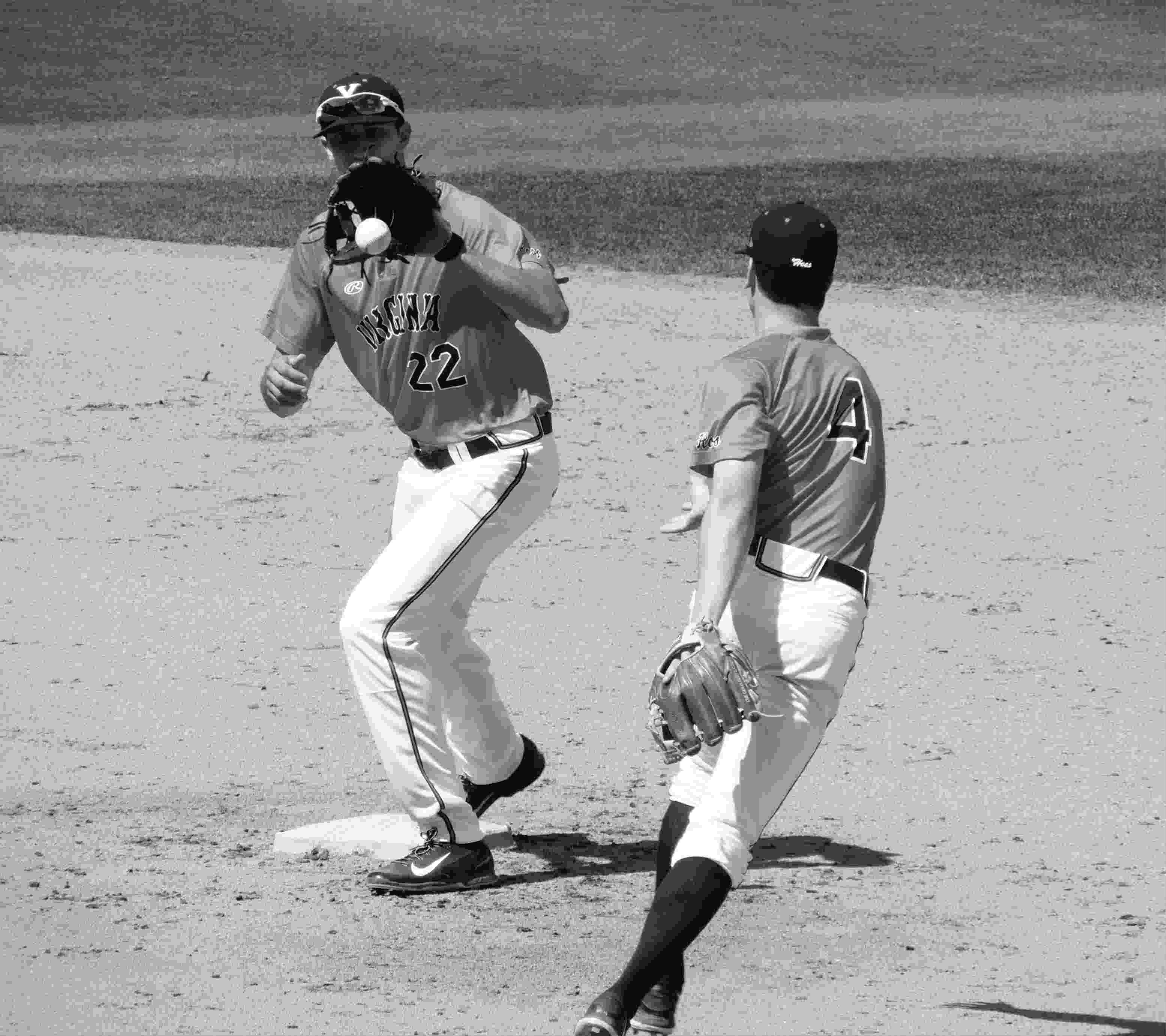
Daniel Pinero, Shortstop & Ernie Clement, 2nd Base
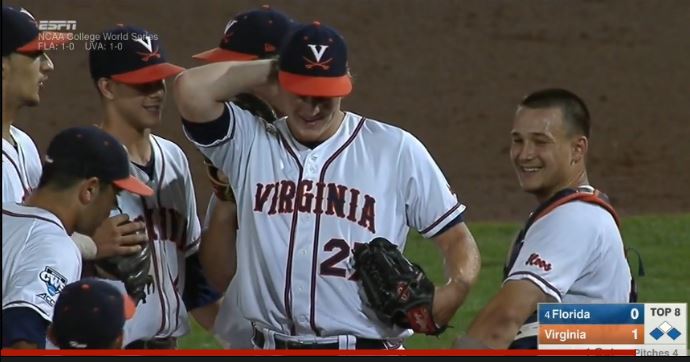
As ESPN was about to cut away following Virginia’s win over Florida on Saturday, their cameras took one last sweep over the Virginia players, huddled around their Coach Brian O’Connor. Just before they cut to commercial you could hear Coach O’Connor tell his team:
“Continue to have fun and enjoy it.”
“We just go out there and do what we have to do. … We know nobody looks at us like a team that should win it all or can win it all. But everyone in our locker room thinks we can.” ~ Matt Thaiss, Catcher
Clement was asked what comes to mind when he hears the word ‘Vanderbilt.’ He looked quizzically at the reporter.
‘Are we playing Vanderbilt?’ he said.
The reporter paused to give Clement a chance to reveal he was joking. The lack of words suggested the freshman was not. Why, yes, Ernie, your opponent in the College World Series finals would be Vanderbilt. You know, the team that’s been all over SportsCenter the past few nights? The defending national champions? The baseball powerhouse that UVa met at this same stage last year?
‘Oh, I didn’t even know that,’ he said. ‘I just know we’re there. I can’t wait to play.’
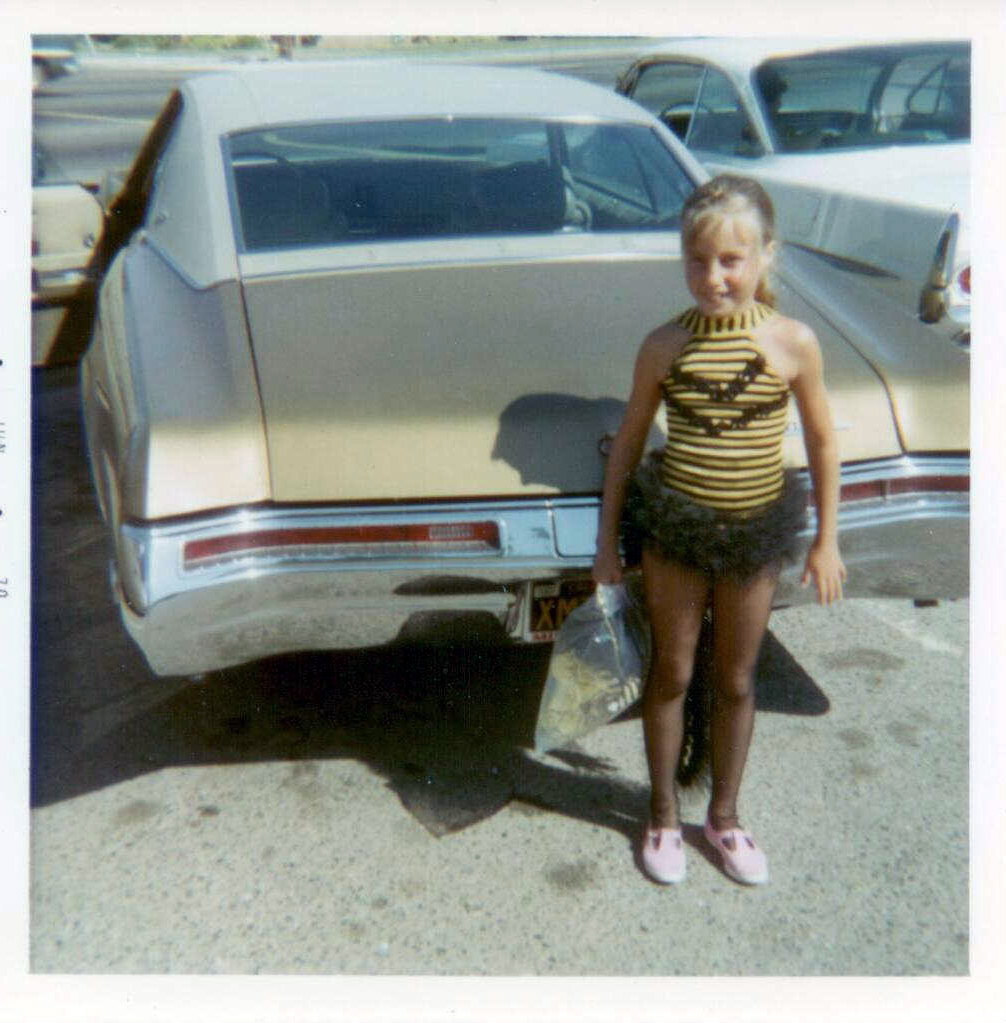
When I was about 10, I challenged my dad to a footrace around the block.
I’m not sure why I wanted to race, but my dad and I were always thinking up competitions with each other. I must have figured it was a no-lose race.
My dad said his longer legs would beat me, but I knew that I was fast. Even faster with my P.F. Flyers. I knew I could out-sprint an oldie like him.
The Favorite.
The Underdog.
We set the ground rules. From the tree in our front yard, we would run counterclockwise around the block. First one back to tag the tree wins.
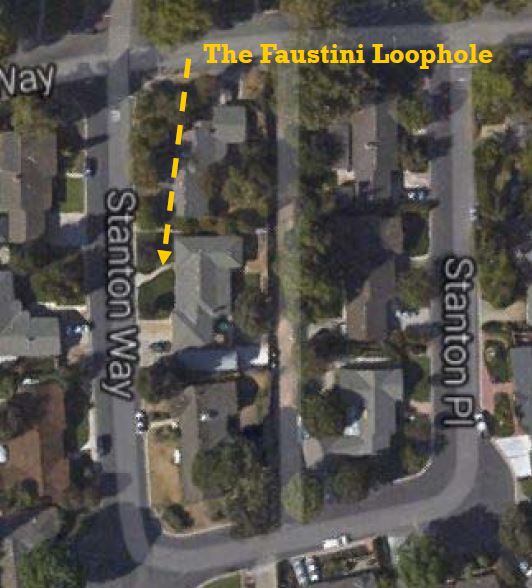
Google Maps confirmed that my childhood home — and the round-the-block track — in California still exists. But, the finish line tree-of-legend is gone.
With the rules set, we took off into the street. A neighborhood block is much longer around than you think it is, especially when you’re 10 and your legs are much shorter than your dad’s. But, I picked up steam just as he was losing his, and I drew even with him somewhere around the houses that lined the block behind us. When we came to the final turn for home, my dad was pooped. I was hitting my stride.
It was at that moment that my dad veered off the street. He cut through our next-door neighbor’s yard, hopped over the waist-high fence that separated our houses, and tagged the tree. He had cut several seconds – and several feet – off of the race by short-cutting across Mr. and Mrs. Faustini’s lawn.
I was still running in the street. Soundly beaten.
I had yet to learn any of the wonderful, bleepful words that grown-ups use but children don’t. So, I probably just called him a “big cheater.” I was pretty mad.
He was jubilant. “Hey, Kid, you never said we had to follow the street.”
It would be my first time getting screwed by a loophole. There would be no rematch.
Happier Times.
I’m not sure my dad saw any great lesson in our race. He was just the kind of guy who liked to prank his kid from time to time.
But, his non-lesson left a big impression on me, and I’ve been pretty careful about making ground rules clear ever since.
Which brings me to this.
Ground rules are a baseball thing. They are the special rules governing play that are unique to a park, usually identifying a park’s lines, corners, poles, and edges as fair or foul.
At Wrigley Field in Chicago, if a ball gets stuck in the ivy it’s a double, but if the ball pops back out, it’s in play.
At Tampa’s Tropicana Field, the four catwalks are governed by different ground rules. Hit the lower ones, it’s a double; hit the higher ones, a homer. Indoor parks have all sorts of ground rules for balls that hit the roof, trusses, cables, or other stuff hanging down.
Some individual games have had their own ground rules. In 1903, during the first World Series, the games were so packed that fans overflowed into the outfield. The Pittsburgh Pirates and Boston Americans agreed that if a ball was hit into the fans it would be a “ground-rule triple.”
The Americans went on to hit 18 triples over the course of the eight-game series, a World Series record that still stands.
The key thing is this – ground rules are unique to a single park or event.
Here’s what’s not unique in baseball.
Rule 5.05 (a) (6)
A fair ball, after touching the ground, bounds into the stands, or passes through, over or under a fence, or through or under a scoreboard, or through or under shrubbery, or vines on the fence, in which case the batter and the runners shall be entitled to advance two bases;
There you have it. A ball that bounces from fair territory into the stands is a double.
Nothing unique. Happens all the time. The rule is the same no matter where you are.
It is not a ground rule double. It’s just a double.
What do doubles have to do with my dad? Nothing really.
But, my dad was a stickler for getting things like this right.
San Francisco Giants broadcaster Jon Miller is a stickler, too. While most everyone else calls a fair ball bouncing out of play a “ground rule double,” Miller will call it what it actually is – an “automatic” double or a “rule book” double.
Like this:
Jon gets it right, but if you listen through, you’ll hear Mike Krukow get it wrong. And, look! That’s former Oriole’s closer Jim Johnson on the mound giving up the automatic!
(Even legendary Dodger’s broadcaster Vin Scully gets it wrong. Listen.)
Though he liked the Dodgers, my dad wasn’t much of a baseball fan, but I think he would appreciate my using this Father’s Day post as an opportunity to set the record straight about ground rule doubles.
And, he’d probably ask me to remind you: Always set clear ground rules, lest you get beaten by someone who discovers the “Faustini Loophole.”
One can be remedied with cheap drugstore reading glasses and I have 11 pairs lying around the house in case of a vitamin emergency. Two, I never could do that. (But, I’m touched that for five seconds you thought I could.) Three, well, if your team plays the late game in the College World Series, bedtime can be an inconvenience.
But, that doesn’t mean I can’t get up at 5 a.m. to watch the post-midnight DVR’d parts of last night/this morning’s University of Virginia vs. Florida game.
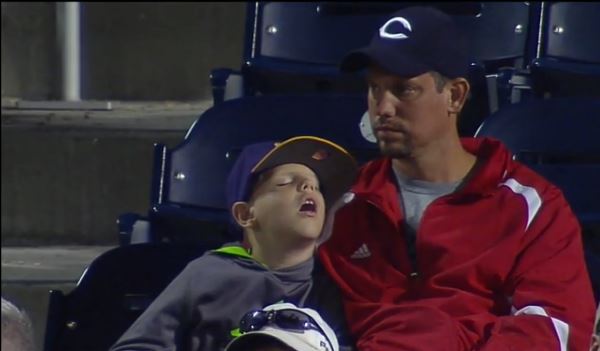
I wasn’t the only sleepy one.
Let’s get to it. UVa won, continuing its miracle run of playing much better (much, much, much better) than it did through the regular season.
Since you might not have made it to 2 a.m. either, watch the recap here.
“Some how. Some way.”
Now, rewind to 3:12 and re-watch the 8th inning highlights and the come-backer to UVa closer Josh Sborz. The one that ricocheted off his glove and sent the glove flying. The one that came with no outs and the tying run on third, the go-ahead run on first, and the go-ahead-even-more run at bat.
No outs.
He gets the out. But, still … it’s break-a-sweat time. Because even with that out, the tying run is still on third, the go-ahead run is still on first, and the go-ahead-ahead run is at bat. One out.
Times like these call for a visit to the mound. To settle down your pitcher. To position your infield. To make sure everything is just so. It’s late and every pitch is potentially a “game changer.”
The recap didn’t share the mound visit that followed that Sborz play. But, I will …
Willie Stargell once said, “They don’t say, ‘Work Ball.’ They say ‘Play Ball.’” And, when you’re in the College World Series, it’s a good idea to savor every moment, even when the game’s on the line.
“Hey, that pitch could have killed you, Josh.”
“Hey, do you think we’ll have time for a swim when we get back to the hotel?”
“Pretty soon the ball player will not have rest enough between seasons to get acquainted with his folks.” ~ The Sporting News, November 7, 1912
In response to The Daily Post’s weekly photo challenge:“Off-Season.”
They call it “The Grind.” That long baseball season. That life ballplayers choose.
For the pros, it begins in February at spring training and, if you’re lucky, it will extend to the far reaches of October.
College ball starts in February and stretches through four months, then summer league teams, and a “bonus” fall season tucked in before the snow falls.
Whatever’s left, that’s your “off-season.”
I thought “off-season” was a baseball term that had worked its way into the rest of the language. But, “off-season” is a business term that was first used in the 1840s.
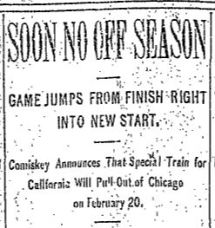
The Sporting News, November 7, 1912
In 1912, The Sporting News complained that Charles Comiskey, President and Owner of the Chicago White Sox, was running his players ragged by shortening the off-season and putting his team on a train to California in the middle of February to begin spring training, forcing his players into exhibition games along the way, stopping at any place where a pick-up game might put extra “coin” into the owner’s pocket.
We don’t lay fallow much. There’s not much off-season for anybody these days. Apparently, there never was.
I’m not sure when college baseball coined the term “Friday Night Guy.”
ESPN suggests it came about in the mid-1990s when the SEC (the always power-packed Southeastern Conference) changed its weekend schedule, moving one of its traditional double-header Saturday games to Friday night.
On that night, in the SEC and in ballparks around the country, the best college pitchers – the aces – pitch.
To be a Friday Night Guy is to be the best pitcher on your team. Facing the other guy’s Friday Night Guy.
When the University of Virginia takes the field in the first game of this year’s College World Series on Saturday afternoon, their Friday Night Guy will take the mound – Sophomore Connor Jones.
(And, by “we,” I mean, really just me. But, it’s a good nickname, don’t you think? I spend a lot of time thinking up nicknames for the players and shouting them out, hoping they catch on. They usually don’t. This one, though, is a shame, because it’s pretty good.)
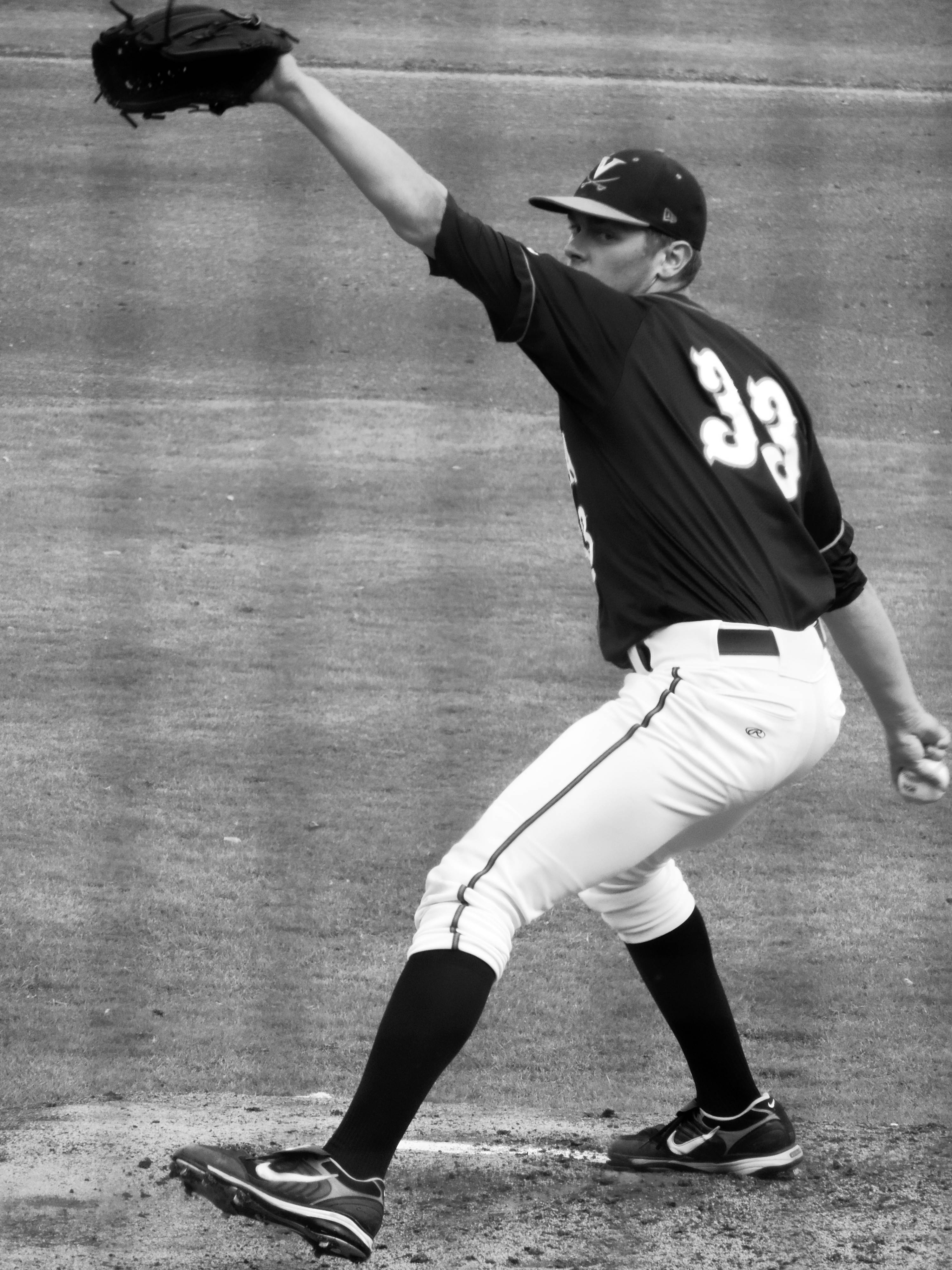
The Hoos will wear their “Connor Camo” jerseys, which they’ve worn whenever CoJo pitches, ever since wearing them for a dominating 5-2 win over heavily favored Miami on April 18. That afternoon Jones went 7 2/3, struck out 11, and gave up two runs, just one earned.
Camo-Clad Connor Jones pitching in that April 18 win over Miami.
Why the camouflage jerseys? “I thought they looked really cool,” Jones said this week.
(Fun Fact: The camouflage jerseys don’t really camouflage the guys. You can still see them.)
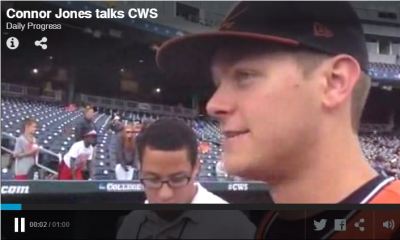
In this short interview, CoJo admits that 1) sometimes he doesn’t know who he is pitching to, he just throws, and 2) he’s a Red Sox fan. A Red Sox fan. How did that happen? The Red Sox could use a CoJo.
Since becoming the Friday Night “Connor Camo” Guy, Jones has started seven games and is 3-0 with a 2.09 ERA. The team is 6-1 in those games.
The University of Virginia Cavaliers face the Arkansas Razorbacks in the College World Series today, Saturday, June 13, at 3:00 p.m. Eastern.
What? You mean you’re not in Omaha? You won’t be at the game?
In response to The Daily Post’s weekly photo challenge: “Vivid.”
The very first time I went to a baseball game — a real game, with a real diamond and a manicured field — the grass made me blink.
I don’t think I’d ever seen grass so green, so bright, so lush, so … vivid … as the outfield grass around a baseball diamond.
When Little League fields and ad hoc diamonds in public parks start to brown in the heat of summer it always makes me a little sad. Because every player deserves some lush vivid green grass under their cleats.
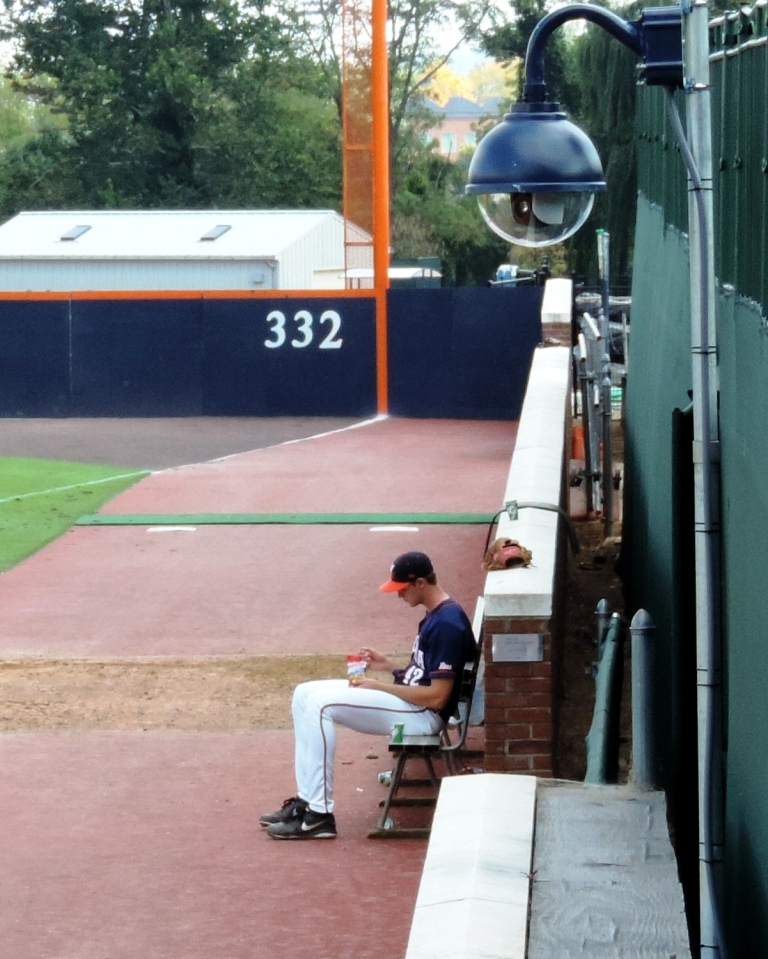
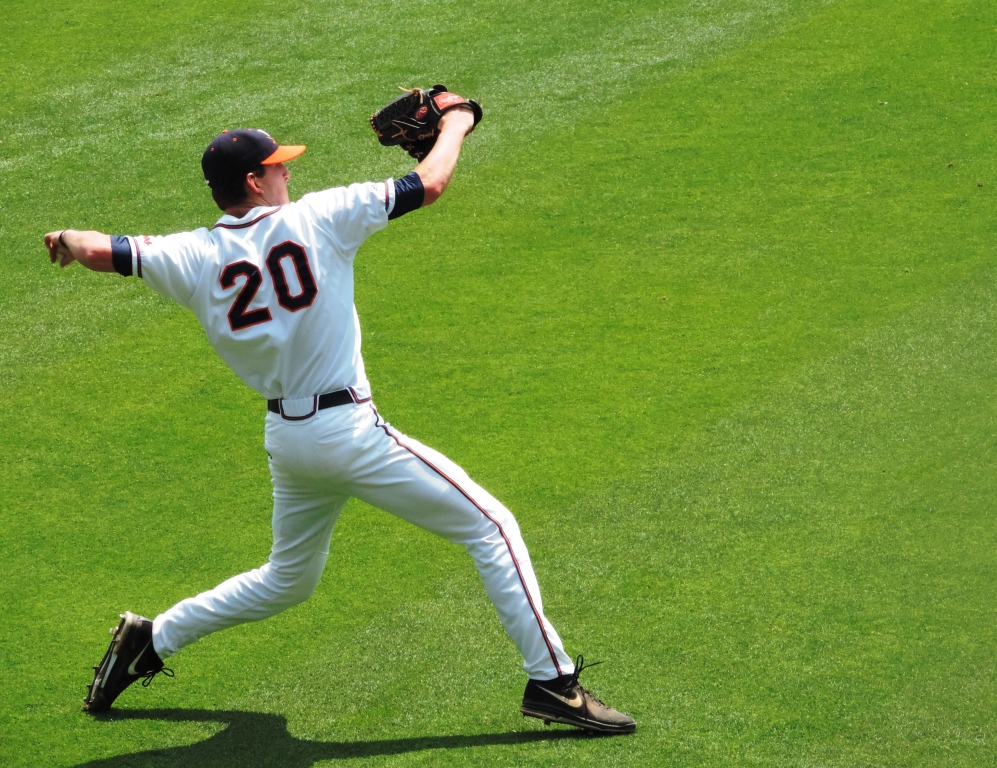
Photo: University of Virginia Starting Pitcher Brandon Waddell, warming up in left field before his start on Saturday in the NCAA Super Regionals. Virginia defeated the University of Maryland and will advance to the College World Series this weekend.























 The Baseball Bloggess