The Face Behind The Mask


Thaiss 2015

“You have to have a catcher because if you don’t you’re likely to have a lot of passed balls.” ~ Casey Stengel

In 1876, Fred Thayer, the team manager of Harvard’s baseball team, took a fencing mask, tinkered with it, and turned it into baseball’s first catcher’s mask. It didn’t take long for other catchers to catch on.

Thayer patent

Thayer’s original catcher’s mask patent.

Fans, according to The New York Times, hated the innovation, considering a protective mask a sign of weakness. They jeered at catchers who wore them.  (Batting helmets? Shin guards? Thumb protectors? Today’s game would drive our great-great-great grandparents nutty.)

The mask annoyed fans, but it changed the game. It allowed catchers to be much closer to the batter. It allowed pitchers to amp up their pitches without worrying about killing their catcher with an errant throw.

By 1878, Spalding had added it to their sporting goods’ catalog.

spalding

Goat hair and dog skin. $3.

Today’s best masks can run to more than $100. (Which, if you ask me, is a pretty small price to pay to keep your nose, cheekbone, and brain intact.) No more dog skin either. Progress.

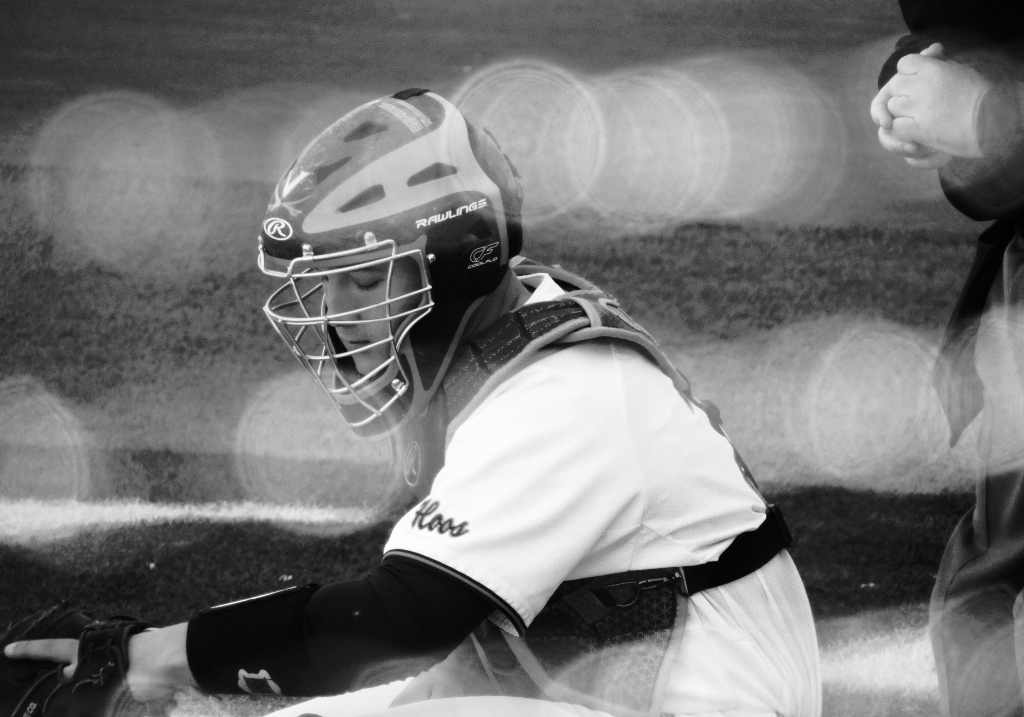
It’s hard to know what’s going on behind those “tools of ignorance.” It’s hard to see a catcher’s face, especially way out in the bleachers.

Thaiss 2016

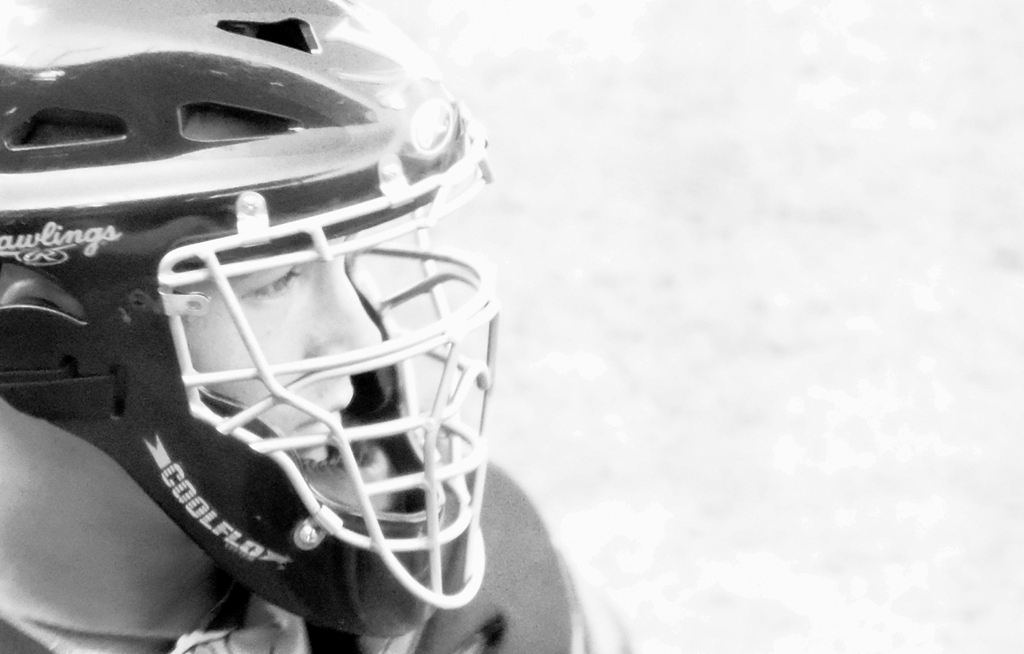
Matt Thaiss, gritty catcher for the University of Virginia, is tough as nails.

“He won’t give up,” UVA pitcher Alec Bettinger told The Daily Progress last week. “He could have his legs chopped off and he’d still go out there and catch. He’s just the toughest guy on the team.”

But, sometimes, when you look inside the mask …

Matt Thaiss March 2016

… he seems almost angelic.

Which just goes to show …

I don’t really know what it goes to show.  But, sometimes the face you find behind a mask isn’t always the face you expected to find.

In response to the Word Press Daily Post Photo Challenge: Face. See more challenge photos here.

Photos: University of Virginia, Charlottesville, Virginia. 2015-2016 © The Baseball Bloggess


“Due To Weather & Field Conditions …”

Rain Out in Richmond

On Friday, I wrote about rain delays and rain outs.

Two days later, what are the chances?

Game Postponed May 1 2016

Seriously?

Maybe I jinxed today’s game …

Tarps on the Field

… Because it was pouring rain by the time we got to Richmond.

Superstitions and jinxes like this run deep in baseball.

Charms On The Ball Field NYTelegraph 1910

New York Telegraph, 1910

In the early years of baseball, players would bury all sorts of lucky charms – especially rabbits’ feet – under home plate and all over the outfield.

Continue reading

“Charlottesville Is No Spot For A Writer Of Baseball.”

Charlottesville is no spot for a writer of baseball Washington Post 3 13 1912

Washington Post, 1912

Here’s what baseball writers will tell you about spring training in Charlottesville, Virginia.

It snows and hails and thunders and pours rain and gusts wind and freezes and scorches. There are plenty of lousy days for baseball and very few good ones.

Those writers, roaming around Charlottesville more than 100 years ago, won’t tell you much about the baseball they saw, but they’ll give you an earful about the rotten weather.

During Virginia’s hybrid time of still-winter-not-yet-spring – spwinter! – there’s no telling what any day will bring.

snowcat

March 2016. © The Baseball Bloggess

Snow.

March weather in Charlottesville is like a grab bag at the dollar store – you’ll get something for your dollar, but you’ll probably look at it and think, “Really? I paid a dollar for this?”

So why did so many teams from 1892 to 1916 come to Charlottesville for spring training? Were they nuts? Or were the grumpy old baseball writers just annoyed that they had to spend a month in a place which was often snowy and always alcohol-free?

Today, baseball’s spring training is held in Arizona and Florida, more accommodating and predictable climates, and where the only things you have to worry about are swarms of bees and the Zika virus.

But, Charlottesville? “More fickle weather could not be found in any part of the globe,” one Washington Post reporter lamented in 1914 after an early March snowfall.

Who would choose Charlottesville for spring training?

These teams …

In 1894, the Baltimore Orioles came through Charlottesville as part of a nomadic spring training tour through the south and took both games against the University of Virginia. The Orioles, then part of the National League, went on to win the pennant. They were a powerhouse, those Orioles. Yup, chew on that O’s fans. A powerhouse.

In 1901, the Boston Red Sox (then called the Americans) spent spring training in Charlottesville. It was the Sox’ first season and, history will show that the first game ever played by the Red Sox, the first ball they ever hit, and the first run they ever scored, happened in Charlottesville.

There were a few others, but it was the Washington Nationals that spent the most springs in Charlottesville. They were officially the Washington Senators, but everyone called them the Nationals and so should you.  (Although today we call them the Minnesota Twins.)

The Nats “springed” in Charlottesville in 1905 and ‘06 and then again, under manager Clark Griffith, from 1911 through 1916.

Embed from Getty Images

Griffith (third from the right) and his Nationals in Charlottesville. March 1915.

Griffith, today enshrined in the Baseball Hall of Fame, told reporters each season that his choice of Charlottesville over warmer locales was purely strategic.

Continue reading

An Umpire’s Valentine

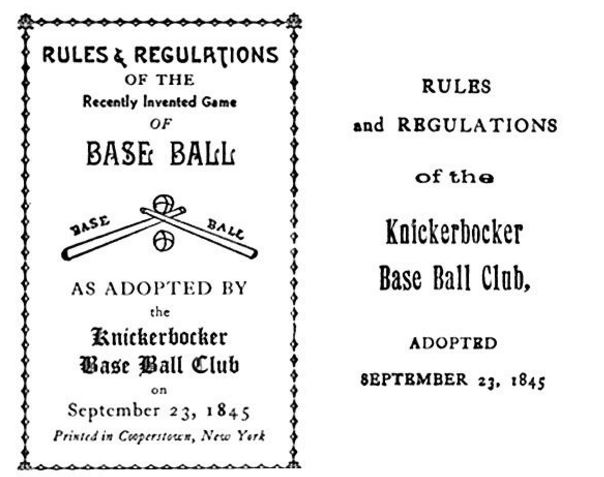
knickerbocker rules

Before baseball even got to the bases, innings, or outs, there was an umpire:

Rule #2 of baseball’s “Knickerbocker Rules” (1845):

When assembled for exercise, the President, or in his absence, the Vice-President, shall appoint an Umpire, who shall keep the game in a book provided for that purpose, and note all violations of the By-Laws and Rules during the time of exercise.”

The only thing more important than an umpire? Rule #1 which reminds players to “strictly observe the time agreed upon for exercise, and be punctual in their attendance.”

So, let’s give umpires some love on Valentine’s Day …

First, don’t call it a clicker.

“[A] ball and strike indicator … figured in my very first lesson in how to be a professional umpire: Never call it a clicker. (Why? Nobody ever said, but, I guess it’s like an opera singer’s not referring to an aria as a song.)”  ~ Bruce Weber, As They See ‘Em: A Fan’s Travels In The Land of Umpires

ball strike indicator

Not a clicker.

Don’t call the Umpire “Blue.”  It’s just rude as it was once a heckle and it was spelled “Blew” – as in “Hey, Blew, you blew the call!”

Embed from Getty Images


Don’t slug the umpire, even in the name of poetry.

Mother, may I slug the umpire
May I slug him right away?
So he cannot be here, Mother
When the clubs begin to play?

Let me clasp his throat, dear mother,
In a dear delightful grip
With one hand and with the other
Bat him several in the lip.

~ Anonymous, Chicago Tribune, 1886

Continue reading

Blizzard, Snow, and My Garden Gnomes

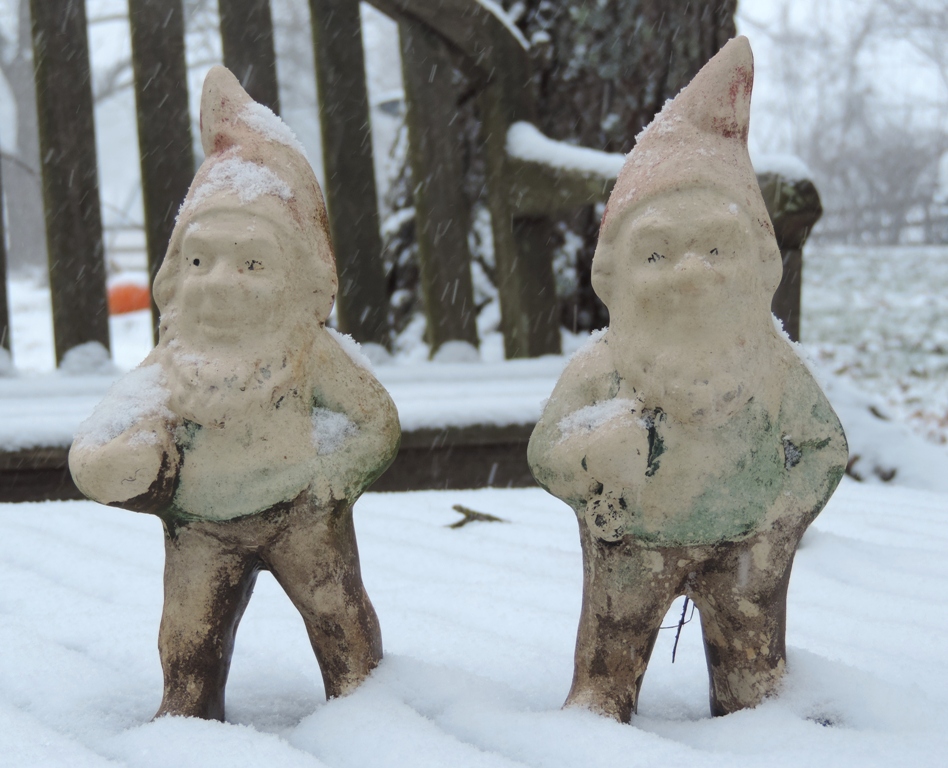
gnome ankles 1 pm

“With the tail-end of that dreadful Northwestern blizzard rattling the windows and doors and the ground partly covered with snow and ice, it is rather difficult to compose an original article on baseball.” ~ The Washington Post, January 22, 1888

Before we get to my garden gnomes …

I wish I could tell you something about Jack Blizzard, who pitched nine games in the Texas minors in 1954. But, there’s nothing much to tell. No one knows much about Jack Blizzard. Or, if they do, they’re not talking.

He pitched nine games or so for the Plainview Ponies and the Abilene Blue Sox. These were Class C teams in the West Texas-New Mexico League. He was from Sulphur Springs, Texas. He was 19. He was a lefty.

Other than that, there’s not much to tell; just a few mentions in The Abilene Reporter News in the spring of 1954.

He first appears on April 28, playing with Plainview. He came into a game as a reliever and pitched part of the 8th. No runs.

On May 8, now with Abilene, he was one of four Blue Sox relievers who struggled through the 4th inning versus the Pampa Oilers; together the four relievers gave up seven runs in that inning. The Sox lost 12-4.

On May 20, another loss, this one to the Clovis Pioneers 9-3, and Blizzard came in to eat up the last 4.1 innings, holding the Oilers to just 3 hits, no runs.

May 25. Double-header, two losses, and two relief appearances from Blizzard who gave up one run in his second game of the day.

June 1. Another Blue Sox loss. Blizzard comes in in the 9th and walks two. On June 21, the Blue Sox send him to Oklahoma City.

And, he disappears. Leastways, I can’t find him.

He could very well be Jack Blizzard of Nederland, Texas, a former salesman, who passed away in 2009. His obituary doesn’t mention the spring of 1954 or baseball, but all the other details fit.

Today would be a good day to talk about Jack Blizzard, when there’s nearly two feet of snow outside here in Virginia.

Continue reading

Chris Davis & The Unjilted

Chris Davis Baseball

Being jilted is no fun.

Which is a shame because “jilt” is a fun word.

Let’s go a’jilting!

It’s a jiltingly beautiful day, let’s have a picnic.

But, language is fickle and being jilted, of course, is no fun at all.

(If you haven’t been jilted – by a date, a boyfriend or girlfriend, or even a fiancé  – you are a rare bird, or a bird with selective memory. You can keep reading, Unjilted One, but this won’t be as meaningful for you.)

So, what to do if you thought you were jilted … but you discover you weren’t? Not jilted. Unjilted. Ajilted. Non-jiltified.

What if you’ve already moved on only to discover that you weren’t jilted after all?

On Saturday morning, reporters learned that Baltimore Orioles first baseman (sometime right fielder and one-time winning pitcher) Chris Davis had re-signed with the club.

Embed from Getty Images

Welcome back to Baltimore, Chris Davis! 

(I’m not sure I can even welcome you back, “Crush”, because, as it turns out, you never really even left.)

Re-signed and resigned are two different things which is extremely hard for some writers to understand.

Continue reading

Yoo-Hoo!

To fall in love with baseball is to fall into the past, as far back as you can remember it when you were a child, and even further than that if you can.

To fall in love with baseball is to fall in love with people and places and games that are from times that are much older than you, places you’ve never been to, and games that are now just box scores on paper.

Baltimore Orioles Defeat NY Giants 8 5 1896

Baltimore Orioles beat the NY Giants 10-4. August 5, 1896.

Embed from Getty Images

Wee Willie Keeler. 1907.

To fall in love with baseball is to be in love with a game that has a history and a culture that is nearly 200 years old. It has changed and evolved and changed back again, but, it’s still pretty close to what it was right from the start.

(When the main thing that people still argue about is the designated hitter rule, you know that things really haven’t changed all that much.)

Continue reading

Sitting Here Thinking About Willie Mays

Warning: Editor/Husband has been sick and in bed since Christmas Eve. This means that I am a) most likely highly contagious, and b) posting without an editor. If you cut out now, I’ll understand. (I’ll be deeply hurt, but I’ll understand.) (Sort of. I’ll sort of understand.)

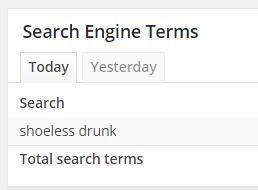
Someone found this blog by searching for this:

shoeless drunk

Shoeless drunk?

First of all, I’m very disappointed in you, Internet. Second of all, I wonder what that person was looking for?

I searched for “shoeless drunk” on the Googler and I didn’t find me. (What I did find was disgusting, with the exception of a few movie stills from 1967’s “Barefoot in the Park,” starring Robert Redford and Jane Fonda.)

barefoot in the park

In writing about baseball, there is always Shoeless Joe Jackson and quite a number of drunks, so maybe it wasn’t such a stretch after all that someone landed here.

Embed from Getty Images

Shoeless Joe Jackson, 1919.

Shoeless Joe may have never really been shoeless, as he occasionally denied the story of ever playing in his stocking feet in the minor leagues.  But, he also occasionally said the story was true, so who’s to know?

Also, no distraught kid ever tugged his sleeve outside a Chicago courthouse and said, “Say it ain’t so,” when the White Sox were found to have tossed the 1919 World Series.

But, Damon Runyon did say this: “Even when he’s trying to throw a Series, Shoeless Joe Jackson can still hit .375.”

This led me to wonder when Joe Jackson died.

December 5, 1951. He was 64 and several hundred people attended his funeral in Greenville, South Carolina.

This led me to wonder, in a tangent I can’t explain, when Willie Mays hit his first home run.

And, it was 1951, too. May 28.

As most baseball fans know, Mays’ first home run was also his first hit as a big leaguer. He had gone 0-for-12 in his first three games. This was his first home at-bat at the New York Giant’s Polo Grounds.

The home run was, The New York Times said, “a towering poke that landed atop the left-field roof.”

The homer, off the Boston Braves’ Warren Spahn, wasn’t enough. The Braves defeated the Giants that night, 4-1.

Embed from Getty Images

Willie Mays.

Historian Charles Einstein shared these quotes from that game:

“You know, if that’s the only home run he ever hits, they’ll still talk about it.” ~ Russ Hodges, who called the game on radio that night. (And, look … he’s right!)

“For the first 60 feet it was a hell of a pitch.” ~ Spahn, who said he threw a fastball as his first pitch to Mays because he was sure Giants’ manager Leo Durocher had told Mays to lay off the first pitch. (Durocher hadn’t.) Or, maybe it was a curve ball, which scouts said Mays couldn’t hit, as Spahn remembered it in 1973.

“The ball came down in Utica. I know. I was managing there at the time.” ~ Lefty Gomez (This would be an even better quote if Gomez actually had been managing in Utica at the time. He hadn’t. But, it’s still pretty good.)

“I never saw a f*ing ball get out of a f*ing ball park so f*ing fast in my f*ing life.” ~ Leo Durocher

I can’t show you that home run, of course, because the Internet and MLB.TV hadn’t been invented yet.

Embed from Getty Images

Warren Spahn.

Mays would hit 17 more home runs off of Spahn including one in the 16th inning of a game on July 2, 1963.

By 1963, the Giants were in San Francisco and the Braves were in Milwaukee.

Mays’ walk-off home run off Spahn in the 16th ended one of baseball’s most awesome pitching performances: 42-year-old Spahn, for the Braves, and 25-year-old Juan Marichal, for the Giants, threw a combined 428 pitches through those 16 innings.

The Giants won 1-0. 

“It was a screwball,” Mays said following the game, “But I guess Warren was getting kind of tired.”

“Yes, I was tired,” Spahn said, “But, I wish Willie had been tired, too.”

I can’t show you that home run either. But, here’s Mays and Marichal talking about it:

“Ok, let me see what I can do about it.”

(Giants fans of a certain age will insist that Willie McCovey’s foul ball in the bottom of the 9th was actually inside the foul pole and should have been the home run that ended the game. McCovey will tell you that, too. But, like the Internet, batting helmets, and wild card teams, instant replay hadn’t been invented yet.)

And, so here it is Boxing Day and Editor/Husband is still feeling crummy and is fast asleep in the room next door. He will dislike this post when he sees it, because it just wanders around pointless.

Just sitting here thinking about Willie Mays.

Becomingly Thankful

“Everybody was becomingly thankful.” ~ The Baltimore Sun, November 26, 1897

There’s not a lot of baseball on Thanksgiving.

It’s just turkey and football, isn’t it?

Sure, maybe there’s someone, somewhere having a catch before dinner. But, finding a game – a real game – is hard to do on Thanksgiving.

It was pretty much just turkey and football back in 1897, too. And, it’s been that way every Thanksgiving since.

But, I did find two bits of Thanksgiving baseball in 1897 …

On Thanksgiving Day, the boys of St. Mary’s Industrial School – the school for truants, miscreants, and wayward boys located on the outskirts of Baltimore – mostly played football. But, a few of them played baseball that day. It was a dull and cloudy day, but the rain held off until after dark, so the day was fine enough for outdoor games.

Thanksgiving 1897 was, for the 535 boys of St. Mary’s, “a delightful day,” The Baltimore Sun reported.

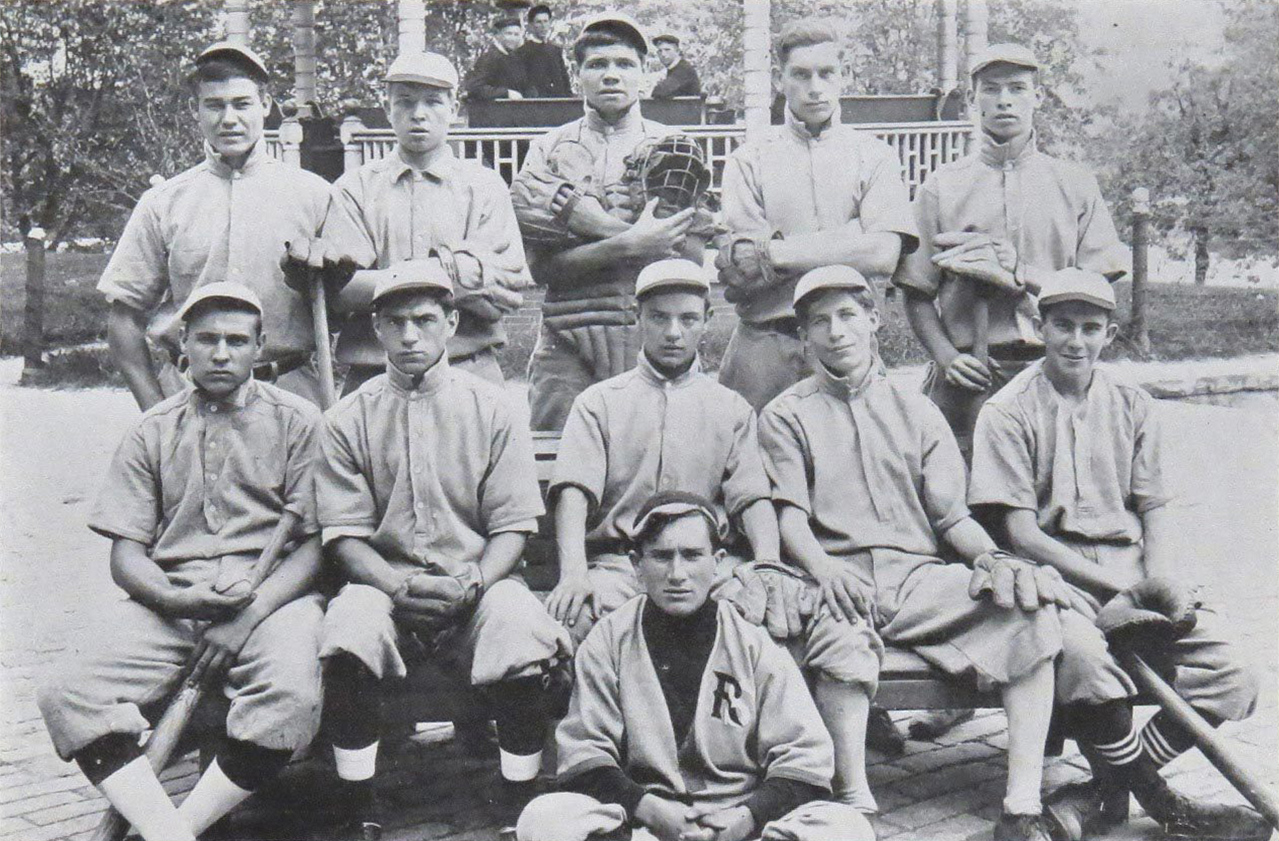
The school was still five years away from enrolling its most famous student – George (not-yet-Babe) Ruth who was committed to St. Mary’s by his parents for being incorrigible in 1902.

Babe_Ruth_-_St._Mary's_Industrial_School

Public Domain image (1913)

In 1897, George “Baby” Ruth was just 2 years old and several years away from becoming a star player for St. Mary’s Industrial School. (Here he is in 1913 — back row, center, with his catcher’s gear.)

The Baltimore Orioles also played on Thanksgiving Day 1897.

They had just finished their season in second place and were out on the West Coast on one of those barn-storming “all-star” tours that travelled through warm-weather states in the off-season as a way to make the owners some dough and help players make ends meet.

orioles california tour 1897

Public Domain (1897)

Baltimore Orioles “California Tour” Promotional Photograph. 1897

The Orioles spent their Thanksgiving being beaten 4-3 by the Sacramento Gilt Edges, a California League team.

(The Gilt Edges, by the way, got their name from Sacramento’s Ruhstaller’s Brewery, maker of Gilt Edge beer. The brewery still exists and they still make Gilt Edge.)

gilt edge beer

But for most Americans, Thanksgiving Day 1897 was a day for church-going (“services were most elaborate affairs, and in their magnitude and importance, were only surpassed by the Easter Festivals,” The Washington Post explained) … college football (the University of Virginia beat Carolina in the “South’s Oldest Rivalry” game, 12-0, wahoowa!) … and serving roast turkey dinners with all the usual trimmings to the poor, the infirm, the elderly, and the imprisoned.

Thanksgiving Day back then, it seems, was less a day to count one’s own blessings, but instead was a day to help provide the less fortunate with a belly-filling meal for which they could be thankful.

The Humphrey House, a Jamestown, New York hotel and restaurant, reminded its diners of the blessings of sharing a meal with the poor on their Thanksgiving Day menu.

humphrey house thanksgiving menu 1897

Public Domain, via University of Nevada, Las Vegas, University Libraries. (1897)

“They who divide the plenty, By a bounteous Father given, Shall multiply this day the thanks, That sweetly rise to Heaven.” 

(You can see the Humphrey House’s full Thanksgiving menu here.)

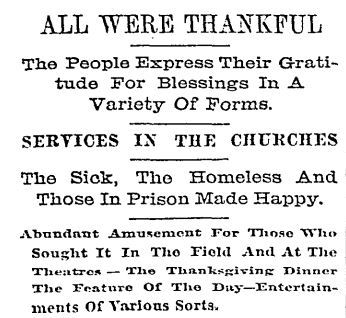
As The Baltimore Sun explained, “Many generous-hearted people were anxious that others should find some rays of sunshine in their lives to be grateful for and devoted part of the remaining hours to aiding the poor, sick, or those confined in institutions.”

Baltimore Sun November 26 1897

The Baltimore Sun, November 26, 1897

“Everybody was becomingly thankful.”

That’s how The Baltimore Sun described Thanksgiving Day 1897.

Becomingly thankful.

May we all be becomingly thankful today, too.


I Wonder What Mike Trout Is Doing Right Now?

“The world’s series turned over and gave its last gasp yesterday. …This morning will see all the players except home-breds on their way back home or headed for the great open spaces where the streams abound with fish and woods are full of game.” The New York Times, October 18, 1923

I wonder what Mike Trout is doing right now?

How strange to have your free days all bundled together into a handful of weeks in the chill of fall and winter. I spend my free time following baseball. Mike Trout doesn’t.

It’s been one week without baseball.

It’s estimated that 800,000 people turned out in Kansas City on Tuesday to greet the World Series champion Royals along the parade route – that’s nearly half the city’s population. Businesses and schools closed, while bars along the parade route opened at 8:30 a.m.

That’s righteous support, Royals fans! You have made baseball feel magical and important again. Take that, Super Bowl.

Embed from Getty Images

That’s one mess of blue.

So, how to spend these winter-ish days? They are, to the casual observer, baseball-less, but, to those who know better, they are filled with games in Arizona and the Caribbean and Australia.

There’s the intrigue of the “hot stove” where owners toss money and players around like Secret Santa gifts, and where I, as is tradition, wonder how I ended up loving cheapskates like the Orioles. There’s a candy cane stuck in my stocking, while everyone else gets coffee gift cards, imported chocolates, and Zack Greinke.

For most players the off-season is already a month old, and these first weeks are spent hunting and fishing, getting married, and having surgeries to knit up season-old injuries.

Cy Young 1908 public domain

Public Domain via Library of Congress

Cy Young

In 1904, Cy Young advised: “Take things comparatively easy during the off season. … Light farm work in the off season has helped me. It is healthier than life in the big city.”

I’m all for taking things comparatively easy, but, any farmer will tell you, “light” farm work is always more strenuous, complicated, and exhausting than you planned on. And, I’m pretty sure that “light farm work” in 1904 meant 14 hours of labor, a hunk of bread for lunch, and trying not to lose your hand in the thresher.

In 1909, the “Old Fox” Clark Griffith, managing the Cincinnati Reds at the time, stopped his players from playing baseball in the off-season. “Playing ball in the winter ruins a man for his best work in the good old summer time,” he told The Washington Post. “Baseball is a sport which taxes the nerves as well as the muscles, and a man is sure to go stale unless he has plenty of time to recuperate.”

clark griffith 1920 public domain

Public Domain via Library of Congress

Clark Griffith Reminds You To Take It Easy … Get Some Rest.

This didn’t stop other players from making a buck by joining barnstorming teams that traveled the country or headed to Cuba or played in indoor leagues.

During the 1980s, the Royals’ wall-climbing outfielder Bo Jackson would spend his off-season as a running-back with the LA Raiders. He called football his “hobby.”

Bo Knows … 

Cy Young pitched for 21 seasons; won 511 games, the most in baseball history; and threw three no-hitters, including one perfect game.

So, maybe he’s right. About the taking it easy part, not the light farm work.

Maybe fans need time to recuperate, too.

The only light farm work I will be doing is taking the garden gnomes in for the winter.

gnome

But, there are books to read, cats that need feeding, and rooms that need dusting. I’m sure there is other stuff as well. And, if you give me a couple days, I will surely come up with something.

mookie the unroller

To Do: Hang The Toilet Paper Back On The Roller.

And, I saved a couple games on the DVR, too … … … because I lied about dusting.

Oh … and what about Mike Trout? Come to find out, he wants to be a weatherman and he’s angling to join The Weather Channel this off-season. “We’re planning on me doing a story when there’s a big storm in Jersey,” he said. “Hopefully, we get a big snowstorm.”

Angels at Orioles June 27, 2012

Angels at Orioles June 27, 2012. Photo by Keith Allison from Owings Mills, MD [CC BY-SA 2.0], via Wikimedia Commons

Mike Trout is a) robbing a “sure” home run from Orioles shortstop J.J. Hardy, or b) checking to see which way the wind blows.

The all-knowing Twitter was able to tell me exactly what Mike Trout was doing “right now” as I wrote this post:

Huntin’ and fishin’. That’s all they do isn’t it?